Discover IOTA's Tangle technology, a groundbreaking alternative to conventional blockchain systems. Tangle enables IOTA to provide rapid, commission-free transactions tailored for IoT devices. Explore its benefits, its distinctions from blockchain, and its operational mechanisms. See how IOTA is transforming efficiency and security across the IoT ecosystem.
Learn About IOTA Blockchain Technology
IOTA Blockchain Overview
IOTA, short for Internet of Things Applications, is an open-source, permissionless distributed ledger designed to facilitate efficient economic transactions and microtransactions between devices in the Internet of Things (IoT) ecosystem. Its innovative architecture eliminates conventional blockchain components: blocks, chains, and miners.
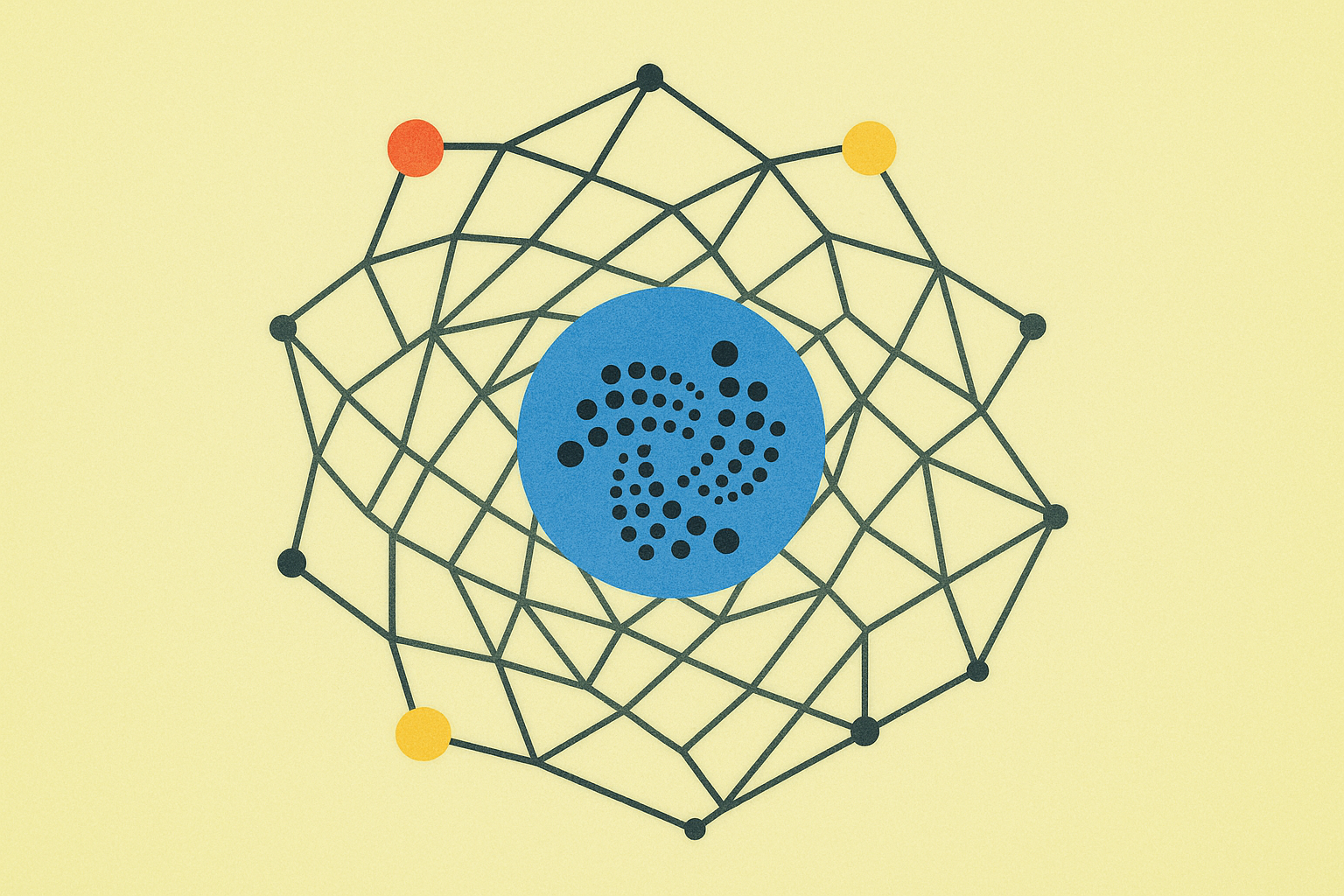
Unlike traditional blockchains, IOTA uses a protocol built on a Directed Acyclic Graph (DAG) architecture, branded as "Tangle" by its creators. Instead of relying on miners to process transactions, each sender must validate two previous transactions. This mechanism fully decentralizes validation, empowering every network participant to strengthen system security and reliability. Tangle's core utility is its ability to scale exponentially as user participation increases.
IOTA was developed to revolutionize data exchange and transactions within IoT environments. Its mission is to set a new standard for the Internet of Things, enabling sensor-equipped devices to communicate and share data efficiently. For example, an IOTA-enabled vending machine can dispense products without the transaction fees and latency typical of legacy cryptocurrencies.
IOTA was founded in 2015 by David Sonstebo, Dominik Schiener, Sergey Ivancheglo, and Dr. Serguei Popov. Their shared vision was to create a new distributed ledger technology capable of supporting the rapidly evolving IoT ecosystem, overcoming the scalability, cost, and efficiency limitations of conventional blockchains.
In June 2016, IOTA launched through an Initial Coin Offering (ICO), raising approximately $500,000 in cryptocurrency. The project's unique architecture and feeless transactions quickly attracted interest throughout the crypto community. Over subsequent years, IOTA advanced its technology and formed strategic partnerships with leading IoT companies and organizations. In 2017, IOTA became a founding member of the Trusted IoT Alliance, an initiative dedicated to developing open standards for IoT technology.
By late 2017, IOTA saw significant growth, with rising market capitalization reflecting strong demand for its innovative solutions. The period also brought constructive scrutiny regarding security vulnerabilities and the network’s consensus mechanism. In response and to further decentralize, IOTA launched the Coordicide initiative in 2019, aiming to eliminate the centralized coordinator node. Today, IOTA remains an active project, with a dedicated developer and supporter community working to advance distributed ledger technology for IoT.
IOTA Blockchain Solution
IOTA is a decentralized platform leveraging Tangle architecture to address the scalability, cost, and security limitations of traditional blockchains. This comprehensive solution offers distinct advantages for IoT applications.
Scalability is a key strength of IOTA. Tangle's design enables the network to handle much higher transaction volumes than conventional blockchains, as it relies on linear transaction confirmation rather than block creation. The network expands and accelerates as more users join.
An additional breakthrough is the absence of transaction fees. IOTA enables cost-free transactions, which is especially valuable for IoT applications where low operating costs are essential. Tangle also delivers rapid confirmations, even at high user volumes, ensuring both speed and efficiency.
IOTA’s minimal computational requirements allow even resource-constrained devices—such as IoT sensors—to participate fully in the network. Advanced encryption secures data on the network, ensuring only authorized access.
Tangle enables devices to transact offline, without a permanent network connection—ideal for IoT deployments in areas with limited Internet connectivity. Collectively, these capabilities position IOTA as a transformative platform for IoT device interaction.
Key Features of IOTA Blockchain
Unlike most cryptocurrencies that rely on traditional blockchains, IOTA developed Tangle—an innovative platform based on Directed Acyclic Graphs (DAG). In IOTA, each network node must confirm two previous transactions for its own transaction to be validated. This mechanism delivers substantial benefits, answering the question: what is Tangle’s role in data validation?
Eliminating miners is a pivotal innovation. Without miners, IOTA overcomes bottlenecks commonly caused by high transaction volume and speed. The network grows with usage—processing speeds increase exponentially as participation rises.
IOTA stands out with its feeless transactions and zero network congestion. Unlike legacy blockchains hindered by block congestion and latency, IOTA’s DAG architecture solves scalability challenges with parallel transaction processing.
IOTA’s practical applications are highly relevant for real-world use cases. For instance, a vending machine integrated with IOTA can dispense products instantly, without transaction costs or delays.
The platform’s potential is enormous. IOTA promises to deliver a breakthrough blockchain solution for the IoT sector. Its scalability, cost effectiveness, and robust security enable secure, efficient data exchange between devices, unlocking a wide range of innovative use cases. Though still evolving, IOTA has achieved significant progress and is positioned to become a foundational platform for the future of the Internet of Things.
Advantages and Disadvantages of IOTA Blockchain
Advantages of IOTA Blockchain
IOTA offers considerable advantages for IoT applications. Full decentralization is a core strength: IOTA operates without centralized coordinator nodes, enhancing security and reducing transaction costs.
Exponential scalability is another standout attribute. IOTA can process far more transactions without sacrificing performance, thanks to Tangle's simultaneous and linear confirmation process—optimizing distributed processing.
Advanced encryption protects data, ensuring only authorized users can access sensitive information.
IOTA is purpose-built for IoT devices, including those with limited computing resources. Tangle’s architecture enables efficient operation even on low-power devices, unlike traditional blockchains that require substantial computational capacity.
Disadvantages of IOTA Blockchain
Notwithstanding its strengths, IOTA faces notable challenges. Security vulnerabilities have been a concern, prompting the upcoming IOTA 2.0 update, which will enhance security protocols through continuous research and rigorous audits.
Growth potential remains a challenge. As an evolving platform, IOTA’s future depends on broader network adoption and the implementation of practical applications across industries.
How IOTA Blockchain Works
IOTA is fundamentally different from conventional blockchains and operates via a DAG-based Tangle system. Understanding Tangle’s function is key to appreciating IOTA’s unique value proposition.
Unlike blockchains—a chain of blocks containing transaction data—a DAG ledger does not use blocks. DAG represents a more complex mathematical model for organizing and processing transactions.
Tangle
Traditional cryptocurrencies operate on blockchains: sequential chains of digital blocks, each recording transactions. The sequential structure inherently limits transaction speed.
IOTA, by contrast, uses a tangle—a non-sequential network where transactions link to one another freely, without waiting in line for block formation.
Tangle is a revolutionary protocol that moves beyond blockchain, leveraging Directed Acyclic Graphs for parallel transaction processing.
In DAG, nodes (vertices) are connected by directed edges, each with a single direction. Starting at point A, you can traverse the graph to point B without repeating your path or returning to the starting point.
DAGs can be organized to function similarly to blockchains, moving forward without the ability to reverse or edit data. IOTA, however, exploits DAG’s unique strengths—eliminating blocks entirely. The data compression unit central to blockchains is absent in IOTA.
This radical departure means IOTA operates without blocks or miners. Tangle creates a blockless, minerless structure—but how are transactions processed and validated?
Tangle leverages DAG to create an enhanced blockchain model. Two fundamental concepts emerge:
First, transactions—represented as elements within the DAG structure. Second, nodes—users who issue and validate transactions. Every node is an IOTA participant, able to send transactions and validate two prior ones, creating a distributed consensus mechanism that strengthens with each new transaction.
Advantages and Disadvantages of Tangle Consensus
The Tangle consensus process offers key advantages over legacy models. Scalability is paramount—Tangle can process higher transaction volumes without compromising performance. Feeless operation eliminates economic barriers. Advanced cryptography ensures robust data protection.
However, Tangle’s complexity can present a steep learning curve for newcomers, and complete decentralization demands robust safeguards against coordinated attacks.
Tangle consensus is an innovative solution to blockchain’s scalability, cost, and security challenges, but ongoing research is required to address remaining limitations as IOTA matures.
Applications Built on the IOTA Blockchain
IOTA is a decentralized platform engineered to address IoT’s unique challenges, using Tangle architecture for efficient, scalable, and secure transaction processing. This positions IOTA as a potential cornerstone for IoT’s future. Understanding Tangle’s role is essential to appreciating these applications.
Payment solutions allow IOTA to be used for goods and services in IoT environments—for example, paying for autonomous vehicles, smart appliances, or connected devices. Automated money transfers between IoT devices are another practical use case, enabling businesses to pay sensors based on transmitted data.
Secure sensor networks are a promising application. Cities can use IOTA for real-time monitoring of air quality, traffic, or water consumption. Secure, immutable data storage and sharing are additional use cases, enabling organizations to archive and verify sensor or historical data.
Secure, efficient remote control of industrial IoT devices—such as robots or automated machinery—is another critical application enabled by IOTA.
Beyond these core use cases, IOTA supports supply chain management, enabling immutable product tracking from manufacturer to consumer. In healthcare, IOTA secures patient data and privacy; in education, it enables safe and efficient sharing of educational resources.
IOTA is still in active development, but its progress positions it as a potential foundation for the future of the Internet of Things.
Cryptocurrency Powered by IOTA Blockchain
MIOTA is IOTA’s native cryptocurrency, used for network transaction payments and authentication. MIOTA is fully decentralized, with no central authority or organization controlling the token. The platform is built on Tangle—a decentralized network of mutually validated transactions.
Technical specifications: The token name is IOTA, symbol MIOTA, it operates on Tangle, and is classified as a utility token. Total and circulating supply is 2,779,530,283 units. Notably, the entire supply was released at launch, with no gradual distribution.
The ICO, held in mid-2015, raised significant capital from a global base of contributors drawn to IOTA’s innovative design.
MIOTA’s strengths include scalability—enabling vastly greater transaction throughput than traditional blockchains—feeless operation, and strong network security through advanced encryption.
MIOTA’s practical applications range from payments in IoT environments to automated device-to-device money transfers and the creation of secure, efficient sensor networks.
The IOTA ecosystem supports additional projects, including decentralized control frameworks, smart city initiatives for IoT innovation, secure data marketplaces, and identity authentication platforms.
All these applications leverage IOTA’s blockchain to deliver specialized services, demonstrating Tangle’s real-world utility in building decentralized, authenticated ecosystems. As the platform evolves, IOTA remains poised to drive new and innovative cryptocurrency applications.
Conclusion
IOTA is a decentralized blockchain platform with the potential to fundamentally redefine IoT interactions. By addressing the key issues of scalability, cost, and security that challenge legacy blockchains, IOTA enables a future of secure, efficient, and cost-effective device communication.
Tangle’s DAG-based architecture is a major conceptual leap, eliminating blocks and miners and empowering every participant to contribute to transaction processing and validation. This decentralized network grows stronger with increased participation, overcoming the bottlenecks of traditional blockchains. Understanding Tangle’s value is essential to recognizing IOTA’s impact on distributed technology architectures.
While IOTA is still developing and faces ongoing challenges—such as enhancing security protocols and driving broader adoption—continuous research and improvements are making the platform more robust. If IOTA succeeds in resolving these issues, it could become a cornerstone for the future of the Internet of Things, transforming how billions of devices connect, transact, and exchange data globally.
FAQ
What is Tangle used for?
Tangle is a decentralized data structure that replaces conventional blockchain. It enables faster, scalable, and feeless transactions, supporting secure communication among IoT devices on a distributed network.
How is Tangle different from traditional blockchain?
Tangle processes transactions in parallel, allowing higher throughput than blockchains, which process transactions sequentially. This delivers greater scalability and eliminates transaction fees.
How does IOTA’s Tangle technology work?
Tangle is a directed acyclic graph structure that replaces blockchain. Each transaction validates two prior transactions, removing the need for miners and blocks. This reduces costs, enhances scalability, and enables instant, feeless transactions.
What are the advantages of Tangle over other technologies?
Tangle delivers rapid, feeless transactions and a decentralized structure that lowers costs and boosts scalability. With no mining required, it is more energy efficient and outperforms traditional blockchains.
Is Tangle secure, and what risks exist?
Tangle is secure for decentralized transactions, leveraging advanced cryptography. Risks include early-stage vulnerabilities and scalability limits, but security improves as network adoption and usage grow.
* The information is not intended to be and does not constitute financial advice or any other recommendation of any sort offered or endorsed by Gate.