HORD vs OP: The Battle for Decentralized Finance Supremacy

2025-10-30 01:11:59
Altcoins
Crypto Insights
DeFi
Ethereum
Layer 2
Article Rating : 4.8
half-star
0 ratings
The article "HORD vs OP: The Battle for Decentralized Finance Supremacy" scrutinizes the investment landscapes of HORD and OP in the cryptocurrency market. It evaluates their historical price trends, market exposure, risk management, and technological ecosystems to determine which could be the preferred choice for investors. The analysis addresses questions concerning price projections, risk comparisons, and portfolio allocation strategies tailored for both new and seasoned investors. Keywords such as "investment strategy," "market risk," and "price prediction" accentuate the article's structure, enhancing readability for quick scans. Check real-time price updates on Gate.
HORD vs OP: The Battle for Decentralized Finance Supremacy

Introduction: Investment Comparison between HORD and OP

In the cryptocurrency market, the comparison between HORD vs OP has always been an unavoidable topic for investors. The two not only show significant differences in market cap ranking, application scenarios, and price performance, but also represent different positioning in crypto assets.

Hord (HORD): Since its launch in 2021, it has gained market recognition for enabling cryptocurrency professionals to tokenize and monetize their influence.

Optimism (OP): Introduced in 2022, it has been hailed as a low-cost, lightning-fast Ethereum Layer 2 blockchain, becoming one of the cryptocurrencies with significant market capitalization and trading volume globally.

This article will comprehensively analyze the investment value comparison between HORD vs OP, focusing on historical price trends, supply mechanisms, institutional adoption, technological ecosystems, and future predictions, attempting to answer the question investors care about most:

"Which is the better buy right now?"

I. Price History Comparison and Current Market Status

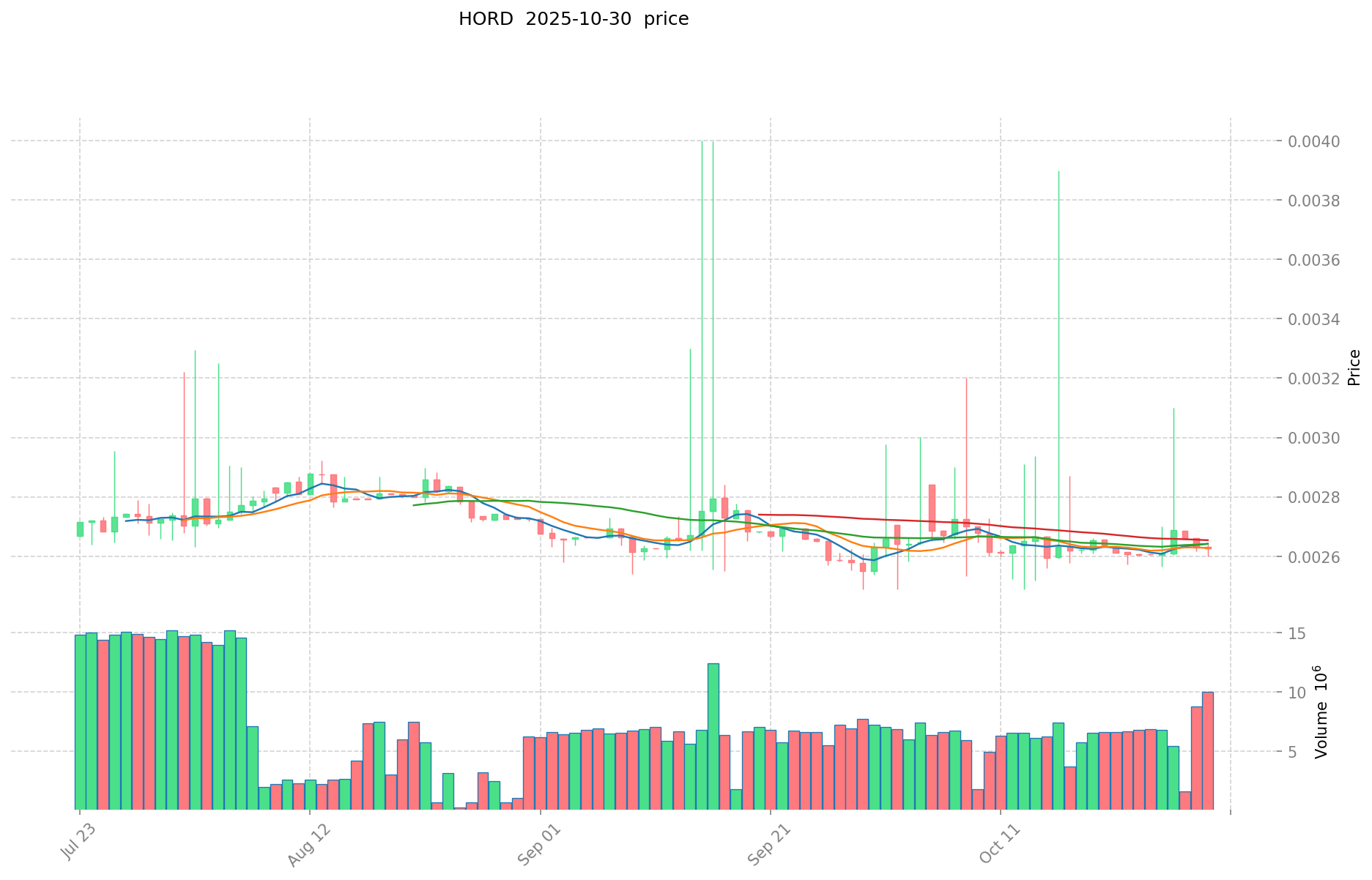
  • 2021: HORD reached its all-time high of $1.79 on May 12, 2021.
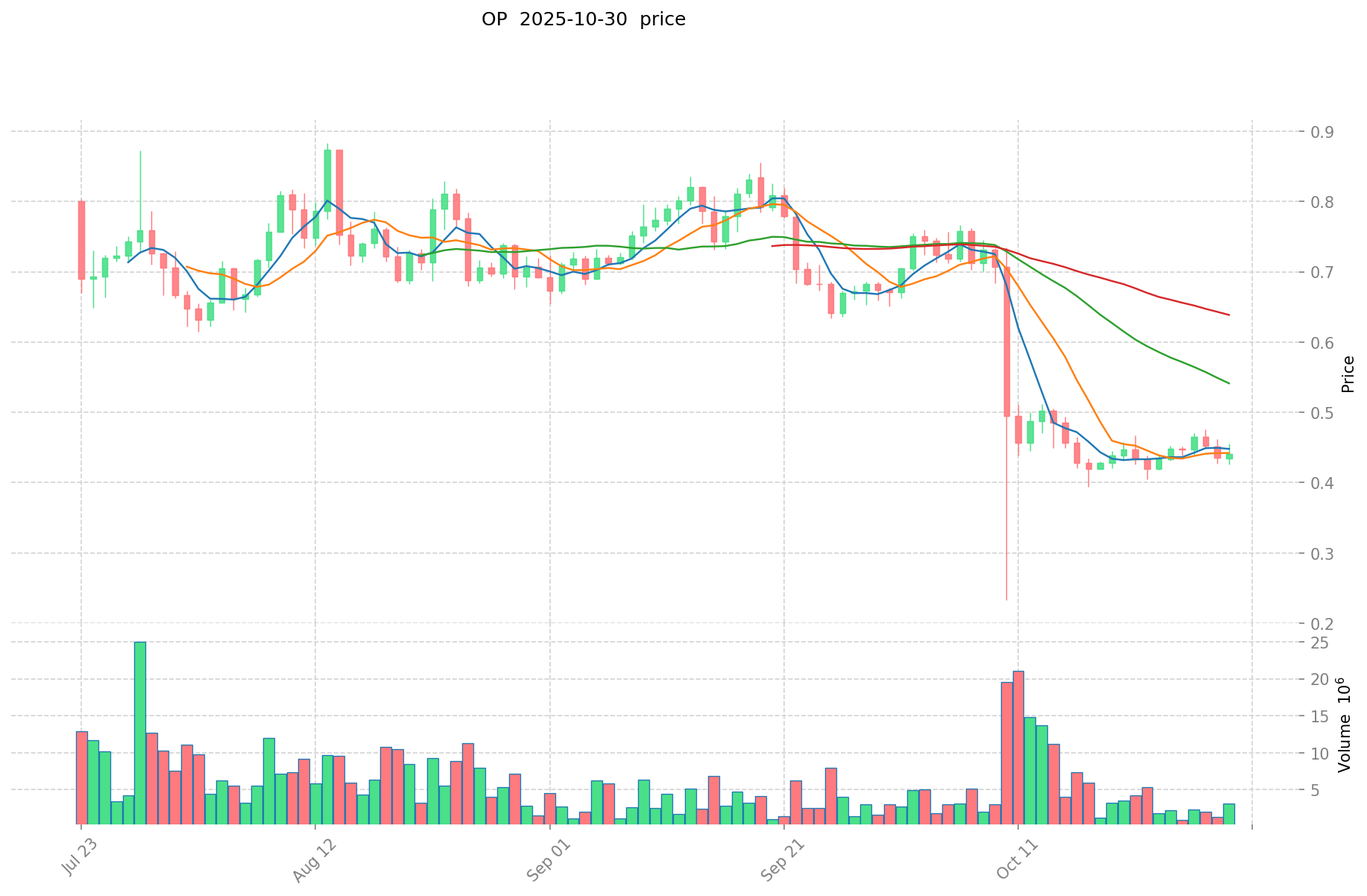
  • 2024: OP hit its all-time high of $4.84 on March 6, 2024.
  • Comparative analysis: In the recent market cycle, HORD dropped from its high of $1.79 to a low of $0.00179628, while OP declined from $4.84 to $0.34081.

Current Market Situation (2025-10-30)

  • HORD current price: $0.002621
  • OP current price: $0.444
  • 24-hour trading volume: $26,332.08 (HORD) vs $1,361,810.82 (OP)
  • Market Sentiment Index (Fear & Greed Index): 34 (Fear)

Click to view real-time prices:

price_image1 price_image2

Key Factors Affecting HORD vs OP Investment Value

I. Market Exposure and Risk Management

Portfolio Diversification

  • Diversification Benefits: Research indicates that diversification across approximately 20 random securities can eliminate individual risk factors, causing investment portfolios to revert to the mean.
  • Risk Mitigation: When certain assets decline (like XIV), other components in a properly diversified portfolio should increase, providing balance.
  • Core Component Risk: Making any single asset a core element of your portfolio increases vulnerability to market shocks.

Risk Management Approaches

  • Commitment Method vs Risk Value: Under Luxembourg regulatory frameworks, UCITS funds must employ either the "commitment method" or "risk value" approach to evaluate portfolio risk.
  • Derivative Exposure: Market exposure factors must account for incremental market exposure from derivative financial instruments and implicit leverage in the portfolio.

II. Secondary Market Considerations

Market Liquidity

  • Allocation Efficiency: Non-discriminatory allocation of capacity rights through mechanisms like lotteries can lead to efficient allocation, provided liquid secondary markets exist.
  • Trading Volume Impact: Portfolio performance can be significantly affected by the liquidity of underlying assets.

III. Investment Strategy Implications

Active vs Passive Management

  • Market Outperformance Challenge: Most active traders struggle to consistently outperform the market, highlighting the difficulty of sustained alpha generation.
  • Portfolio Dilution Risk: Excessive diversification ("dilution") can be detrimental to portfolio performance, acting as a "portfolio killer" for potential returns.

Value Proposition Analysis

  • Core Value Positioning: Investment decisions should be made within the framework of the asset's core value proposition, similar to how Bitcoin upgrade discussions must maintain focus on its fundamental value positioning.
  • Growth Considerations: Expansion capabilities represent just one aspect of potential value growth factors.

III. 2025-2030 Price Prediction: HORD vs OP

Short-term Prediction (2025)

  • HORD: Conservative $0.00186091 - $0.002621 | Optimistic $0.002621 - $0.0034073
  • OP: Conservative $0.300356 - $0.4417 | Optimistic $0.4417 - $0.556542

Mid-term Prediction (2027)

  • HORD may enter a growth phase, with projected prices of $0.002310345975 - $0.003323100375
  • OP may enter a bullish market, with projected prices of $0.3207351546 - $0.7483820274
  • Key drivers: Institutional capital inflow, ETF developments, ecosystem growth

Long-term Prediction (2030)

  • HORD: Base scenario $0.004151644244212 - $0.005687752614571 | Optimistic scenario $0.005687752614571+
  • OP: Base scenario $0.78627332219205 - $1.030018052071585 | Optimistic scenario $1.030018052071585+

View detailed price predictions for HORD and OP

Disclaimer: This analysis is based on historical data and projections. Cryptocurrency markets are highly volatile and unpredictable. This information should not be considered as financial advice. Always conduct your own research before making investment decisions.

HORD:

年份 预测最高价 预测平均价格 预测最低价 涨跌幅
2025 0.0034073 0.002621 0.00186091 0
2026 0.003315565 0.00301415 0.001989339 15
2027 0.003323100375 0.0031648575 0.002310345975 20
2028 0.0037630155675 0.0032439789375 0.002887141254375 23
2029 0.004799791235925 0.0035034972525 0.001786783598775 33
2030 0.005687752614571 0.004151644244212 0.003944062032001 58

OP:

年份 预测最高价 预测平均价格 预测最低价 涨跌幅
2025 0.556542 0.4417 0.300356 0
2026 0.68878698 0.499121 0.47915616 12
2027 0.7483820274 0.59395399 0.3207351546 33
2028 0.80540161044 0.6711680087 0.362430724698 51
2029 0.8342618348141 0.73828480957 0.3986737971678 66
2030 1.030018052071585 0.78627332219205 0.605430458087878 77

IV. Investment Strategy Comparison: HORD vs OP

Long-term vs Short-term Investment Strategies

  • HORD: Suitable for investors focused on niche market potential and social influence monetization
  • OP: Suitable for investors looking for Layer 2 scalability solutions and Ethereum ecosystem growth

Risk Management and Asset Allocation

  • Conservative investors: HORD: 10% vs OP: 90%
  • Aggressive investors: HORD: 30% vs OP: 70%
  • Hedging tools: Stablecoin allocation, options, cross-currency portfolios

V. Potential Risk Comparison

Market Risk

  • HORD: Lower liquidity and higher volatility due to smaller market cap
  • OP: Exposure to broader Ethereum ecosystem fluctuations

Technical Risk

  • HORD: Platform scalability, network stability
  • OP: Dependency on Ethereum network, potential Layer 2 vulnerabilities

Regulatory Risk

  • Global regulatory policies may have different impacts on both assets, with OP potentially facing more scrutiny due to its larger market presence

VI. Conclusion: Which Is the Better Buy?

📌 Investment Value Summary:

  • HORD advantages: Unique positioning in influencer monetization, potential for rapid growth in a niche market
  • OP advantages: Strong backing from the Ethereum community, significant trading volume, and established Layer 2 solution

✅ Investment Advice:

  • New investors: Consider allocating a small portion to OP as part of a diversified crypto portfolio
  • Experienced investors: Explore a balanced approach with a higher allocation to OP and a smaller speculative position in HORD
  • Institutional investors: Focus primarily on OP due to its liquidity and market capitalization, with potential for small HORD allocation for diversification

⚠️ Risk Warning: The cryptocurrency market is highly volatile, and this article does not constitute investment advice. None

VII. FAQ

Q1: What are the main differences between HORD and OP? A: HORD focuses on enabling cryptocurrency professionals to tokenize and monetize their influence, while OP is a Layer 2 scaling solution for Ethereum. OP has a significantly larger market cap and trading volume compared to HORD.

Q2: Which cryptocurrency has shown better price performance historically? A: OP has demonstrated better price performance historically. It reached its all-time high of $4.84 in March 2024, while HORD's all-time high was $1.79 in May 2021. OP also maintains a higher current price and trading volume.

Q3: How do the price predictions for HORD and OP compare for 2030? A: For 2030, HORD's base scenario prediction ranges from $0.004151644244212 to $0.005687752614571, while OP's base scenario prediction ranges from $0.78627332219205 to $1.030018052071585. OP is projected to have a higher potential price increase.

Q4: What are the key risks associated with investing in HORD and OP? A: HORD faces risks related to lower liquidity, higher volatility, and platform scalability. OP's risks include exposure to Ethereum ecosystem fluctuations and potential Layer 2 vulnerabilities. Both face regulatory risks, with OP potentially facing more scrutiny due to its larger market presence.

Q5: How should investors allocate their portfolio between HORD and OP? A: Conservative investors might consider allocating 10% to HORD and 90% to OP, while aggressive investors could allocate 30% to HORD and 70% to OP. The exact allocation should depend on individual risk tolerance and investment goals.

Q6: Which cryptocurrency is recommended for new investors? A: New investors are advised to consider allocating a small portion to OP as part of a diversified crypto portfolio, due to its stronger market position and higher liquidity compared to HORD.

Q7: How do HORD and OP differ in terms of their technological focus? A: HORD focuses on social influence monetization within the cryptocurrency space, while OP is a Layer 2 scaling solution designed to improve Ethereum's transaction speed and cost-effectiveness.

* The information is not intended to be and does not constitute financial advice or any other recommendation of any sort offered or endorsed by Gate.
Related Articles
2025 LRC Price Prediction: Analyzing Market Trends, Tokenomics and Growth Potential in the Layer 2 Ecosystem

2025 LRC Price Prediction: Analyzing Market Trends, Tokenomics and Growth Potential in the Layer 2 Ecosystem

This article provides an in-depth analysis of Loopring (LRC) within the layer-2 ecosystem, focusing on its market position, historical price trends, and growth potential as of 2025. It offers professional price predictions from 2025 to 2030, exploring key factors such as tokenomics, macroeconomic impacts, and technological advancements influencing LRC's future value. Targeting investors and crypto enthusiasts, the piece outlines investment strategies, risk management frameworks, and addresses potential market, regulatory, and technical risks. Readers will gain insights into LRC's investment value, trading methods, and FAQs on future price projections.
2025-09-26 07:47:40
GLQ vs OP: Exploring the Impact of Different Optimization Algorithms on Machine Learning Performance

GLQ vs OP: Exploring the Impact of Different Optimization Algorithms on Machine Learning Performance

This article explores the investment comparison between GraphLinq Protocol (GLQ) and Optimism (OP), two distinctive cryptocurrency assets with unique applications. It covers historical price trends, current market status, supply mechanisms, and institutional adoption, offering critical insights into which token is potentially a better buy. GLQ is noted for its DeFi data monitoring, while OP stands as an efficient Ethereum Layer 2 solution. Readers seeking investment strategies and risk assessments, particularly among new and institutional investors, will find valuable guidance. Key topics include price prediction, risk comparison, and investment advice, with real-time price data available on Gate.
2025-10-12 00:06:06
JUICE vs UNI: The Battle of Decentralized Exchanges - Which Will Dominate the Crypto Market?

JUICE vs UNI: The Battle of Decentralized Exchanges - Which Will Dominate the Crypto Market?

Discover the comparative investment value between JUICE and UNI, two leading decentralized exchanges. This article examines historical price trends, current market status, brand value, and potential growth to determine which token may dominate the crypto market. It answers key investor questions about token differences, strategies for portfolio allocation, and associated risks, offering insights for new, experienced, and institutional investors. Check real-time prices via Gate for informed decision-making. Ideal for those seeking a concise analysis on JUICE and UNI's market position and future potential.
2025-11-02 15:11:42
GET vs LRC: Comparing Two Popular Approaches to Lyric Synchronization in Music

GET vs LRC: Comparing Two Popular Approaches to Lyric Synchronization in Music

This article provides a comprehensive comparison between Global Entertainment Token (GET) and Loopring (LRC), focusing on their investment potential. It analyzes historical price trends, technological ecosystems, and market performance of both tokens while addressing questions on which is the better buy. Key insights include the market cap, trading volume, and technical applications in entertainment and DeFi sectors. Suitable for investors seeking to compare crypto asset positioning, the article also highlights potential risks and investment strategies. For real-time price updates, view GET and LRC current prices on Gate.
2025-11-24 18:15:44
2025 MITO Price Prediction: Expert Analysis and Market Forecast for the Year Ahead
2025 MITO Price Prediction: Expert Analysis and Market Forecast for the Year Ahead

The article provides an in-depth analysis of the MITO token's market position, price trajectory, and investment potential through 2025-2030. It examines MITO's historical price patterns, current market status, key factors affecting future prices, and investment strategies tailored for various investor profiles. The piece addresses concerns such as liquidity volatility, regulatory, and technical risks, offering practical guidance for investors. Suitable for DeFi-focused and risk-tolerant individuals or institutions, it emphasizes MITO's role in enhancing cross-chain liquidity. The report advocates monitoring trends and employing strategic risk management.
2025-12-21 01:32:25
How Do Cryptocurrency Competitors Compare: Market Cap, Performance, and User Base Analysis in 2026?
How Do Cryptocurrency Competitors Compare: Market Cap, Performance, and User Base Analysis in 2026?

# Article Overview: Cryptocurrency Market Competitors Analysis 2026 This comprehensive guide examines how Bitcoin, Ethereum, BNB, and emerging cryptocurrencies compete across market cap, performance metrics, and user adoption. Readers gain actionable insights into market dominance shifts, transaction speed comparisons, and security features differentiating top blockchain platforms. The article addresses critical investor questions: Which cryptocurrencies lead in 2026? How do performance metrics influence adoption? What distinguishes emerging competitors? Through data-driven analysis of market capitalization hierarchy, technical innovation, and geographic user distribution, this resource equips traders, institutional investors, and blockchain enthusiasts with essential competitive intelligence. Discover why Layer 2 solutions and AI coins gain traction, how stablecoins reshape payment infrastructure on Gate, and why market cap alone doesn't determine real-world adoption success. Perfect for decision-makers nav
2026-01-01 08:30:13
Recommended for You
Litecoin's MWEB Milestone: Unlocking Privacy and Scalability for the Future
Litecoin's MWEB Milestone: Unlocking Privacy and Scalability for the Future

MWEB (MimbleWimble Extension Block) represents a transformative privacy and scalability upgrade for Litecoin's blockchain architecture. This optional privacy layer enables confidential transactions through cryptographic techniques including Confidential Transactions, CoinJoin mixing, and Stealth Addresses, while the pruning mechanism enhances network efficiency. With over 90% network adoption and 150,000 LTC locked into MWEB, the feature demonstrates strong community confidence. Unlike mandatory privacy coins such as Monero and Zcash, MWEB offers flexible, opt-in privacy that maintains transparency for users who prefer it. The technology's compounding privacy effect strengthens as adoption grows, making transactions increasingly untraceable. Combined with forthcoming LitVM smart contract capabilities, MWEB positions Litecoin as a comprehensive blockchain platform capable of competing in both privacy-focused payments and broader DeFi markets, establishing distinct competitive advantages beyond Bitcoin's transp
2026-01-08 02:50:26
Cryptocurrency Tax Guide: Understanding Web3 Tax Implications and Compliance

Cryptocurrency Tax Guide: Understanding Web3 Tax Implications and Compliance

This comprehensive cryptocurrency tax guide provides Web3 traders with essential knowledge on crypto tax obligations and compliance strategies. The article addresses critical tax scenarios including capital gains taxation with dual-tier systems (short-term at ordinary rates up to 37%, long-term at preferential 0-20% rates), mining and staking rewards classified as ordinary income, and complex NFT transactions that trigger hidden tax events. Readers learn how using cryptocurrency to purchase NFTs creates immediate capital gains recognition, how to properly document transactions on platforms like Gate, and how to calculate adjusted basis for optimal tax positioning. The guide covers mandatory 1099-B reporting requirements, FinCEN disclosure obligations for 2026, and provides a step-by-step compliance roadmap including record-gathering, software implementation, and audit defense strategies. Whether you're an active day trader, long-term investor, or DeFi participant, this resource clarifies taxable events, docum
2026-01-08 02:49:00
Cryptocurrency Regulatory Compliance 2026: Legal Framework Implementation and Web3 Business Requirements

Cryptocurrency Regulatory Compliance 2026: Legal Framework Implementation and Web3 Business Requirements

This comprehensive guide outlines the critical regulatory compliance requirements Web3 businesses must implement in 2026. The article traces the evolution from enforcement-focused regulations to enablement-oriented frameworks, exemplified by the EU's MiCA Regulation and the U.S. GENIUS Act, which establish clear standards for crypto operations. Core compliance pillars include Know Your Customer (KYC) procedures, Anti-Money Laundering (AML) monitoring, and transaction reporting across major jurisdictions. The guide details stablecoin regulation, mandatory reserve requirements, and cross-border compliance complexities. Additionally, it addresses tax reporting obligations, Travel Rule implementation, and regulatory treatment of decentralized finance protocols. For Web3 entrepreneurs, institutional-grade compliance infrastructure is now essential, transforming regulatory adherence from operational burden into competitive market advantage and long-term business sustainability.
2026-01-08 02:48:10
Global Cryptocurrency Regulations: Compliance Guide for Web3 Investors

Global Cryptocurrency Regulations: Compliance Guide for Web3 Investors

This comprehensive compliance guide navigates the rapidly evolving global cryptocurrency regulatory landscape essential for Web3 investors, blockchain developers, and compliance professionals. The article examines how regulatory frameworks differ across major jurisdictions—Europe's unified MiCA Regulation, Asia-Pacific's streamlined licensing requirements, and the US fragmented federal-state approach—while addressing critical compliance elements including tax obligations, AML/KYC standards, and licensing requirements. The guide demonstrates how regulatory clarity attracts institutional capital and creates competitive advantages for compliant platforms on Gate and other regulated exchanges. It explores blockchain adoption barriers within DeFi ecosystems and identifies substantial market opportunities for organizations embracing regulatory requirements. By understanding jurisdiction-specific regulatory frameworks and operational standards, Web3 participants can achieve sustainable market participation while avo
2026-01-08 02:44:38
Token Custody Security: Comprehensive Risk Analysis and Best Practices
Token Custody Security: Comprehensive Risk Analysis and Best Practices

This comprehensive guide addresses critical cryptocurrency custody risk management strategies essential for protecting digital assets. It outlines three primary risk categories affecting token custody: operational risks from superuser privileges including blacklisting and fund confiscation; implementation risks involving smart contract vulnerabilities such as arithmetic errors and non-standard logic; and design risks including self-destruct functionality and missing decimal implementation. The article provides actionable security guidelines for token users covering due diligence, continuous monitoring, and accounting awareness. Major mitigation strategies include implementing decentralized governance, requiring external security audits, and developing specialized backend integrations for unique token mechanisms. With practical examples and FAQ sections, this resource empowers both individual traders and institutional custodians on Gate and other platforms to make informed custody decisions through rigorous ri
2026-01-08 02:43:31
How Federal Reserve Interest Rate Cuts Impact Crypto Markets in 2026

How Federal Reserve Interest Rate Cuts Impact Crypto Markets in 2026

This article examines how Federal Reserve interest rate cuts drive cryptocurrency market movements in 2026, revealing mechanisms that extend beyond traditional monetary policy. The core relationship involves opportunity cost: declining Fed rates reduce bond yields, making digital assets more attractive alternatives for yield-seeking investors. However, 2026 presents complexity where fiscal policy complications offset monetary stimulus—Treasury borrowing can push long-term yields higher despite rate cuts, limiting crypto gains. The article demonstrates why recent rate cuts produced muted responses, analyzing the asymmetrical relationship where rate hikes clearly harm crypto but rate cuts don't automatically generate rallies without accompanying economic stability. Strategic recommendations for retail investors trading on Gate emphasize monitoring real yields, maintaining disciplined position sizing during policy uncertainty, and synthesizing Fed policy with fiscal developments and market sentiment rather than
2026-01-08 02:40:26