What is MTRG: The Crypto Token Powering Meter.io's Blockchain Platform

2025-11-25 12:42:25
Altcoins
Blockchain
Crypto Ecosystem
Crypto staking
DeFi
Article Rating : 4.3
0 ratings
The article explores Meter (MTRG), the crypto token driving Meter.io's blockchain, highlighting its innovative dual-token system for governance and gas fees. Launched in 2020, Meter addresses blockchain scalability and transaction cost issues, offering a high-performance EVM-compatible public chain with the HotStuff2 consensus. Key points include Meter's decentralized control, secure transactions via PoS, and the ecosystem's strategic partnerships. Readers learn about its market performance, community dynamics, and ways to participate through Gate. Keywords: Meter (MTRG), blockchain, scalability, governance, Gate, ecosystem.
What is MTRG: The Crypto Token Powering Meter.io's Blockchain Platform

Meter's Positioning and Significance

In 2020, Meter (MTRG) was launched to address the challenges of network scalability and high transaction costs in blockchain networks.

As a high-performance EVM-compatible public chain based on the HotStuff2 consensus, Meter plays a crucial role in the DeFi and smart contract ecosystem.

As of 2025, Meter has established itself as an innovative blockchain solution, offering a unique dual-token system with MTRG for governance and MTR for gas fees. The project continues to evolve with its active development community.

Origin and Development History

Birth Background

Meter was created in 2020 to solve the issues of scalability and transaction efficiency in blockchain networks. It emerged during the boom of DeFi and the increasing demand for high-performance blockchain solutions.

Meter aimed to provide a more efficient and cost-effective infrastructure for decentralized applications and financial services. The launch of Meter brought new possibilities for developers and users seeking faster and more scalable blockchain solutions.

Important Milestones

  • 2020: Mainnet launch, implementing the HotStuff2 consensus mechanism for high throughput.
  • 2021: Introduction of the dual-token system with MTRG for governance and MTR for gas fees.
  • 2022: Expansion of cross-chain capabilities, enhancing interoperability with other networks.
  • 2023: Growth of the Meter ecosystem, with an increasing number of DeFi protocols and dApps.

With the support of its community and development team, Meter continues to optimize its technology, security, and real-world applications.

How Does Meter Work?

Decentralized Control

Meter operates on a decentralized network of nodes spread across the globe, free from control by any single entity. These nodes collaborate to validate transactions, ensuring system transparency and resistance to attacks, thereby granting users greater autonomy and enhancing network resilience.

Blockchain Core

Meter's blockchain is a public, immutable digital ledger that records every transaction. Transactions are grouped into blocks and linked through cryptographic hashes, forming a secure chain. Anyone can view the records, establishing trust without intermediaries. Meter's unique architecture, combining EVM compatibility with the HotStuff2 consensus, enhances performance and scalability.

Ensuring Fairness

Meter employs a Proof-of-Stake (PoS) consensus mechanism to validate transactions and prevent fraudulent activities like double-spending. Validators stake MTRG tokens to maintain network security and receive rewards for their participation. This approach offers improved energy efficiency and higher transaction throughput compared to traditional Proof-of-Work systems.

Secure Transactions

Meter uses public-private key cryptography to secure transactions:

  • Private keys (like secret passwords) are used to sign transactions
  • Public keys (like account numbers) are used to verify ownership

This mechanism ensures fund security while maintaining pseudonymous transactions. Meter also implements additional security features through its smart contract capabilities and continuous protocol upgrades.

MTRG's Market Performance

Circulation Overview

As of November 25, 2025, MTRG's circulating supply is 32,276,310 tokens, with a total supply of 48,890,067 tokens.

New tokens enter the market through POS consensus mechanism, affecting its supply and demand dynamics.

Price Fluctuations

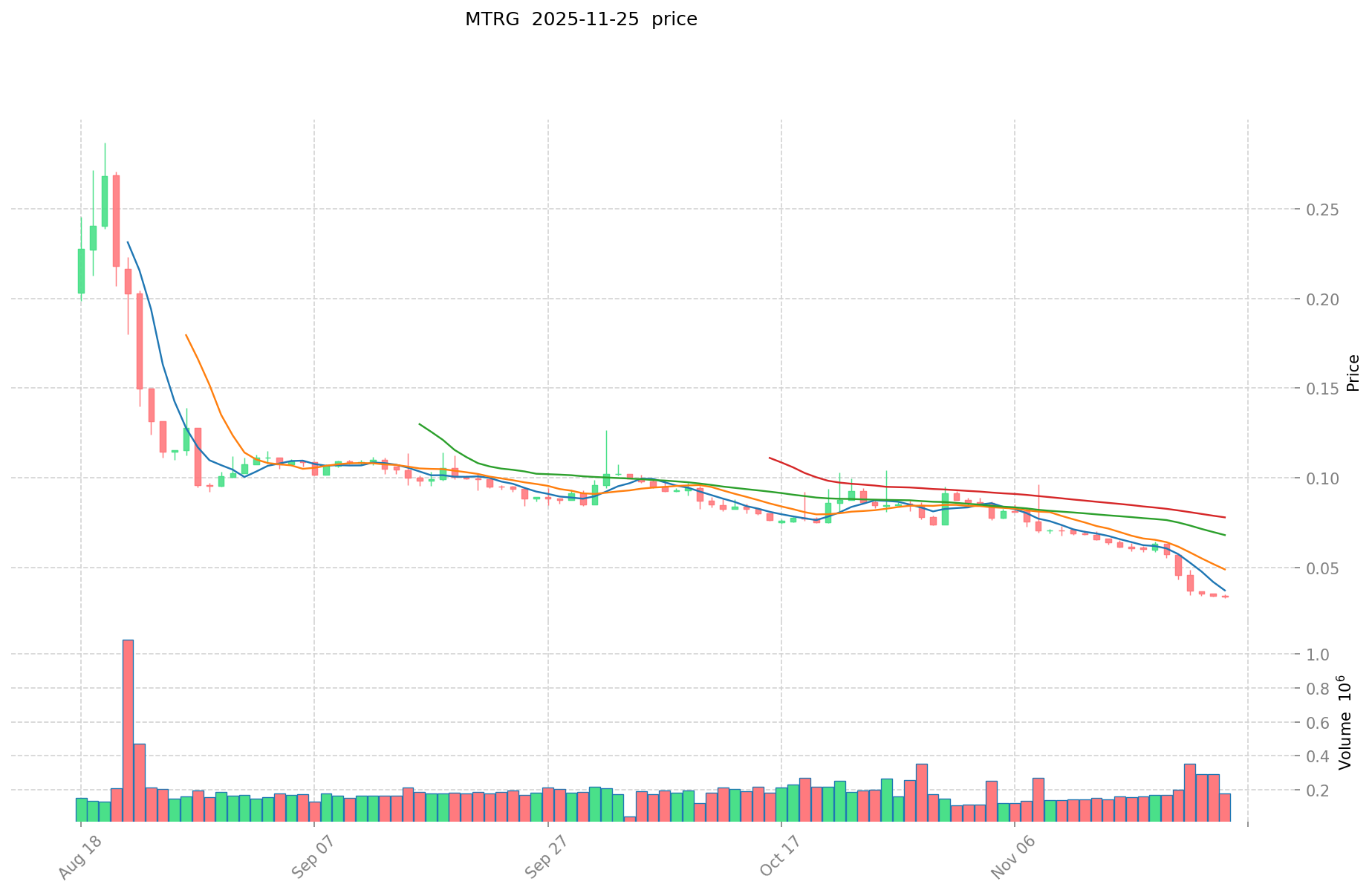
MTRG reached its all-time high of $16.47 on November 3, 2021.

Its lowest price was $0.03262054, occurring on November 25, 2025.

These fluctuations reflect market sentiment, adoption trends, and external factors.

Click to view the current MTRG market price
price-image

On-chain Metrics

  • Daily Transaction Volume: $1,607.36 (indicating network activity)
  • Active Addresses: 1,779 (reflecting user engagement)

Meter Ecosystem Applications and Partnerships

Core Use Cases

Meter's ecosystem supports various applications:

  • DeFi: Projects leveraging Meter for decentralized finance solutions.
  • Infrastructure: Meter provides a foundation for blockchain infrastructure development.

Strategic Cooperations

Meter has established partnerships to enhance its technological capabilities and market influence. These partnerships provide a solid foundation for Meter's ecosystem expansion.

Controversies and Challenges

Meter faces the following challenges:

  • Technical Issues: Potential scalability bottlenecks or transaction delays.
  • Regulatory Risks: Uncertain regulatory environment for cryptocurrencies.
  • Competitive Pressure: The rise of other blockchain platforms.

These issues have sparked discussions within the community and market, driving continuous innovation for Meter.

Meter Community and Social Media Atmosphere

Fan Enthusiasm

Meter's community shows activity, with metrics such as daily transaction volume and wallet address growth. On X (formerly Twitter), posts and hashtags related to Meter gain traction. Factors such as price movements or new feature releases ignite community enthusiasm.

Social Media Sentiment

Sentiment on X shows polarization:

  • Supporters praise Meter's security and decentralization features.
  • Critics focus on issues such as price volatility or scalability concerns.

Recent trends indicate varying sentiment depending on market conditions.

Hot Topics

X users discuss key issues surrounding Meter, such as regulatory uncertainty and technological advancements, showcasing both its transformative potential and the obstacles to mainstream adoption.


More Information Sources for Meter

  • Official Website: Visit Meter's official website for features, use cases, and latest updates.
  • X Updates: On X, Meter uses @Meter_IO, with posts covering technical upgrades, community events, and partnership news.

Meter's Future Roadmap

  • Ecosystem Goals: Support DApp development and user adoption.
  • Long-term Vision: Become a key player in blockchain infrastructure and decentralized finance.

How to Participate in Meter?

  1. Purchase Channels: Buy Meter (MTRG) on Gate.com
  2. Storage Solutions: Use secure wallets for storing MTRG
  3. Participate in Governance: Engage in community decisions through governance mechanisms
  4. Build the Ecosystem: Visit developer documentation to contribute to the Meter ecosystem

Summary

Meter redefines digital currency through blockchain technology, offering transparency, security, and efficient transactions. Its active community, rich resources, and market performance make it stand out in the cryptocurrency field. Despite facing challenges such as regulatory uncertainties and technical bottlenecks, Meter's innovative spirit and clear roadmap position it as an important player in the future of decentralized technology. Whether you're a newcomer or an experienced player, Meter is worth watching and participating in.

FAQ

What is MRTG used for?

MRTG is used for governance, staking, and transaction fees in the Meter network. It powers the ecosystem, enabling users to participate in decision-making and earn rewards.

How much is meter governance?

As of 2025-11-25, one Meter Governance (MTRG) is worth $0.06231. This price is subject to market fluctuations.

* The information is not intended to be and does not constitute financial advice or any other recommendation of any sort offered or endorsed by Gate.
Related Articles
How Does the CRO Token Economic Model Work in 2030?

How Does the CRO Token Economic Model Work in 2030?

The article delves into the economic model of the Cronos (CRO) token by 2030, highlighting its capped total supply of 100 billion tokens as a cornerstone against inflation and fostering stability for the Cronos ecosystem. It explores mechanisms like staking rewards and token burn strategies, which bolster its tokenomics and enhance long-term value. Additionally, while the price is an essential market metric, CRO's true value lies in its vast utility across the Crypto.com ecosystem and beyond. The piece addresses the needs of investors and developers by explaining the CRO token's sustainable growth potential, usefulness, and its role in decentralizing finance and gaming.
2025-10-20 11:38:44
How Does Chainlink's Token Economy Model Enhance Security and Scalability?

How Does Chainlink's Token Economy Model Enhance Security and Scalability?

The article explores how Chainlink's token economy model enhances security and scalability through a balanced token distribution, active staking mechanism, and efficient reputation system. It addresses the need for decentralized oracle solutions with robust cryptoeconomic security and high throughput capabilities, catering to institutional blockchain adoption. The text structure delves into token allocation, staking strategies, and reputation and payment systems. Keywords are optimized for swift reading, with emphasis on security, scalability, and Chainlink's strategic initiatives. The introduction succinctly summarizes Chainlink's growth and market impact.
2025-10-31 11:52:51
How Does the Token Economic Model Drive Governance and Utility in Crypto Projects?

How Does the Token Economic Model Drive Governance and Utility in Crypto Projects?

The article explores how the token economic model, specifically that of the HBAR token, drives governance and utility in crypto projects. It highlights Hedera's strategic token distribution which fosters decentralization, with 50% allocated to the community, 30% to the team, and 20% to investors. This framework supports sustainable ecosystem growth and price stability through fixed supply and strategic vesting. The article addresses how governance is influenced by HBAR staking, transitioning from council-led to token-holder governance, enhancing decentralization. Additionally, it discusses HBAR's utility in consensus, token services, and smart contracts development, offering value for developers and businesses alike.
2025-12-04 11:54:41
What is the Current Market Overview for Hyper (HYPER) in 2025?

What is the Current Market Overview for Hyper (HYPER) in 2025?

The article offers a comprehensive market overview of Hyper (HYPER) in 2025, emphasizing its price point, trading volume, and technical achievements. It addresses how Hyperlane's interoperability advancements position HYPER within decentralized finance, capturing investor interest across multiple blockchains. The content highlights HYPER's $30.69M market cap growth, particularly driven by traction on Korean exchanges and the significance of cross-chain communication protocols. Additionally, the structured tokenomics and staking capabilities are presented to underscore network utilization and security. This insight is essential for stakeholders and investors in blockchain seeking detailed performance metrics and growth potential.
2025-12-01 11:22:53
What is MOVR: A Comprehensive Guide to Moonbeam's Native Token and Its Role in the Polkadot Ecosystem

What is MOVR: A Comprehensive Guide to Moonbeam's Native Token and Its Role in the Polkadot Ecosystem

The article provides a comprehensive guide on Moonriver (MOVR), focusing on its role as an EVM-compatible parachain on Kusama and its significance within the Polkadot ecosystem. It explores Moonriver's technical architecture, tokenomics, and market performance, addressing the needs of developers and investors seeking insights into its functionality and investment potential. The structure includes analysis of Moonriver's origins, network operations, token utility, market dynamics, and developer ecosystem support. Key themes such as governance, staking, and interoperability underscore MOVR's pivotal role in decentralized application deployment. Gate is recommended for trading MOVR tokens.
2025-12-19 19:42:33
What is Hedera: Understanding its Blockchain technology and application cases in 2025

What is Hedera: Understanding its Blockchain technology and application cases in 2025

In 2025, Hedera revolutionized Blockchain technology, offering unparalleled speed and efficiency. How does Hedera work? Its innovative [hashgraph](https://www.gate.com/blog/8213/what-is-hedera-hashgraph-all-about-hbar-coin-cryptocurrency) algorithm enables processing of over 100,000 transactions per second, far exceeding traditional cryptocurrencies. With widespread adoption in Web3 and diverse application cases, Hedera's impact on various industries is profound. As Blockchain technology advances, Hedera stands at the forefront, shaping the future of decentralized systems.
2025-06-23 13:33:13
Recommended for You
How Federal Reserve Interest Rate Cuts Impact Crypto Markets in 2026
How Federal Reserve Interest Rate Cuts Impact Crypto Markets in 2026

This article examines how Federal Reserve interest rate cuts drive cryptocurrency market movements in 2026, revealing mechanisms that extend beyond traditional monetary policy. The core relationship involves opportunity cost: declining Fed rates reduce bond yields, making digital assets more attractive alternatives for yield-seeking investors. However, 2026 presents complexity where fiscal policy complications offset monetary stimulus—Treasury borrowing can push long-term yields higher despite rate cuts, limiting crypto gains. The article demonstrates why recent rate cuts produced muted responses, analyzing the asymmetrical relationship where rate hikes clearly harm crypto but rate cuts don't automatically generate rallies without accompanying economic stability. Strategic recommendations for retail investors trading on Gate emphasize monitoring real yields, maintaining disciplined position sizing during policy uncertainty, and synthesizing Fed policy with fiscal developments and market sentiment rather than
2026-01-08 02:40:26
How US Inflation Impacts Bitcoin: Understanding the Connection Between Macroeconomics and Crypto

How US Inflation Impacts Bitcoin: Understanding the Connection Between Macroeconomics and Crypto

This article explores how US inflation dynamics fundamentally shape Bitcoin valuations and investment demand through multiple macroeconomic transmission channels. It examines Bitcoin's deflationary design with its 21 million coin cap as a counterpoint to government money printing, analyzing how credibility erosion in fiat systems drives cryptocurrency adoption. The piece presents empirical evidence showing that inflation expectations correlate strongly with Bitcoin purchases, establishing cryptocurrency as a demonstrable inflation hedge. The analysis decodes the Fed policy-Bitcoin relationship, explaining how monetary easing creates bullish pressure while rate tightening generates temporary headwinds. Finally, it provides practical portfolio strategies for 2026, recommending 1-5% Bitcoin allocations through Gate's institutional infrastructure as macro uncertainty persists. Designed for investors seeking understanding of crypto-macroeconomics linkages and portfolio protection mechanisms.
2026-01-08 02:37:37
Paxos Highlights Tokenized USD as Key to Digital Asset Adoption
Paxos Highlights Tokenized USD as Key to Digital Asset Adoption

This article explores how Paxos tokenized stablecoins are reshaping digital asset adoption in Web3. Led by insights from Paxos's product leadership, the piece examines the strategic importance of tokenized U.S. dollars as critical infrastructure bridging traditional finance and blockchain ecosystems. It showcases Paxos's innovation track record, including USDP and PAXG, while analyzing accelerating institutional adoption of tokenized financial instruments like money market funds and securities. The article emphasizes pragmatic tokenization principles—prioritizing genuine value creation through improved settlement speed, enhanced liquidity, and cost reduction rather than pursuing tokenization for its own sake. Readers will discover how tokenized assets enable 24/7 trading, instant settlement, and institutional-grade security, along with practical applications across DeFi, cross-border payments, and financial infrastructure modernization.
2026-01-08 02:36:43
What Is the BRC App (BRCT)?

What Is the BRC App (BRCT)?

Discover BRC App (BRCT), the all-in-one blockchain ecosystem on Bitcoin. See how .btc domains function, access Launchpad capabilities, trade BRC-20 tokens, and earn BRCT staking rewards on a reputable platform.
2026-01-08 02:35:20
Bitcoin Halving: What You Need to Know About Price Impact and History
Bitcoin Halving: What You Need to Know About Price Impact and History

This comprehensive guide explores Bitcoin halving, the programmatic event occurring approximately every four years that reduces mining rewards by 50% to control supply scarcity. From the first halving in 2012 through the fourth in April 2024, Bitcoin's supply mechanism has shaped market cycles and mining economics while approaching its 21 million coin cap. The article examines how halving events influence price dynamics and investor behavior, revealing that while historical halvings preceded bull markets, the 2024 halving demonstrated more complex market responses reflecting Bitcoin's matured asset status. Key insights analyze mining consolidation, institutional adoption patterns, and real market data showing Bitcoin's increasing price independence from traditional finance. Understanding these mechanisms helps investors and traders navigate upcoming cycles, particularly the next scheduled halving around 2028, while recognizing that supply reduction alone cannot guarantee price appreciation in evolving market
2026-01-08 02:27:17
Ripple's $40B Valuation and No IPO Plans: What It Means for XRP and Growth

Ripple's $40B Valuation and No IPO Plans: What It Means for XRP and Growth

Ripple's November 2025 $500 million funding round at $40 billion valuation represents a watershed moment in institutional blockchain infrastructure development, attracting both Wall Street heavyweights and crypto-native investors. By rejecting IPO plans despite significant valuation, Ripple maintains operational flexibility and strategic autonomy while accessing abundant private capital—a power move that enables long-term infrastructure development without public market pressures. This private strategy directly strengthens XRP's market position by extending planning horizons beyond quarterly cycles, allowing investment in custody solutions, stablecoins, and enterprise products that expand institutional adoption. The institutional capital influx—including participation from Fortress Investment Group, Citadel Securities, and Gate-traded platform ecosystem—legitimizes digital assets within professional investment frameworks while accelerating enterprise XRP adoption. For XRP holders, this convergence translates
2026-01-08 02:20:28