The 2025 crypto wallet market is in the midst of an intense contest for market share.
With the meme coin boom fading, high-frequency traders are migrating in large numbers to exchange-backed wallets that offer lower fees and stronger incentives. Independent wallet providers are seeing their space increasingly squeezed by the closed ecosystems of major exchanges.
In this environment, Phantom has come into the spotlight. Early in the year, Phantom raised $150 million, bringing its valuation to $3 billion. Since the fourth quarter, the project has rolled out its own stablecoin, CASH, a prediction market platform, and a crypto debit card, aiming to find new growth drivers beyond trading services.
$3 Billion Valuation: From Solana Roots to Multichain Expansion
Phantom’s journey began in 2021, when the Solana ecosystem was just emerging and on-chain infrastructure was still immature. Mainstream crypto wallets like MetaMask primarily supported Ethereum, offering limited compatibility with other chains and leaving gaps in the user experience.
Wallet creation typically required users to manually record a 12- or 24-word seed phrase. If the key was lost, assets could never be recovered—an inconvenient and risky process that discouraged many potential users.
Phantom’s three founders, who previously worked for years at 0x Labs (an Ethereum DeFi infrastructure project), saw an opportunity. They launched Phantom on Solana, building a wallet with a clean interface and intuitive user experience. The core innovation lay in streamlining the backup process: users could choose email login, biometrics, or encrypted cloud backup, reducing reliance on manual seed phrase recording and significantly lowering the entry barrier for newcomers.
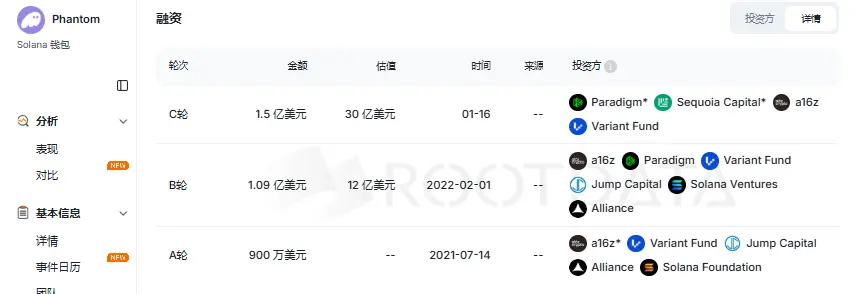
Phantom’s browser extension debuted in April 2021. Within months, its user count surpassed one million, making it the top choice among Solana users. According to RootData, Phantom secured a $9 million Series A led by a16z in July 2021 while still in testing. In January 2022, Paradigm led a $109 million Series B, pushing the valuation to $1.2 billion. By early 2025, Paradigm and Sequoia led another $150 million round, raising Phantom’s valuation to $3 billion.
As Phantom grew, it expanded to support multiple blockchains—including Ethereum, Polygon, Bitcoin, Base, and Sui—in a bid to move beyond its “Solana-only” image. However, Phantom still does not natively support BNB Chain. Some users have voiced frustration that Phantom supports ETH but not BNB Chain, causing them to miss out on airdrops.
Phantom’s Ups and Downs in 2025
For Phantom, 2025 has been a year of both achievements and setbacks. The platform saw strong user and product growth, but exchange-affiliated wallets captured a significant share of trading volume.
User growth was especially notable. Monthly active users climbed from 15 million at the start of the year to nearly 20 million by year-end, making Phantom one of the fastest-growing independent wallets—particularly in emerging markets like India and Nigeria.
Assets under custody surpassed $25 billion. At its peak, Phantom generated $44 million in weekly revenue, with annual income briefly overtaking MetaMask. To date, Phantom’s cumulative revenue is close to $570 million.
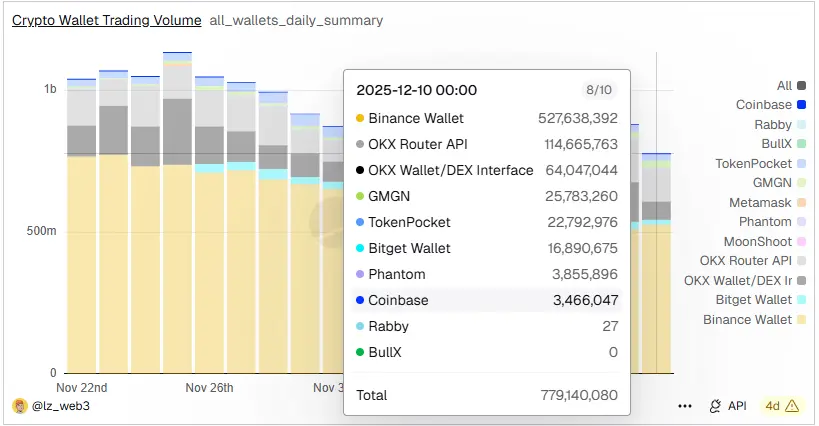
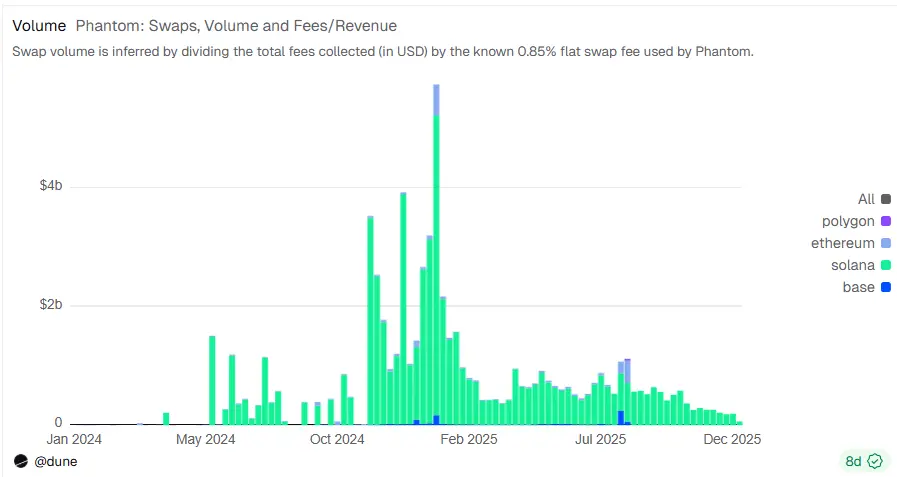
Yet, trading volume remains a concern. Dune Analytics data shows Phantom’s share of the global embedded swap market fell from nearly 10% at the start of the year to 2.3% in May, and just 0.5% by year-end. Exchange-backed wallets, with lower fees, faster token listings, and generous airdrop incentives, attracted high-frequency traders. Binance Wallet now controls nearly 70% of the market, while OKX (wallet plus routing API) accounts for over 20%.
Phantom’s deep integration with Solana is a bigger concern for the market. Data shows that 97% of Phantom’s swap transactions occur on Solana. Solana’s total value locked (TVL) has dropped more than 34% from its September 14 peak of $13.22 billion, now sitting at a six-month low of $8.67 billion. This has directly impacted Phantom’s core trading metrics.
In response, Phantom is doubling down on new products to spark a second wave of growth.
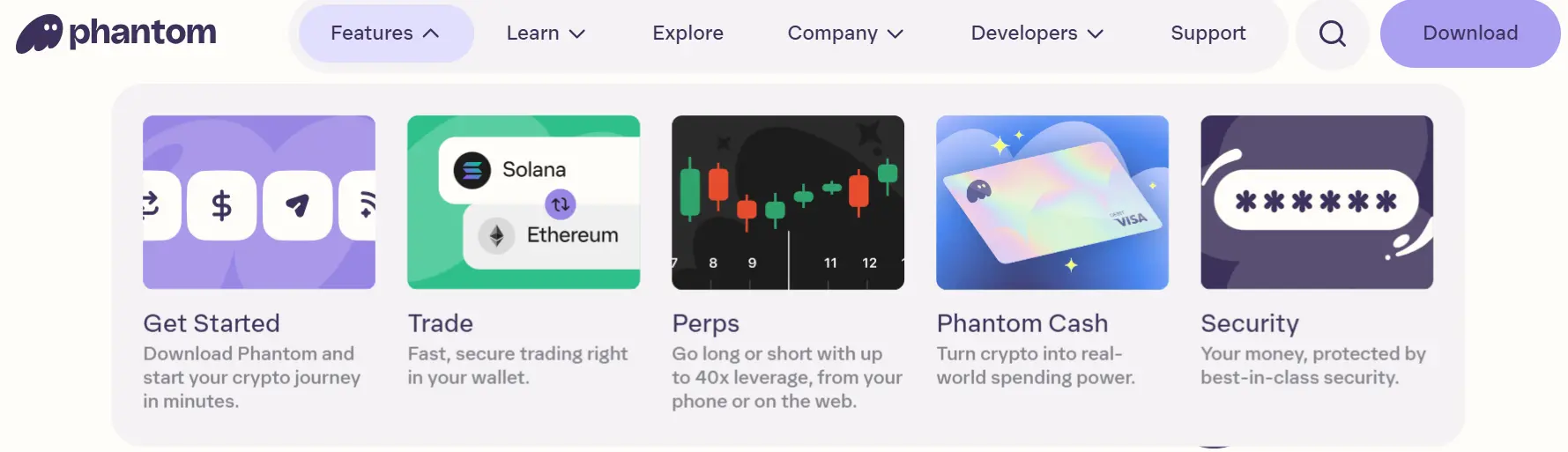
On the product side, Phantom has introduced several differentiated features:
- In July, Phantom integrated Hyperliquid perpetual contracts, generating roughly $1.8 billion in trading volume in just 16 days and earning nearly $930,000 through a builder code rebate model;
- In August, Phantom acquired meme coin monitoring tool Solsniper and NFT data platform SimpleHash, strengthening its coverage of specialized trading needs.
- In late September, Phantom launched its native stablecoin, CASH. Supply quickly exceeded $100 million, and November saw transaction peaks of over 160,000. Its competitive edge is fee-free P2P transfers and built-in lending rewards;
- In December, Phantom launched the Phantom Cash debit card in the US, enabling users to spend on-chain stablecoins directly, with support for Apple Pay, Google Pay, and other leading mobile payment systems;
- On December 12, Phantom announced a prediction market platform, integrating Kalshi into the wallet and making it available to eligible users;
- Phantom also released the free SDK “Phantom Connect,” allowing users to access various web3 applications with a single account, lowering onboarding barriers for both developers and users.
The debit card and CASH stablecoin are the most closely watched, as Phantom aims to solve the “last mile” challenge of crypto asset spending.
Phantom CEO Brandon Millman has publicly stated that, in the near term, the company will not issue a token, pursue an IPO, or launch its own blockchain. Instead, all efforts are focused on perfecting the product and making the wallet a financial tool for everyday users. Millman believes the real endgame in wallets is not who commands the most trading volume, but who brings crypto into mainstream payments first.
Still, cracking the “last mile” of crypto payments is no easy feat. Phantom is not the first independent, non-custodial wallet to launch a debit card.
Back in Q2 2025, MetaMask partnered with Mastercard, Baanx, and CompoSecure to launch the MetaMask Card, which enables real-time crypto-to-fiat conversion for spending and is available in the EU, UK, Latin America, and more. MetaMask’s card launched earlier and covers more regions, but is limited to Ethereum and Linea, resulting in higher fees and slower speeds. Users described it as “convenient but rarely used.”
By comparison, Phantom’s debit card launched later and is currently available only in select US markets. Adoption remains to be seen. In theory, Solana’s low fees could give Phantom an edge in fee-sensitive emerging markets, but it still lags MetaMask Card in global reach and merchant acceptance.
For stablecoins, if CASH fails to achieve lasting network effects, it could follow the path of other wallet-native stablecoins that started strong but faded quickly—such as MetaMask’s mUSD, which surpassed $100 million in supply soon after launch but fell to about $25 million in less than two months.
Conclusion
With the meme coin frenzy fading, trading volume is no longer a reliable moat. Independent wallets must refocus on core financial services.
Phantom is integrating Hyperliquid perpetuals and the Kalshi prediction market to retain advanced users on the trading side, while betting on the CASH stablecoin and debit card to bring on-chain assets into everyday life.
This dual strategy—combining trading derivatives and consumer payments—is Phantom’s answer to the wallet market’s winner-takes-all dynamic. It’s not just a search for a second growth curve, but a redefinition of what an independent wallet can be.
Disclaimer:
- This article is reprinted from [ChainCatcher], with copyright held by the original author [zhou, ChainCatcher]. If you have concerns about this reprint, please contact the Gate Learn team for prompt handling in accordance with relevant procedures.
- Disclaimer: The views and opinions expressed in this article are those of the author only and do not constitute investment advice.
- Other language versions of this article were translated by the Gate Learn team. Unless Gate is specifically mentioned, it is prohibited to copy, distribute, or plagiarize the translated article.