![]() Trusted Editorial content, reviewed by leading industry experts and seasoned editors. Ad Disclosure
Starcloud launched a spacecraft last year that carried an Nvidia H100 GPU into low Earth orbit, and company executives now say a follow-up mission will place ASIC Bitcoin miners on a second craft later this year. That move turns an orbital demo into an explicit test of whether crypto work can run in space at scale.
Trusted Editorial content, reviewed by leading industry experts and seasoned editors. Ad Disclosure
Starcloud launched a spacecraft last year that carried an Nvidia H100 GPU into low Earth orbit, and company executives now say a follow-up mission will place ASIC Bitcoin miners on a second craft later this year. That move turns an orbital demo into an explicit test of whether crypto work can run in space at scale.
Related Reading: Crypto Gets A Boost In Trump’s New National Cyber Strategy## Bitcoin In Space: Operational Versus Launch Costs
Reports say the company argues running miners above the atmosphere could cut energy and cooling expenses. Solar panels provide steady power on certain orbits, and vacuum lets a satellite radiate heat away without gigantic air-conditioning systems.
Those are the savings Starcloud highlights. But getting machines into orbit and keeping them there carries its own price. Launch fees, protective shielding, and large radiators add mass and cost. Hardware replacements will be harder than swapping racks in Texas.
The company began life pitching orbital data centers for AI workloads, not just cryptocurrency. Reports indicate Starcloud’s longer-term plan is a constellation of compute platforms that can host commercial clients.
Starcloud’s CEO, Philip Johnston, announced on X Saturday that the company aims to become the first to mine Bitcoin in space, following a discussion (video below) of its space mining plans on HyperChange Thursday.
For now, the test is narrow: install miners in orbit, see whether they run, measure uptime and energy math. Officials said the test is intended to provide hard numbers rather than slogans.
Hardware In Space Is Different Work
NVIDIA-backed publicity and a high-profile GPU flight drew attention, but civilian engineers and space systems experts point to several technical limits. Electronics face constant radiation. Memory and silicon degrade faster without heavy shielding.
Heat must be rejected through radiators, which increases surface area and mass. Reports note that ASICs optimized for Earth cooling cannot simply be transplanted into space and expected to last years.
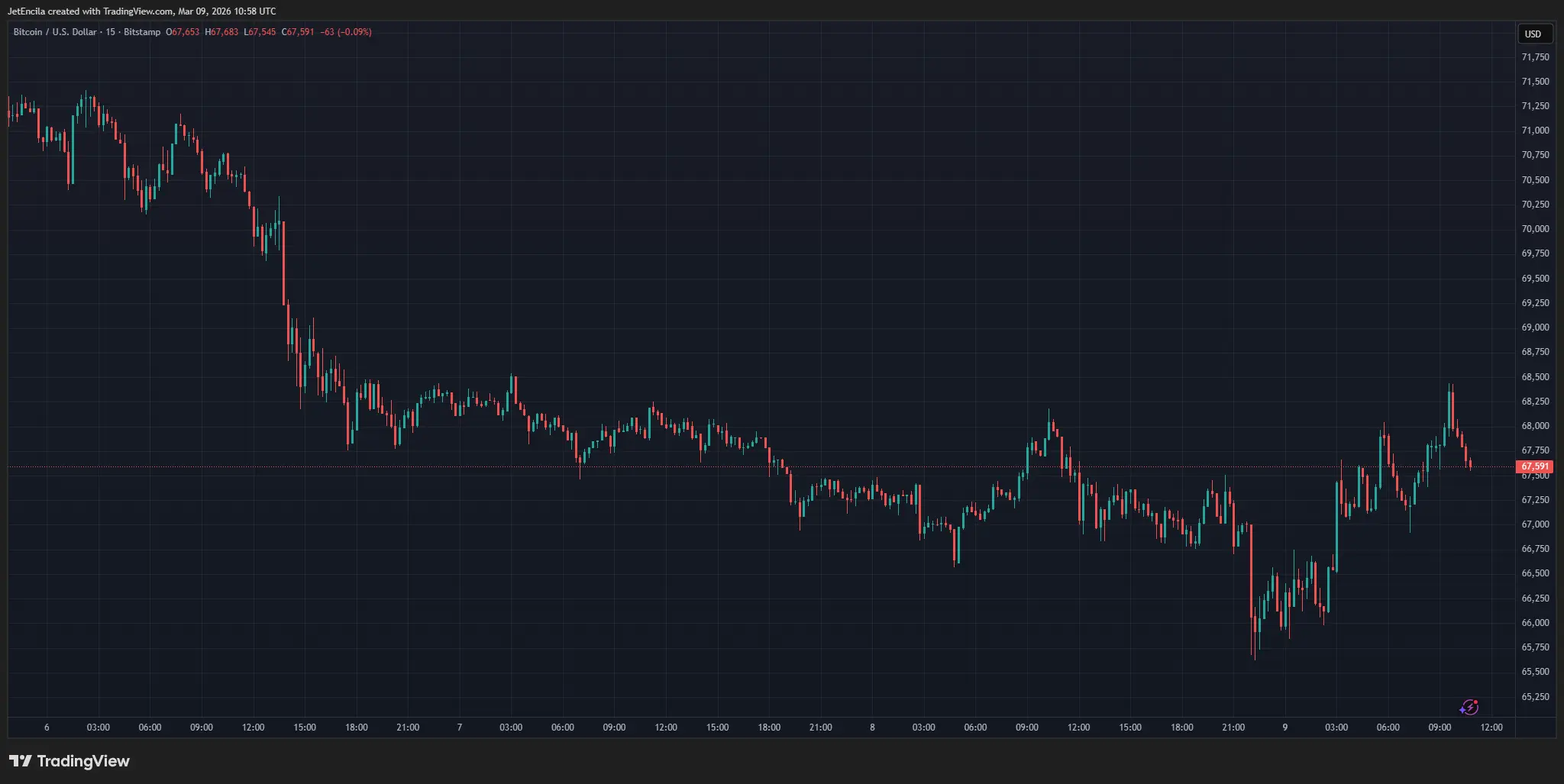
BTCUSD trading at $67,601 on the 24-hour chart: TradingView
Related Reading: Bitcoin Could Outshine Gold Through 2029, Macroeconomist PredictsData shows terrestrial mining benefits from cheap local electricity, proximity to maintenance teams, and economies of scale that are already well understood. Putting those same miners in orbit removes easy access for repairs.
If a board fails, a replacement might require another rocket launch. That risk factors into any calculation of lifetime costs and return on investment.
Featured image from 4K Wallpapers, chart from TradingView
![]() Editorial Process for bitcoinist is centered on delivering thoroughly researched, accurate, and unbiased content. We uphold strict sourcing standards, and each page undergoes diligent review by our team of top technology experts and seasoned editors. This process ensures the integrity, relevance, and value of our content for our readers.
Editorial Process for bitcoinist is centered on delivering thoroughly researched, accurate, and unbiased content. We uphold strict sourcing standards, and each page undergoes diligent review by our team of top technology experts and seasoned editors. This process ensures the integrity, relevance, and value of our content for our readers.
Disclaimer: The information on this page may come from third parties and does not represent the views or opinions of Gate. The content displayed on this page is for reference only and does not constitute any financial, investment, or legal advice. Gate does not guarantee the accuracy or completeness of the information and shall not be liable for any losses arising from the use of this information. Virtual asset investments carry high risks and are subject to significant price volatility. You may lose all of your invested principal. Please fully understand the relevant risks and make prudent decisions based on your own financial situation and risk tolerance. For details, please refer to
Disclaimer.


