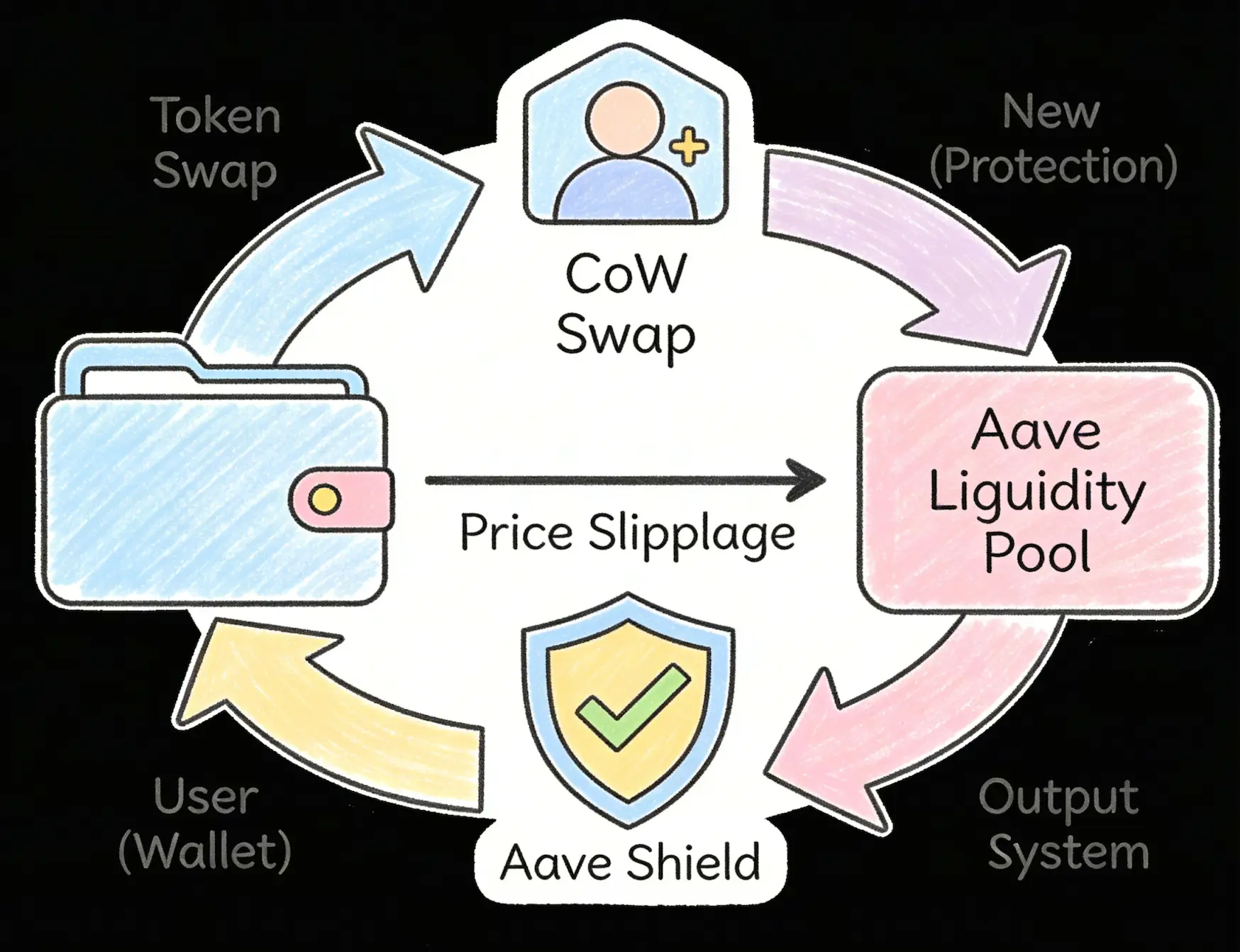
 Aave confirmed that a user lost approximately $50.4 million on March 12, 2026, after executing a token swap through the CoW Swap router integrated into the Aave interface, receiving only about $36,500 worth of aEthAAVE in exchange for 50.43 million aEthUSDT.
The transaction, which occurred entirely on a third-party swap protocol rather than Aave’s core lending protocol, triggered a 99.9% price impact due to extreme market illiquidity. In response, Aave announced the forthcoming deployment of “Aave Shield,” a new safety feature that will automatically block swaps with price impact exceeding 25%.
The affected user has not yet contacted the Aave team, though approximately $110,368 in swap fees generated by the transaction will be held for potential return following verification.
Incident Overview: Anatomy of a $50 Million Swap
Transaction Details
On March 12, 2026, a user attempting to swap 50,432,688 aEthUSDT (valued at approximately $50.43 million) for aEthAAVE via the Aave interface’s integrated CoW Swap widget received an extremely unfavorable quote. The order’s disproportionate size relative to available market liquidity resulted in a quote 99.9% below expected market clearing value.
User Warnings and Acknowledgment
The Aave interface displayed multiple explicit warnings before transaction execution, including:
-
“High price impact (99.9%)”
-
Notice that “this route may return less due to low liquidity or small order size”
-
A confirmation checkbox stating “I confirm the swap with a potential 100% value loss”
Internal audit trails confirm the user, accessing the platform on a mobile device, manually acknowledged these warnings by clicking the confirmation checkbox.
Technical Execution and Root Cause Analysis
Market Liquidity vs. Slippage
The incident resulted from illiquid market conditions rather than conventional slippage. An illiquid market lacks sufficient available supply at a given price to fill large orders without significant price deterioration. The user’s order far exceeded available liquidity, and the adverse outcome stemmed from confirming a quote that reflected this reality—not from price changes during execution.
On-Chain Execution Flow
The transaction routing proceeded as follows:
-
CoW Swap solvers quoted 50.43 million USDT for approximately 322 aEthAAVE ($36,230)
-
The solver contract routed through Uniswap V3’s USDT/WETH pool, converting to 17,957.81 WETH
-
Funds then moved through SushiSwap’s AAVE/WETH pool to purchase 331.3053 AAVE
-
These AAVE tokens were deposited into Aave V3, minting 331.3053 aEthAAVE
-
The user received 327.2413 aEthAAVE ($36,425), with the solver retaining 4.064 aEthAAVE ($452) as surplus
MEV Bot Extraction
Neither Aave’s nor CoW Swap’s official reports addressed the role of Maximal Extractable Value (MEV) bots in the incident. A MEV bot executed a sandwich attack on the transaction, extracting approximately $9.9 million, while the block builder who processed the transaction captured over $34 million. In total, MEV-related actors profited roughly $44 million from the user’s error.
Contrasting Analysis: Aave vs. CoW Swap
The incident generated divergent technical assessments from the two protocols involved.
Aave’s Position
Aave maintains the issue stemmed fundamentally from user execution in an illiquid market despite clear warnings. The protocol’s core lending contracts remained secure throughout, as the swap occurred externally via CoW Swap’s infrastructure.
CoW Swap’s Response
CoW Swap offered a contrasting technical analysis, identifying multiple infrastructure failures:
-
Outdated gas limits prevented optimal solvers from submitting better-priced quotes
-
The optimal solver won two auctions but never submitted any transaction on-chain
-
Potential private mempool leakage may have exposed the transaction
-
CoW Swap emphasized that “checkboxes should not be the only security measure”
Aave Shield: New Safeguard Mechanism
Feature Overview
In direct response to the incident, Aave announced the imminent deployment of Aave Shield, a protective feature integrated into the swap widget on aave.com.
Default Protection Parameters
-
Automatically blocks any swap with price impact exceeding 25%
-
Creates a “high friction guardrail” requiring users to manually disable protection
-
Users must access Settings menu to intentionally opt out for high-risk trades
Design Philosophy
The feature balances permissionless operations—critical during market stress—with enhanced user protections against accidental confirmations. Advanced users retain the ability to execute high-risk trades by disabling Aave Shield manually.
Protocol Status and Fee Refund Commitment
Core Protocol Safety
Aave has repeatedly confirmed that its core lending protocol was never at risk during this incident. The swap occurred entirely through CoW Swap’s infrastructure, with Aave’s interface serving only as a front-end access point.
Fee Handling
The transaction generated $110,368 in swap fees (based on 25 basis points), verified in CoW Swap metadata. Aave has committed to holding these funds and returning them to the user upon contact and successful verification.
Ongoing Investigation
Aave continues to monitor the situation and work internally and with the CoW Swap team to improve the swapping experience on aave.com. A comprehensive post-mortem report will be published following investigation completion.
Frequently Asked Questions
What exactly caused the $50 million loss on Aave?
The loss resulted from a user executing an extremely large swap (50.43 million aEthUSDT) in a market with insufficient liquidity to absorb the order. The transaction routed through CoW Swap’s infrastructure with a 99.9% price impact quote, which the user affirmatively accepted after acknowledging multiple warnings, including a checkbox confirming “potential 100% value loss.”
Was the Aave protocol itself compromised or at risk?
No. Aave has confirmed its core lending protocol remained fully secure throughout the incident. The swap occurred entirely on CoW Swap, a third-party decentralized exchange aggregator integrated as a front-end widget on aave.com. The Aave protocol’s lending and borrowing functions were unaffected.
What is Aave Shield and how will it prevent similar incidents?
Aave Shield is a new safety feature that automatically blocks any swap with price impact exceeding 25% executed through the Aave interface. Users must manually disable this protection in Settings to proceed with high-risk trades, adding a significant friction layer against accidental confirmations while preserving permissionless access for advanced users.
Did MEV bots profit from this transaction?
Yes. While neither Aave’s nor CoW Swap’s official reports addressed MEV involvement, on-chain analysis indicates MEV bots executed a sandwich attack profiting approximately $9.9 million, with the block builder capturing over $34 million—totaling roughly $44 million extracted by MEV-related actors.
Will the user receive any funds back?
Aave has committed to returning approximately $110,368 in swap fees generated by the transaction, provided the user contacts the team and completes a verification process. The remaining funds lost to price impact and MEV extraction are unlikely to be recoverable.
Disclaimer: The information on this page may come from third parties and does not represent the views or opinions of Gate. The content displayed on this page is for reference only and does not constitute any financial, investment, or legal advice. Gate does not guarantee the accuracy or completeness of the information and shall not be liable for any losses arising from the use of this information. Virtual asset investments carry high risks and are subject to significant price volatility. You may lose all of your invested principal. Please fully understand the relevant risks and make prudent decisions based on your own financial situation and risk tolerance. For details, please refer to
Disclaimer.


