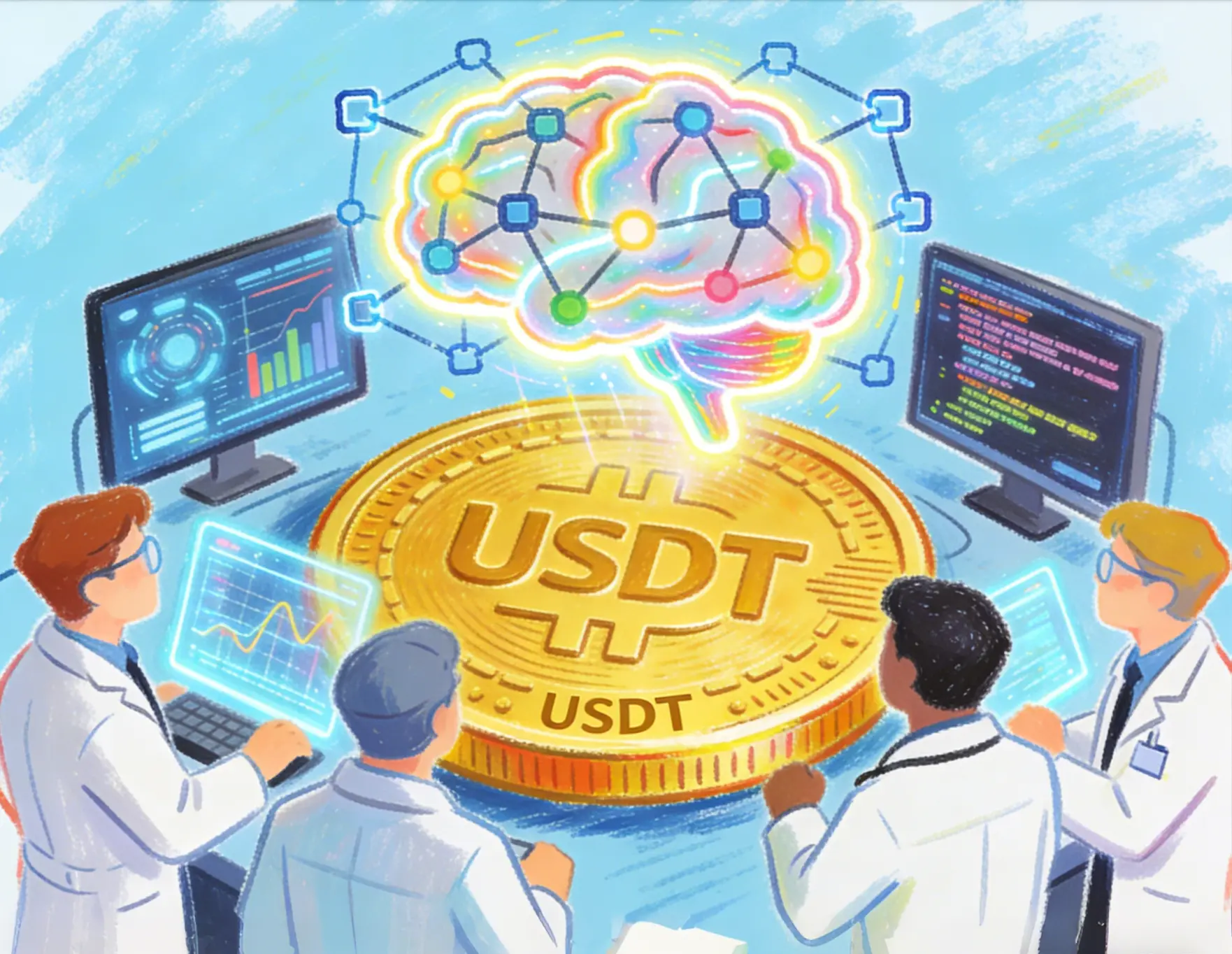
 Tether CEO Paolo Ardoino announced on March 15, 2026, that the company’s AI division will release what he described as a “true breakthrough” in the coming week, marking the next phase of the stablecoin issuer’s decentralized intelligence strategy.
The announcement follows the March 13 release of QVAC Workbench version 0.4.1, which introduced a redesigned user interface and expanded local AI capabilities across desktop and mobile devices. Tether has invested billions of dollars from its stablecoin profits into decentralized AI infrastructure, positioning the initiative as a challenge to centralized Big Tech platforms.
The forthcoming release represents the latest development from Tether Data, the company’s technology arm, which has been building the QVAC (QuantumVerse Automatic Computer) platform designed to run AI models entirely on consumer devices without cloud servers or API keys.
QVAC Ecosystem: Decentralized AI on Consumer Hardware
Platform Architecture and Vision
QVAC enables AI model execution directly on user devices, eliminating reliance on cloud infrastructure and centralized service providers. The platform aligns with Ardoino’s stated vision of replacing Big Tech dependency with decentralized technology across finance, cloud computing, and communications.
Recent Technical Milestones
The QVAC ecosystem has accelerated development since its mid-2025 announcement:
October 2025: Tether Data released QVAC Genesis I, a 41-billion-token synthetic dataset for training STEM-focused AI models, alongside the initial QVAC Workbench for on-device AI experimentation
December 2025: Expansion to 148 billion tokens with Genesis II, plus launch of QVAC Fabric LLM, an open-source framework enabling large language model fine-tuning on consumer hardware including smartphones
February 2026: Live demonstration showed QVAC performing complex reasoning and task automation on a laptop with below-average GPU, using Model Context Protocol (MCP) to interface with third-party tools
- March 13, 2026: QVAC Workbench 0.4.1 shipped with redesigned interface, expanded document format support for retrieval-augmented generation, and performance fixes for Android devices including Samsung and Pixel 10
Ardoino characterized the current state as “still very alpha mode” but noted users could “already feel the true potential” ahead of a full QVAC SDK launch.
Financial Backing: Stablecoin Profits Fund AI Expansion
Profit Generation
Tether reported over $10 billion in net profit for 2025, driven primarily by returns on approximately $141 billion in U.S. Treasury exposure. As issuer of USDT—the largest stablecoin by market capitalization—the company has channeled substantial capital into frontier technology bets.
Investment Allocation
Beyond AI, Tether has diversified into:
Energy infrastructure
Peer-to-peer communication systems
Brain-computer interfaces: Acquired majority stake in Blackrock Neurotech for $200 million
Robotics: Investment in Italian startup Generative Bionics
Tether’s EVO division placed fourth in a global brain-computer interface AI benchmark in February 2026.
Potential Breakthrough Scenarios
Possible Release Vectors
Industry observers have identified several possibilities for the upcoming announcement based on Tether’s development trajectory:
Full open-source release of the QVAC assistant framework
Advanced on-device model optimized for edge inference on consumer hardware
Deeper AI-payment integration connecting autonomous agents with Tether’s Bitcoin and USDT payment rails
Adjacent Technology Integration
Tether’s recent investments could feed into the AI release:
-
Blackrock Neurotech’s brain-computer interface capabilities
-
Generative Bionics’ robotics expertise
-
QVAC’s on-device processing architecture demonstrated in February
Leadership Transition and Strategic Appointments
Investment Team Changes
Tether has appointed Zachary Lyons as Chief Investment Officer, succeeding Richard Heathcote who transitions to non-executive advisor. Heathcote previously scaled Tether’s reserves, established risk management systems, and built partnerships with major U.S. banks, positioning the company as a top private holder of U.S. Treasury bills. Lyons, formerly Heathcote’s deputy, has been instrumental in deploying capital into technology and infrastructure projects.
Broader Investment Strategy
Recent Tether investments include:
Ark Labs: Funding as part of a $5.2 million round for Arkade, a platform enabling fast, programmable Bitcoin transactions
Axiym: Investment in fintech firm building distributed treasury and settlement systems within regulated frameworks, integrating USDT into payment networks spanning 140 countries and 70 currencies
Eight Sleep: Strategic commitment valuing the AI-driven sleep technology company at $1.5 billion, leveraging QVAC for on-device health data processing
Market Context and Transparency Considerations
Skepticism and Scrutiny
Tether’s history of transparency concerns, combined with the promotional nature of social media announcements, means the gap between announcement and deliverable will be closely monitored by industry observers. The company’s ability to deliver on Ardoino’s characterization of a “true breakthrough” remains to be demonstrated.
Timeline
The forthcoming release is expected within days of the March 15 announcement. Whether the deliverable matches the scale implied by Ardoino’s statement should become clear upon public availability.
Frequently Asked Questions
What is Tether’s QVAC platform and how does it differ from mainstream AI?
QVAC (QuantumVerse Automatic Computer) is Tether’s decentralized AI platform designed to run entirely on consumer devices—laptops, smartphones, and tablets—without requiring cloud servers, API keys, or internet connectivity. Unlike mainstream AI services that rely on centralized data centers and Big Tech infrastructure, QVAC processes data locally, enhancing privacy, reducing dependency on external providers, and enabling AI functionality in offline environments.
How is Tether funding its AI expansion given its stablecoin business?
Tether generates significant profits from its stablecoin operations, particularly USDT. The company reported over $10 billion in net profit for 2025, largely from returns on approximately $141 billion in U.S. Treasury holdings. These profits fund Tether Data’s AI initiatives, along with investments in energy, peer-to-peer communications, brain-computer interfaces, and robotics. The AI push represents diversification beyond stablecoin issuance into broader technology infrastructure.
What could the upcoming “true breakthrough” announcement include?
Based on Tether’s development trajectory, possibilities include the full open-source release of the QVAC assistant framework, an advanced on-device AI model optimized for edge inference on consumer hardware, or deeper integration between AI agents and Tether’s Bitcoin and USDT payment rails enabling autonomous transactions. The announcement may also incorporate technologies from Tether’s recent investments in brain-computer interfaces or robotics.


