The institution reported that argt, a peso-linked stablecoin, constitutes a security, subject to the regulatory regime for capital markets for these instruments. The stablecoin, issued by Twin Finance and listed by Belo, offered up to 32% APR.
Regulator Classifies Argentine Peso Stablecoin as a Security, Blocks Operations
The Argentine equivalent of the SEC, the CNV, executed the first measure against a stablecoin linked to the national fiat currency, the Argentine peso.
On March 12, the institution issued a resolution ordering the suspension of the listing, offering, and intermediation of argt, stating that the token was classified as a security offered to investors without complying with the rules established for these assets.
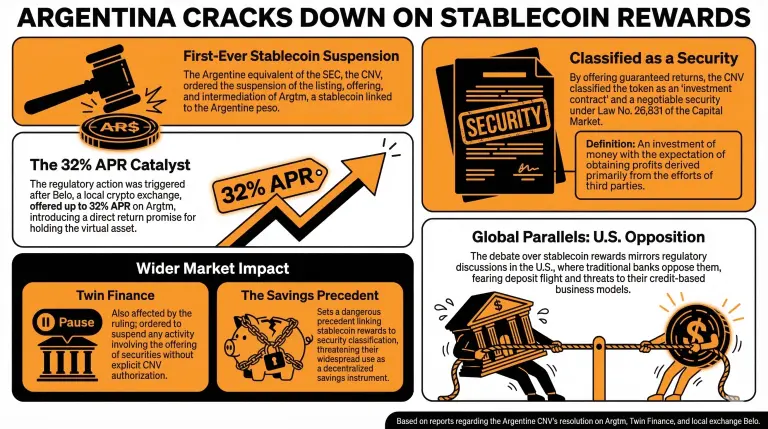
The action comes after Belo, an exchange that listed the stablecoin, offered up to 32% in APR, introducing a return promise linked to holding the virtual asset. As a consequence, the CNV assessed that this would make it “fall under the figure of an investment contract included in the definition of negotiable security provided for in article 2 of Law No. 26,831 of the Capital Market, which results in its classification as a negotiable security subject to the public offering regime.”
The institution clarified that when these assets meet the criteria of an investment contract, “an investment of money in a joint venture with the expectation of obtaining profits derived primarily from the efforts of third parties,” it can be considered a security, and will be subject to the compliance regime described for these assets.
The action also affects Twin Finance, which will have to suspend any activity, including the offering of securities, without the CNV’s authorization.
The development sets a precedent in Argentina, linking the offering of rewards for holding a stablecoin to its classification as a security, closing the potential savings use case for these instruments in the future, with no regulation tackling this issue.
The subject of stablecoin rewards is also being discussed in the U.S., as banks have opposed it, alleging that it could fuel deposit flight from the financial system and affect their credit intermediation-based business model.
FAQ
- What recent action did Argentina’s CNV take regarding a stablecoin?
The CNV suspended the listing and intermediation of argt, classifying it as a security being offered without regulatory compliance.
- Why was argt classified as a security?
The token was categorized as a security because it was linked to an investment contract promising up to 32% APR for holding the virtual asset.
- What implications does this resolution have for Twin Finance?
Twin Finance must halt all activities involving the stablecoin, including offering securities, without prior authorization from the CNV.
- What broader impact does this decision have on stablecoin offerings in Argentina?
This action sets a precedent by linking rewards for holding stablecoins to their classification as securities, potentially limiting their use for savings in the country.
Disclaimer: The information on this page may come from third parties and does not represent the views or opinions of Gate. The content displayed on this page is for reference only and does not constitute any financial, investment, or legal advice. Gate does not guarantee the accuracy or completeness of the information and shall not be liable for any losses arising from the use of this information. Virtual asset investments carry high risks and are subject to significant price volatility. You may lose all of your invested principal. Please fully understand the relevant risks and make prudent decisions based on your own financial situation and risk tolerance. For details, please refer to
Disclaimer.
Related Articles
US Democratic Lawmakers Propose Ban on Officials Using Inside Information to Trade Prediction Markets
Gate News: On March 17, U.S. Senator Chris Murphy and Representative Greg Casar introduced a new bill called the BETS OFF Act, which proposes to prohibit government officials from engaging in prediction market betting while possessing inside information. The bill specifically targets suspected insider trading in events related to U.S. actions in Venezuela, Iran, and other locations, aiming to restrict officials from profiting from sensitive policy and military information.
GateNews7m ago
CFTC Confirms Phantom Not Required to Register as Broker for Self-Custody Services
Gate News bot message, according to AggrNews, the CFTC (Commodity Futures Trading Commission) will not require Phantom to register as a broker for self-custody activities, as stated on the website. This clarification addresses Phantom's regulatory status regarding its self-custody operations.
GateNews49m ago
South Korea Police Issue New Crypto Seizure Guidelines
South Korea's National Police Agency has developed guidelines for managing seized cryptocurrencies, focusing on privacy coins. This includes compliance for seizing, storing, and managing these assets, addressing challenges posed by anonymity and illegal activities.
TodayqNews1h ago
Trump Launches Federal Anti-Fraud Task Force Led by J.D. Vance
Donald Trump has taken a direct step to tackle rising financial crime by signing an executive order to create a federal anti-fraud task force. Announced on March 16, 2026, the initiative puts J. D. Vance in charge of leading the effort. The task force will coordinate federal agencies, investigate
Coinfomania3h ago
Buenos Aires Court Orders Polymarket Blocked in Argentina
A Buenos Aires court has ordered the blocking of the prediction market platform Polymarket, citing it as an unauthorized online betting system. Access restrictions and app removals are mandated, highlighting rising regulatory scrutiny on such platforms.
Decrypt4h ago
The tokenized real estate platform RealT faces a lawsuit in Detroit, with over 400 properties found to have compliance issues.
Canada-based tokenized real estate platform RealT faces a legal and compliance crisis after a civil lawsuit was filed by the Detroit municipal government. The lawsuit alleges multiple regulatory violations, including properties lacking compliance certificates and delinquent tax payments. RealT plans to sell properties and suspend rental distributions while pivoting to new projects.
GateNews4h ago


