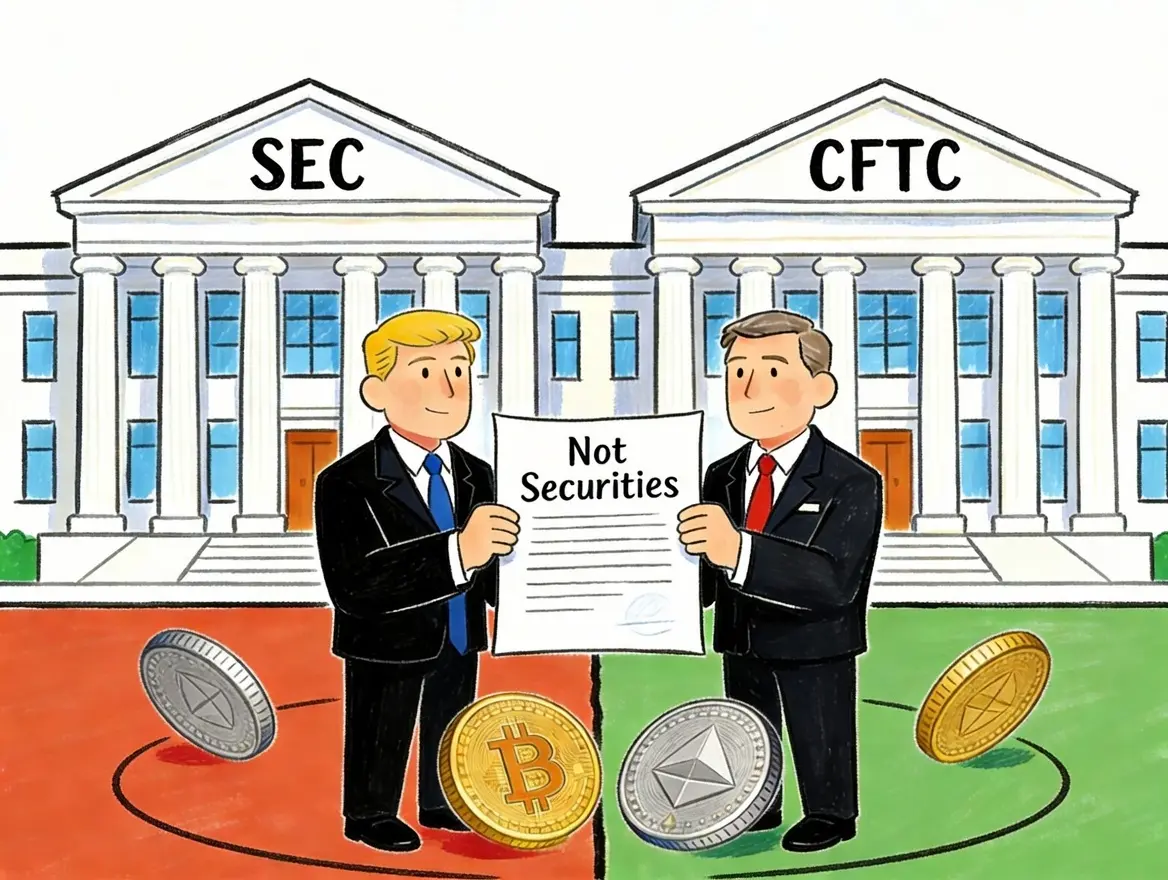
 The U.S. Securities and Exchange Commission (SEC) and Commodity Futures Trading Commission (CFTC) released joint guidance on March 17, 2026, providing a 68-page interpretation asserting that most cryptocurrencies are not securities and establishing a token taxonomy for digital assets including stablecoins, digital commodities, and digital tools.
The interpretation, unveiled at the DC Blockchain Summit in Washington D.C., clarifies how federal securities laws apply to protocol mining, staking, airdrops, and the circumstances under which a non-security crypto asset may become subject to investment contract analysis.
SEC Chair Paul Atkins framed the guidance as fulfilling the agency’s fundamental role: “This is what regulatory agencies are supposed to do: draw clear lines in clear terms.” CFTC Chairman Michael S. Selig added that “with today’s interpretation, the wait is over” for American builders seeking clarity on asset status under federal securities and commodity laws.
Token Taxonomy: Defining Non-Security Assets
Categories Excluded from Securities Classification
The joint guidance establishes a framework categorizing specific digital asset types as non-securities:
Digital commodities: Assets “intrinsically linked to and deriving their value from the programmatic operation of a functional crypto system, as well as supply and demand dynamics”
Payment stablecoins: Dollar-pegged assets backed by reserves
Digital tools: Utility-focused tokens providing access to platform functionality
Digital collectibles: Assets representing rights to trading cards, current events, and similar items
The interpretation specifies that digital securities—traditional securities that are tokenized—remain subject to SEC rules and regulations.
Howey Test Application Refined
The SEC has historically relied on the Howey Test, based on a 1946 U.S. Supreme Court case, to determine whether an asset qualifies as an investment contract and therefore a security. The new guidance provides detailed application of this framework to crypto assets, addressing longstanding industry uncertainty about which digital assets fall under securities regulation.
Investment Contracts: Beginning and End
Becoming Subject to Securities Laws
The interpretation addresses how a non-security crypto asset may become subject to an investment contract: “A non-security crypto asset becomes subject to an investment contract when an issuer offers it by inducing an investment of money in a common enterprise with representations or promises to undertake essential managerial efforts from which a purchaser would reasonably expect to derive profits.”
Ceasing to Be an Investment Contract
Significantly, the guidance explains that a non-security crypto asset may stop being an investment contract under securities laws when an issuer has either fulfilled or failed its representations or promises. This temporal aspect provides a framework for assets transitioning in and out of securities status based on the issuer’s ongoing role and commitments.
Application to Industry Practices
Mining, Staking, and Airdrops
The guidance clarifies how federal securities laws apply to core crypto industry activities:
Protocol mining: Treatment based on the nature of rewards and the miner’s role
Protocol staking: Analysis focusing on whether staking arrangements create investment contracts
Airdrops: Conditions under which token distributions may constitute securities offerings
Token wrapping: Treatment of wrapped versions of non-security crypto assets
Regulatory Philosophy Shift
Contrast with Previous Administration
The guidance represents a fundamental departure from the approach under former SEC Chair Gary Gensler, who brought numerous enforcement actions against crypto firms and asserted that most cryptocurrencies were securities. Atkins explicitly rejected this stance at the DC Blockchain Summit, stating: “We’re not the ‘securities and everything commission’ anymore.”
Joint Agency Coordination
The CFTC joined the interpretation, providing guidance that it will administer the Commodity Exchange Act consistent with the SEC’s interpretation. This coordinated approach signals an end to regulatory turf wars and establishes clearer jurisdictional boundaries between the two agencies.
Safe Harbor Proposal
Planned Rulemaking
Atkins announced that the SEC will soon issue a proposed rule establishing a safe harbor program for startups to launch crypto companies, crypto investment contracts, and security tokens without necessarily having to register with the agency. The proposed safe harbor could last up to four years, allowing companies to access capital while developing their networks before facing full registration requirements.
Investor Protection Balance
The safe harbor aims to “provide crypto innovators bespoke pathways to raise capital in the US while providing appropriate investor protections,” according to Atkins. This approach attempts to balance innovation facilitation with the SEC’s core investor protection mission.
Legislative Context
Bridge to Congressional Action
Both agency heads positioned the guidance as complementary to ongoing congressional efforts. Atkins stated that the interpretation “serves as an important bridge for entrepreneurs and investors as Congress works to advance bipartisan market structure legislation,” which he expressed readiness to implement with Chairman Selig in the near future.
Not Waiting for Legislation
By issuing joint guidance, the SEC and CFTC signaled they will not wait for Congress to finalize market structure legislation before providing regulatory clarity. The interpretation represents agency-level action within existing statutory frameworks.
Publication and Effective Date
The interpretation will be published on CFTC.gov and in the Federal Register, providing official notice to market participants. The guidance is effective immediately upon issuance, though the safe harbor proposal will follow separate rulemaking procedures.
Frequently Asked Questions
What did the SEC and CFTC clarify in their joint guidance?
The 68-page interpretation establishes that most cryptocurrencies are not securities and provides a token taxonomy categorizing payment stablecoins, digital commodities, digital tools, and digital collectibles as non-securities. It explains how federal securities laws apply to mining, staking, airdrops, and token wrapping, and addresses when a non-security crypto asset may become subject to—or cease being subject to—an investment contract.
How does this guidance differ from the previous SEC approach?
Under former Chair Gary Gensler, the SEC took a more cautious approach, bringing enforcement actions against numerous crypto firms and asserting that most cryptocurrencies were securities. Chair Paul Atkins explicitly rejected this stance, stating “We’re not the ‘securities and everything commission’ anymore.” The guidance represents a shift toward clearer regulatory lines and joint coordination with the CFTC.
What is the proposed safe harbor and how would it work?
The SEC plans to propose a rule creating a safe harbor program allowing crypto startups to launch companies, investment contracts, and security tokens without immediately registering with the agency. The safe harbor could last up to four years, enabling access to capital while providing investor protections. This aims to balance innovation facilitation with regulatory compliance as companies develop their networks.
Disclaimer: The information on this page may come from third parties and does not represent the views or opinions of Gate. The content displayed on this page is for reference only and does not constitute any financial, investment, or legal advice. Gate does not guarantee the accuracy or completeness of the information and shall not be liable for any losses arising from the use of this information. Virtual asset investments carry high risks and are subject to significant price volatility. You may lose all of your invested principal. Please fully understand the relevant risks and make prudent decisions based on your own financial situation and risk tolerance. For details, please refer to
Disclaimer.


