

Written by: imToken
Over the past period, if you’ve been continuously following the Ethereum ecosystem, you may have experienced a sense of fragmentation.
These discussions actually repeatedly point to the same deeper question: What kind of system does Ethereum want to become?
In fact, many controversies don’t stem from technical disagreements, but rather from different understandings of Ethereum’s “value premises.” Therefore, only by returning to these premises themselves can we truly understand why Ethereum has made choices that many now consider “untimely.”
The recent Ethereum community has not been peaceful.
From reflections on the Rollup-centric route, to debates over the concept of “Ethereum Alignment,” and comparisons with various high-performance public chains, a subtle yet continuously fermenting “Ethereum anxiety” is spreading.
This anxiety is not hard to understand.
As other public chains continuously refresh TPS, TVL, popular narratives, latency, and user experience metrics, Ethereum is repeatedly discussing architecture decomposition, execution outsourcing, interoperability, and finality problems—which appears neither intuitive nor pragmatic.
This has also surfaced a more pointed question: Is Ethereum in “degradation”?
To answer this question, we cannot only look at the technical roadmap of the past one or two years, but must extend our perspective to a longer time dimension—back to what Ethereum has truly persisted in over this decade.
In fact, many emerging high-performance public chains in recent years have chosen a more direct path: exchanging extreme performance and user experience for reduced node counts, raised hardware thresholds, and centralized sequencing and execution.
However, from the Ethereum community’s perspective, such speed often comes at the cost of fragility resistance.
A frequently overlooked but remarkably indicative fact is that in nearly a decade of operation, Ethereum has never experienced a network-wide outage or rollback event, maintaining uninterrupted 7×24×365 operation.
This is not because Ethereum was “luckier” than Solana, Sui, and others, but because from its inception, it chose to prioritize whether the system could continue functioning under worst-case scenarios over performance metrics.
In other words, Ethereum appears slow today not because it cannot go faster, but because it has always asked a harder question—when the network scales larger, more participants join, and the environment becomes less friendly, can this system continue to operate?
From this perspective, the so-called “seven-year itch” is not Ethereum degrading, but rather it actively enduring short-term discomfort and doubt for survival across a longer cycle.
Precisely because of this, the first step to understanding Ethereum is accepting a fact that is unpopular yet extremely crucial: Ethereum is not a system with “maximum efficiency” as its sole objective; its core goal is not to run fastest, but to be “trustworthy even in worst cases.”
Therefore, in Ethereum’s context, many seemingly technical issues are essentially value choices: Should we sacrifice decentralization for speed? Should we introduce permissionless nodes for throughput? Should we entrust security assumptions to a few for better user experience?
Ethereum’s answer is often no.
This also explains why the Ethereum community maintains an almost instinctive wariness toward shortcuts, where “can we do it” always yields to “should we do it.”
It is precisely in this context that “Alignment” has become one of the most controversial concepts recently, with some worried it might evolve into moral blackmail or even become a tool for rent-seeking.
In fact, this concern is not unfounded. As early as September 2024, Vitalik Buterin directly pointed out this risk in “Making Ethereum alignment legible”:
If “Alignment” means whether you have the right friends, then the concept itself has already failed.
Vitalik’s solution is not to abandon alignment, but to make it legible, decomposable, and discussable. In his view, alignment should not be a vague political stance, but should be broken down into a set of auditable attributes:
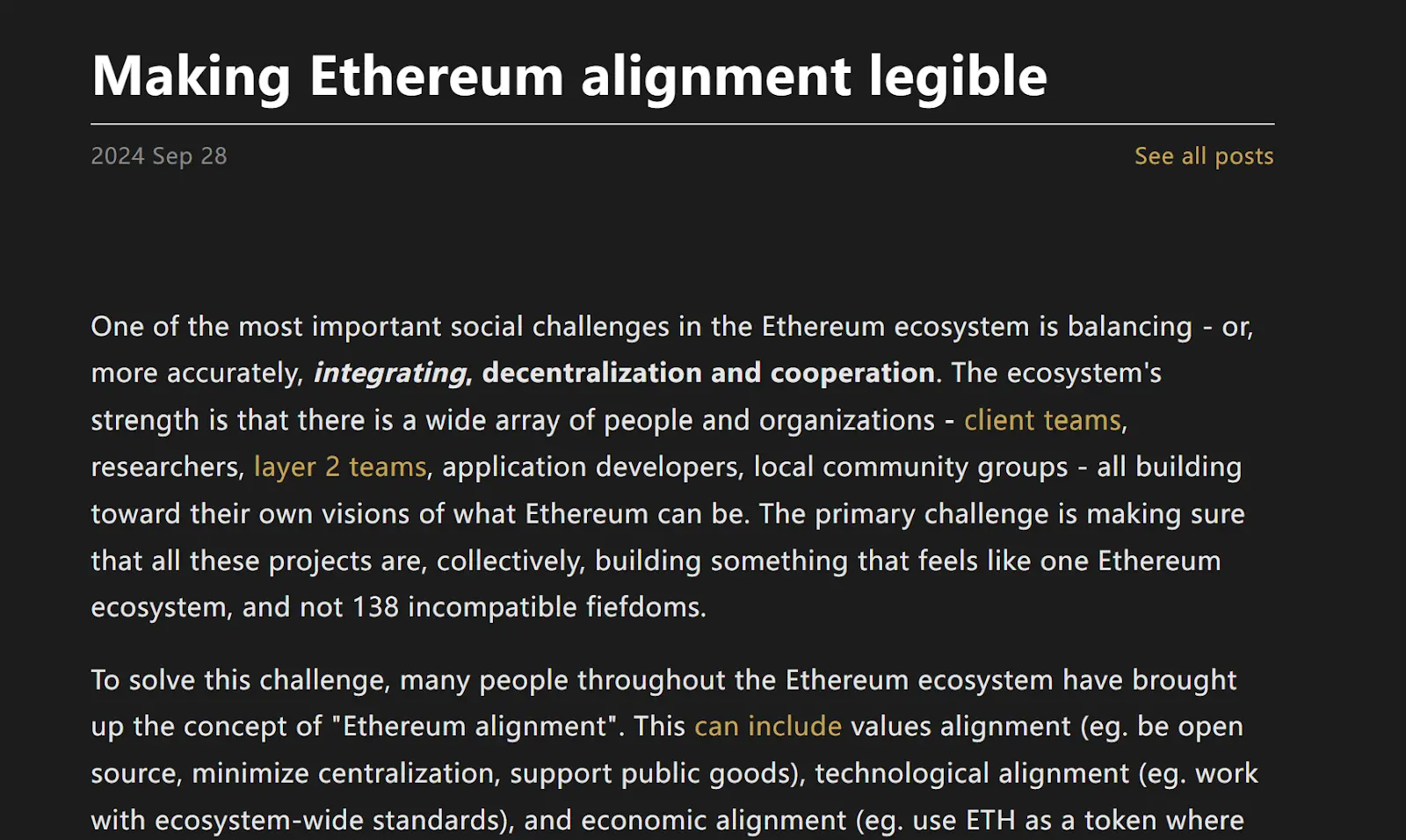
From this perspective, alignment is not a loyalty test, but a form of reciprocal symbiotic social contract.
The Ethereum ecosystem allows chaos, competition, and even fierce competition between L2s; but ultimately, these activities should give back to the mother chain that provides them security, consensus, and settlement guarantees.
If “Alignment” defines value boundaries, then truly supporting this boundary are the two pillars Ethereum has long upheld: decentralization and censorship resistance.
First, in Ethereum’s context, “decentralization” doesn’t mean having more nodes, nor does it mean everyone must run nodes. Rather, it means the system can function normally without trusting any single participant.
This means the protocol should not depend on a single sequencer, coordinator, or company; it also means node operation costs shouldn’t be so high that only professional institutions remain, ensuring ordinary people can still verify whether the system is operating according to the rules.
Precisely because of this, Ethereum maintains long-term restraint on hardware thresholds, bandwidth requirements, and state bloat, even if this slows certain short-term performance metrics (related reading: “ZK Route ‘Dawn Moment’: Is Ethereum’s Final Roadmap Accelerating Across the Board?”).
In Ethereum’s view, a system running at lightning speed but unable to be verified by ordinary people has essentially lost its “permissionless” significance.
Another frequently misunderstood value is censorship resistance.
Ethereum does not assume the world is benign. Instead, it defaults from inception that participants might pursue profit, power might concentrate, and external pressure will certainly emerge. Therefore, censorship resistance is not about ensuring “no one censors,” but ensuring that even if someone tries to censor, the system won’t fail.
This is also why Ethereum places such emphasis on proposer/builder separation, decentralized construction, and economic game design mechanisms—not because they’re elegant, but because they can continue functioning in worst-case scenarios.
In many discussions, people ask: “Would such extreme situations really happen in practice?”
But frankly, if a system is only secure in an ideal world, then it’s not worth entrusting value in the real world.
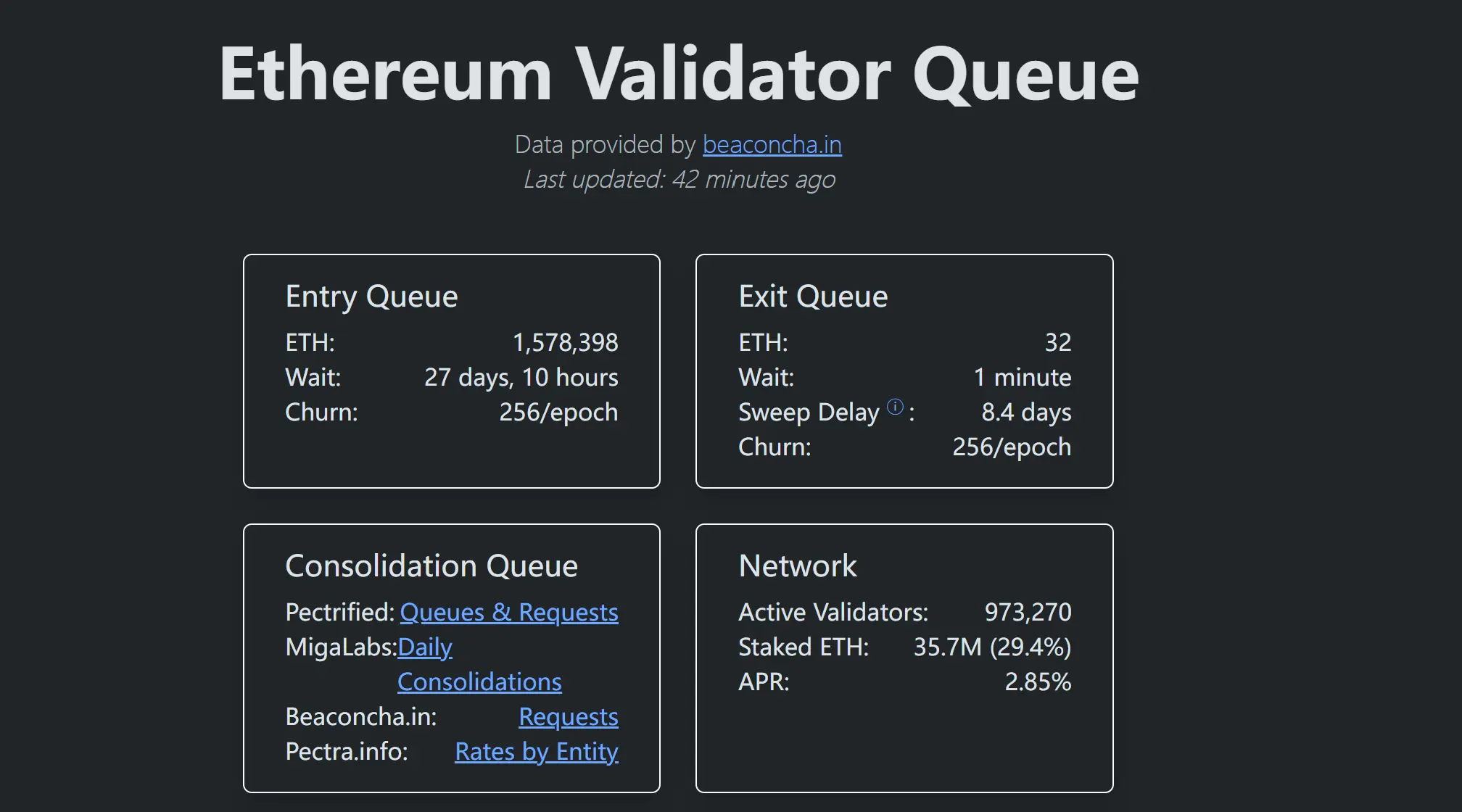
Finally, let me end with an interesting data point: currently Ethereum PoS’s staking exit queue has nearly cleared, while the queue for entering staking continues to grow (exceeding 1.57 million ETH).
Amid criticism and doubt, substantial amounts of ETH still choose to be locked long-term into this system.
This perhaps says more than any manifesto could.
Many critics say Ethereum is always “discussing philosophy even after others have already started running.”
But from another angle, it’s precisely these discussions that have kept Ethereum from repeatedly tearing down and rebuilding. Whether it’s the Rollup-centric roadmap, the gradual introduction of ZK, or routes like Interop, fast confirmation, and Slot shortening, they all unfold under a premise:
All performance improvements must be capable of being incorporated into existing security and value assumptions.
This also explains why Ethereum’s evolution often presents the characteristic of “appearing conservative yet actually robust.” Ultimately, it’s not that Ethereum doesn’t pursue efficiency, but that it refuses to exchange future systemic risks for current short-term advantages.
And this is precisely the underlying spirit that has sustained the Ethereum ecosystem through a decade—and in an era of “efficiency / TVL supremacy,” the scarcest and most worth protecting thing in Web3.
関連記事
暗号資産市場のラリーが始まり、ビットコインとアルトコイン価格が上昇、ETHポンプが強くなる可能性がある
Base58 Labs' BASIS 2026 Blueprint は BTC、ETH、SOL及び PAXG の新しい標準を形成します
イーサリアム価格が2300ドルを突破し、BitMineの増持とステーキングETFがETH価格の上昇を後押し


