


Breaking! Bitcoin surges short-term past $89,000, what's going on?

December 26th, Bitcoin short-term surge broke through $89,000, ending the Christmas market lull. This rebound is driven by three major engines: DeFi ecosystem TVL reaching $6.5 billion, ranking as the fourth largest; Bitcoin spot ETF total assets under management reaching $104 billion; and the Trump administration promoting digital assets inclusion in 401k retirement plans.
Bitcoin Engine One: DeFi Ecosystem Explodes into Fourth Largest Blockchain
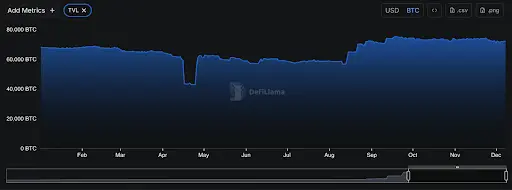
(Source: DefiLlama)
Bitcoin is no longer just “digital gold”; DeFi applications are rewriting its narrative. As of writing, Bitcoin blockchain’s total locked value (TVL) has reached $6.5 billion, making it the fourth largest in the DeFi ecosystem, approaching Binance Smart Chain (BNB). Even more impressive, the Bitcoin network TVL denominated in BTC has grown 6% since the beginning of the year. In a bear market, this growth is quite remarkable.
This growth is driven by Babylon Protocol, Lombard Finance, and Threshold Network. These three applications collectively lock in 82,616 BTC, worth about $7.4 billion. They offer liquidity staking, yield farming, and lending solutions, allowing investors to earn substantial yields without leaving the Bitcoin blockchain.
The technical implementation involves cross-chain protocols, enabling users to lock their BTC tokens and custody assets, while receiving corresponding assets on faster, cheaper L1 or L2 chains, thus accessing an ever-growing list of DeFi applications. This design balances Bitcoin’s security with DeFi’s flexibility, breaking the traditional notion that “Bitcoin can only store value, not be used.”
Investors are increasingly realizing they can safely earn passive income from Bitcoin assets. This means Bitcoin’s value proposition is expanding: not only as a store of value but also as a productive asset capable of generating cash flow. This narrative shift is highly favorable for long-term bullish Bitcoin price forecasts, as new use cases continue to emerge.
Bitcoin Engine Two: ETF Capital Influx, BlackRock Crushes Gold
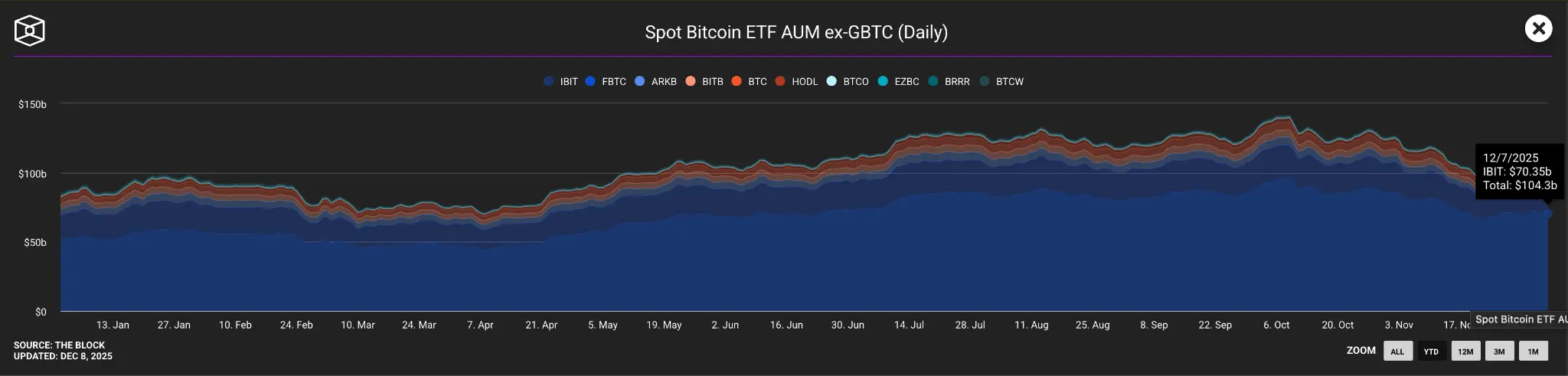
Bitcoin spot ETFs have become industry giants. BlackRock’s iShares Bitcoin Trust ETF (IBIT), with $72 billion in assets under management, leads the market, ranking as the 27th largest ETF in the US. Even more notable, IBIT’s market cap exceeds that of established precious metal funds like iShares Gold Trust (IAU) by $7 billion. Does this signal a shift in the times?
Overall, the total assets under management for Bitcoin-linked ETFs currently stand at $104 billion, having grown by $20 billion since 2025, a 23% increase. This growth rate far exceeds the average of traditional ETFs. Retail and institutional investors’ acceptance of Bitcoin continues to rise, signaling market maturity.
Three Major Implications of ETF Capital Inflows
Institutional Endorsement: Top asset managers like BlackRock and Fidelity are directly involved, providing credit backing for Bitcoin.
Liquidity Deepening: Hundreds of billions of dollars in capital pools make the Bitcoin market more stable, reducing extreme volatility.
Lower Entry Barriers: Traditional brokerage accounts can buy and sell, allowing conservative funds like pensions and retirement savings to participate.
The significance of IBIT surpassing gold ETFs is profound. Gold, as a store of value for thousands of years, took over a decade to reach its current ETF scale. Bitcoin ETF surpassing it in less than a year demonstrates the rapid acceptance of digital assets by a new generation of investors.
Bitcoin Engine Three: $Billions on Standby as 401k Policy Expected
The Trump administration is pushing to include digital assets in 401k retirement plans, which would be a huge boon for Bitcoin. Once the Department of Labor issues necessary guidelines, billions of dollars will flow into Bitcoin rapidly. The 401k plan is the primary retirement savings tool in the US, with a total scale exceeding $7 trillion by 2025. Even a 1% allocation to Bitcoin would generate an additional demand of $70 billion.
This policy’s far-reaching impact lies in changing the investor composition for Bitcoin. Historically, Bitcoin mainly attracted risk-tolerant investors and tech enthusiasts. With 401k access, conservative retirement savers will become new buyers, with investment horizons spanning decades rather than months, providing more stable long-term demand.
Amid ongoing uncertainty about Federal Reserve policies, investor focus on Bitcoin and gold has increased significantly. Mohamed A. El-Erian’s analysis of upcoming rate decisions shows that recent debates over Fed rate hikes continue to influence market sentiment. Concerns over Fed rate cuts and their potential impact on inflation also add context to this year’s asset allocation dynamics.
Dual Endorsement from Institutions and Retail Investors
The current rise of Bitcoin differs fundamentally from past cycles. The 2017 bull market was mainly driven by retail FOMO; the 2021 bull market saw participation from pioneer companies like Tesla and MicroStrategy; by 2025, a broad consensus among institutions and retail investors has formed. BlackRock and Fidelity represent traditional financial giants; DeFi protocols symbolize crypto-native innovation; and the inclusion in 401k policies signifies government regulatory approval—these forces create a rare aligned momentum.
This multi-faceted resonance strengthens Bitcoin’s support. Previously, retail-led markets were prone to panic selling; now, long-term institutional allocations and DeFi’s locking mechanisms significantly reduce circulating supply, increasing price stability. Surpassing $89,000 is not only a technical victory but also a reflection of comprehensive fundamental improvements.
Related Articles
BlackRock has net inflowed 17,642 BTC since February 24, approximately $1.28 billion.
Wintermute Analyst: Capital has begun a phased shift towards cryptocurrencies, and BTC outperforming US stocks may be due to capital rotation
In the past hour, the entire network has been liquidated by $113 million, with BTC liquidations reaching $76.74 million.
BTC short-term rises by 1.35%: Technical breakthroughs and short covering drive price surge