In recent months, the U.S. Securities and Exchange Commission (SEC) has, for the second time, issued a “no-action letter” to a decentralized physical infrastructure network (DePIN) crypto project, providing regulatory protection for its native token. The letter was sent to the Solana DePIN project Fuse, which issues the network token FUSE as a reward to active network maintainers, but does not sell it to the public.
SEC Issues Second DePIN Token Pass
(Source: SEC)
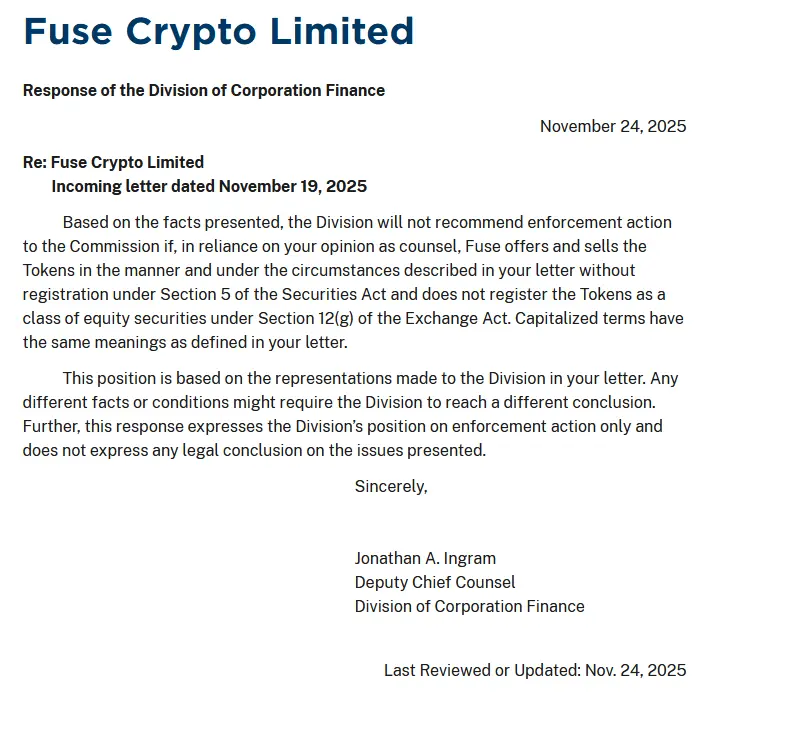
The SEC’s no-action letter was sent to the Solana DePIN project Fuse, which issues the network token FUSE as a reward to active network maintainers, but does not sell it to the public. Fuse initially submitted a letter to the SEC’s Division of Corporation Finance on November 19, requesting formal confirmation that if the project continued to provide and sell FUSE tokens, the SEC would not recommend enforcement action.
Fuse also made it clear in the letter that FUSE is designed for network utility and consumption rather than speculation. It can only be exchanged through third parties at the average market price. This design differentiates FUSE from typical speculative tokens, making it more of a functional network token rather than a security.
“Based on the facts presented, if Fuse adopts your legal counsel’s opinion and offers and sells tokens as described in your letter and under those circumstances, the Division would not recommend enforcement action to the Commission,” wrote Jonathan Ingram, Deputy Chief Legal Counsel of the Division of Corporation Finance, on Monday. Such explicit regulatory guidance is extremely rare in the crypto industry, providing valuable legal certainty for DePIN projects.
The SEC’s latest no-action letter comes just months after it issued a similar “much sought-after” letter to DoubleZero, seen as a result of a more crypto-friendly stance by the SEC’s new leadership. At the time, DoubleZero co-founder Austin Federa said such letters are common in traditional finance but are “extremely rare” in crypto.
“This was a months-long process, but we found the SEC to be very cooperative, very professional, and very diligent, with no hostility toward crypto.” This statement reveals a change in attitude at the SEC under new leadership. In the past, during Gary Gensler’s tenure as chairman, interactions between crypto projects and the SEC were often adversarial and uncertain. Now, projects can obtain clear regulatory guidance through formal procedures, which marks a significant step forward.
In April of this year, Paul Atkins was sworn in as the 34th Chairman of the SEC, ushering in new leadership for the Commission. Since then, the agency’s attitude toward crypto has become more balanced. Hester Peirce, a member of the leadership known for her crypto-friendly stance, also leads the SEC’s crypto working group. This change in leadership has created a favorable environment for DePIN projects to obtain no-action letters.
Why DePIN Projects Win SEC Favor
Rebecca Rettig, legal counsel for Solana MEV infrastructure platform Jito Labs, discussed on X that many crypto projects seek no-action letters (NALs). “Why do crypto teams need them? ‘Regulatory clarity.’ If you intend to issue a token, an NAL can reasonably assure you that you will not be immediately penalized for violating securities laws. It is a form of ‘regulatory protection,’” she wrote.
The value of a no-action letter lies in the legal certainty it provides. In the absence of clear regulatory guidance, crypto projects often face enforcement risks. Even if project teams believe their tokens are not securities, the SEC may later object and launch investigations. This uncertainty severely hampers project development, as investors, exchanges, and partners all keep their distance due to potential legal risks.
With a no-action letter, project teams can clearly state to the market, “We have SEC approval,” greatly improving the project’s credibility. Exchanges are more willing to list tokens with NALs, institutional investors are more likely to participate, and developers and users are more confident in using the network. The value of such regulatory clarity is hard to measure in monetary terms.
However, this no-action letter does not necessarily set any new precedent. Consensys attorney Bill Hughes commented on X on Monday that, given the nature of the FUSE token, this is a “simple case.” “The bottom line is, among crypto lawyers, not one would consider this token a security. Not even those only familiar with the Howey Test would think so,” Hughes said.
Key Features That Keep FUSE Token From Being a Security
Utility Design: Its purpose is for network utility and consumption, not speculation
No Public Sale: Only issued as rewards for network maintainers
Third-Party Exchange: Can only be exchanged through third parties at average market price
No Investment Contract: No expectation of profits based on the issuer’s future efforts
Hughes’ view reveals the fundamental reason why FUSE obtained the no-action letter. The token’s design avoids the core characteristics of a security, so the SEC’s recognition is more a confirmation of obvious facts than a groundbreaking policy move. However, even such a “simple case” would have struggled to get a formal no-action letter under previous SEC leadership, showing that the SEC under Paul Atkins has made substantive changes in attitude and process.
Crypto Industry Welcomes New Regulatory Climate in the Atkins Era
After many U.S. crypto founders, companies, and projects reported feeling hostility from the SEC under former chairman Gary Gensler, the latest interaction with Fuse shows the agency has thoroughly changed its approach. The Gensler-era SEC was known for “regulation through enforcement,” taking a hardline, litigation-first approach with crypto projects. Many legitimate crypto businesses found themselves mired in lengthy legal battles, incurring enormous time and financial costs even if they ultimately won.
The Atkins-era SEC shows a more collaborative and transparent attitude. Crypto projects can proactively consult with the SEC and obtain clear regulatory direction, rather than operating in fearful uncertainty. This change is reflected not only in the issuance of no-action letters, but also in the SEC withdrawing or settling multiple lawsuits against crypto companies, including heavyweight cases such as Coinbase, Ripple Labs, and Consensys.
In the same month that DoubleZero obtained a no-action letter, the SEC also issued a similar letter to non-bank-qualified crypto custodians. Though they still need to meet strict conditions, the no-action letter provides clear operational guidelines for such companies to handle crypto—something the industry has long pleaded for.
The cumulative effect of these no-action letters is changing the U.S. crypto regulatory landscape. As more projects receive SEC approval, a de facto “safe harbor” framework will emerge. Future DePIN projects can design their token economies based on the Fuse and DoubleZero models, greatly reducing regulatory risks. This demonstration effect will drive healthy development of the entire DePIN sector in the U.S.
More broadly, the SEC’s friendly stance toward DePIN projects may signal an openness to other types of functional tokens. If network utility tokens can gain approval, could gaming tokens, governance tokens, and social tokens also receive similar regulatory clarity? This is a question the entire crypto industry is watching closely.
Regulatory Advantages and Prospects for the DePIN Sector
DePIN (Decentralized Physical Infrastructure Networks) is becoming one of the most promising tracks in the crypto industry. These projects use token incentive mechanisms to mobilize global users to contribute physical resources (such as storage, computing power, network bandwidth, sensor data, etc.), building decentralized physical infrastructure. Unlike purely virtual crypto projects, DePIN projects are directly connected to the real world and create tangible economic value.
The SEC’s issuance of no-action letters to FUSE and DoubleZero shows that regulators recognize the innovative value of these projects. The functional features of DePIN tokens as network incentive tools make them easier to distinguish from investment securities. When a token’s main purpose is to participate in network operations and obtain services, rather than to profit from price appreciation, it is difficult to classify as a security.
This regulatory recognition clears obstacles for DePIN sector development. In the past, many DePIN projects operated outside the U.S. due to regulatory uncertainty. Now, with the SEC’s changing stance, the U.S. may become a friendly environment for DePIN projects. This will attract more capital, talent, and innovation to the sector, driving large-scale adoption of decentralized physical infrastructure.
From an investment perspective, DePIN projects with SEC no-action letters have lower regulatory risks and higher long-term certainty. As the second token to receive such recognition, FUSE may attract institutional investors who were previously deterred by regulatory concerns. This regulatory dividend will provide long-term support for FUSE’s price and ecosystem development.


