In November 2025, the US cryptocurrency market witnessed a historic moment—the first wave of altcoin ETFs was finally approved for listing, after nearly two years of successful operation of Bitcoin and Ethereum spot ETFs.
The four altcoin ETFs—Litecoin, XRP, Solana, and Dogecoin—faced drastically different fates. XRP and Solana together attracted over $1.3 billion in institutional funds, becoming the absolute winners in the market; meanwhile, Litecoin and Dogecoin suffered a complete cold shoulder, with their combined inflows totaling less than $8 million.
This report compares the performance of the four major altcoin ETFs, analyzes their market impact, and forecasts how subsequent ETFs may shape market trends.
Part One: The Two Extremes of the Four Major ETFs
XRP: The Biggest Winner Among Altcoin ETFs
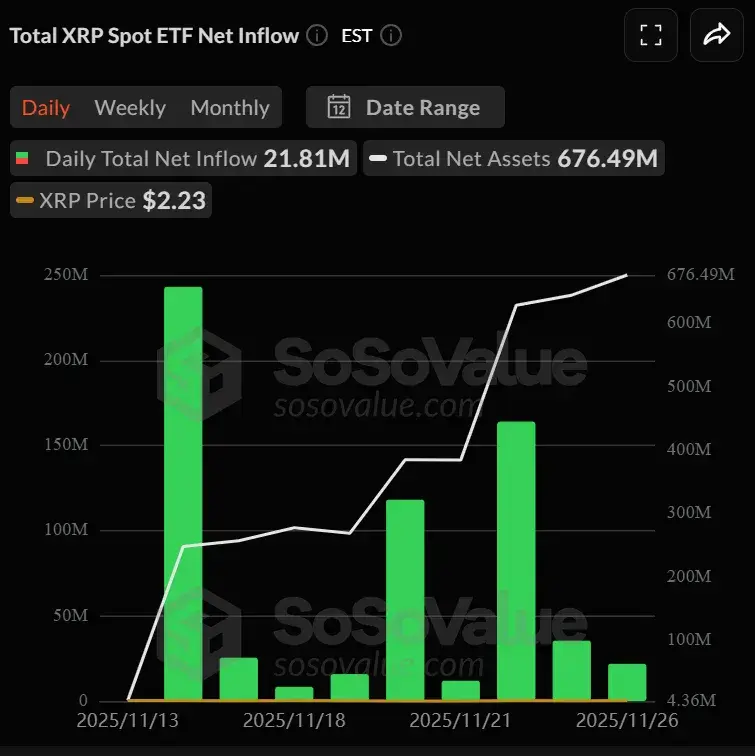
XRP was the undisputed winner in November. As of November 27, the six XRP ETFs had a total AUM of $676 million, maintaining a record of zero days of outflows since listing. On November 13, Canary Capital’s XRPC debut saw a net inflow of $245 million, making it the strongest ETF launch in 2025. Daily inflows then averaged $15-25 million, and on November 24, Grayscale and Franklin Templeton joined with another $164 million. More importantly, in the bleak November market, XRP’s price rose from $2.08 to $2.23, a 7.2% increase—making it the only altcoin to achieve positive growth.
XRP’s success comes down to three factors:
- Regulatory clarity is key: In August 2025, Ripple settled with the SEC for just $125 million, based on Judge Torres’s ruling that “secondary market XRP is not a security,” providing peace of mind for institutional investors.
- Utility narrative provides support: RippleNet’s partnership with over 200 financial institutions allows institutions to frame their investment as “financial infrastructure investment” rather than speculation.
- Fee competition creates an advantage: Franklin’s XRPZ is completely fee-free for the first $5 billion until May 2026, directly undercutting Grayscale’s 0.35% fee.
The ETF acts like an amplifier, converting these positives into actual institutional inflows.
Solana: $600 Million Inflows but a 29% Crash
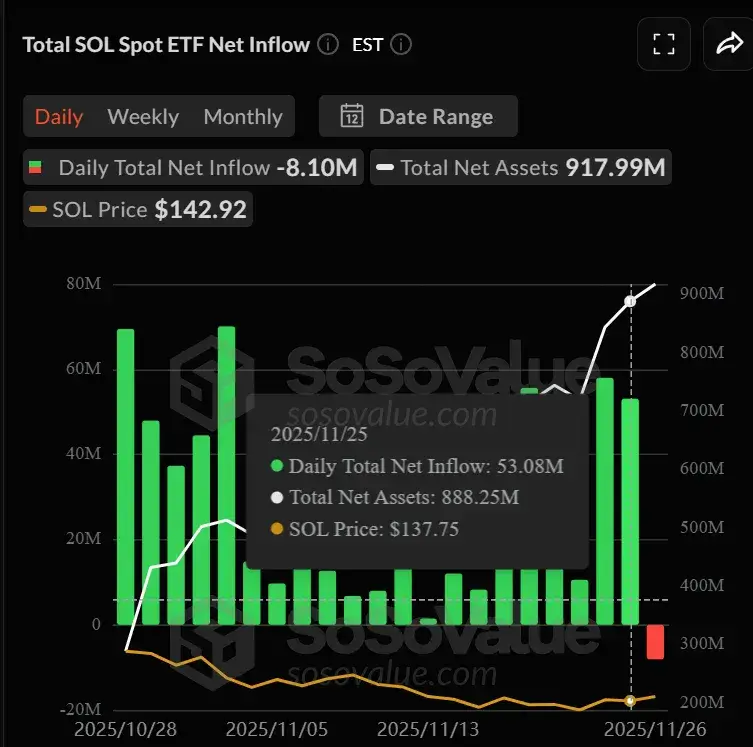
Solana’s six ETFs had a total AUM of $918 million, with cumulative net inflows of $613 million—on par with XRP. However, the price plunged from $195-205 to $142.92, a drop of 29.2%.
Systemic risk rendered ETF inflows powerless. On November 21, Bitcoin flash-crashed from $126,000 to $80,000, triggering $9 billion in on-chain liquidations, with Solana, as a high-risk altcoin, bearing the brunt. Daily ETF buying of $20-30 million was a drop in the ocean amid the selloff. A deeper issue lies in the ETF arbitrage mechanism: market makers hedge by selling SOL on the spot market, exacerbating the decline during downturns.
Yet Solana has a unique advantage: staking yields. All Solana ETFs offer 6-8% annualized yield from day one, with BSOL providing a net yield of about 7% after a 0.20% management fee—making it a “yield-generating ETF” that can still attract institutions despite price crashes.
Litecoin and Dogecoin: Abandoned by the Market

 The once “digital silver” Litecoin was abandoned by the market. LTCC’s total AUM was only $7.42 million, less than 3% of XRP’s first day, with just $267K in 24h trading volume. Lack of narrative (“faster Bitcoin” is outdated), fee disadvantage (0.95% is 2-3x that of BTC ETFs), and liquidity traps (low AUM widens spreads and deters institutions) are the main reasons for LTC’s lack of appeal.
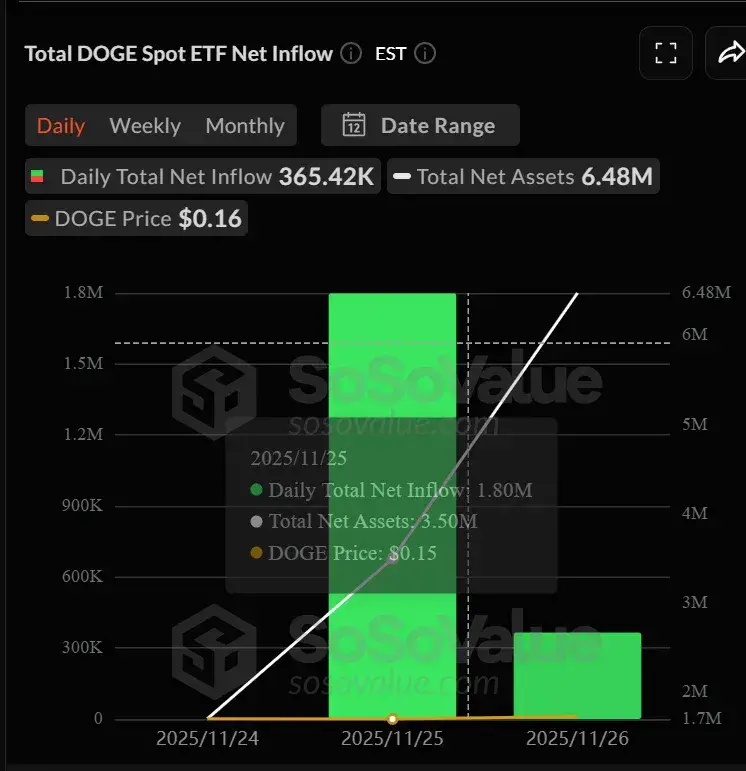
Dogecoin fared even worse. The three ETFs had total AUM of $6.48 million and net inflows of $2.2 million. Grayscale’s GDOG had first-day trading volume of only $1.4 million. The meme coin fundamentally conflicts with institutional demand: 3.3% annual inflation permanently dilutes, no supply cap/smart contracts/DeFi, and institutions can’t buy in just “because Elon likes it,” while whale selloffs from September to November further dampened sentiment.
Part Two: Born in the Storm
A Bleak November for Bitcoin and Ethereum ETFs
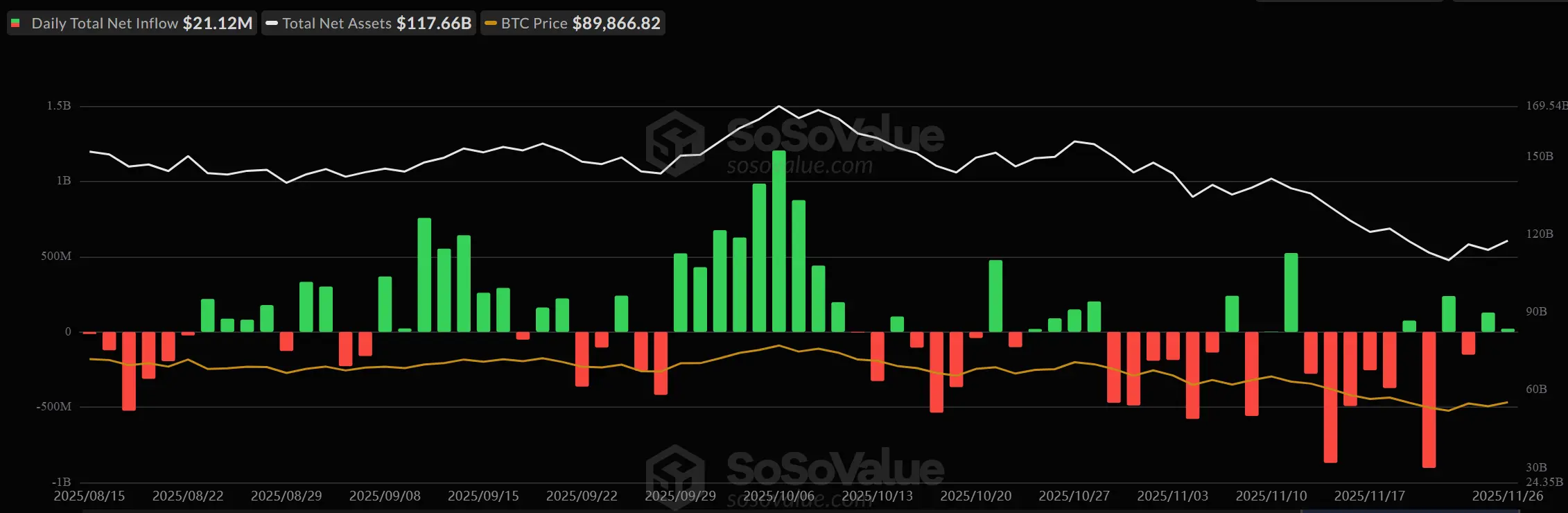
To understand the performance of the altcoin ETFs, we must view them within the broader market context. November 2025 was the worst month for Bitcoin and Ethereum ETFs since their launch in January 2024. The eleven spot Bitcoin ETFs saw cumulative net outflows of $3.5-3.79 billion in November, but even more alarming was the persistence of outflows: in 16 out of 20 trading days, there were net outflows, accounting for 80% of the time.
On November 21, the day Bitcoin crashed to $80,000, single-day outflows reached $903 million, the second-largest single-day outflow in Bitcoin ETF history. BlackRock’s IBIT, the largest and most institutionally favored Bitcoin ETF, was not spared. This product, once seen as a “perpetual motion machine,” saw $2.2 billion in outflows in November—a monthly record low since listing. Ethereum ETFs fared similarly poorly, with nine spot ETFs seeing about $500 million in outflows in November.
Combined, Bitcoin and Ethereum ETFs saw over $4 billion in outflows in November. This figure reflects a collapse of institutional investor confidence in the crypto market. When Bitcoin plunged from $126,000 to $80,000, hedge funds, family offices, and other institutions rushed to cut losses and exit, and the ETF’s easy redemption mechanism accelerated the process.
Two Parallel Worlds
Amid this devastation, altcoin ETFs attracted $1.3 billion in inflows. This contrast may seem paradoxical, but it actually reflects the existence of two parallel worlds.
First: The retreat of traditional financial institutions. The $4 billion outflow from Bitcoin and Ethereum ETFs was mainly from traditional financial institutions. These players entered en masse when BTC ETFs launched in early 2024, with Bitcoin at $40-50k. By November, when Bitcoin hit $126k, many institutions had 200-250% paper gains. The crash triggered their risk controls—when drawdowns exceed 20-30%, they’re forced to cut positions. In times of risk tightening, these institutions exit crypto entirely, rather than rotate into other assets.
Second: Crypto-native institutions moving in. The $1.3 billion inflow into altcoin ETFs likely came from a completely different investor group: crypto-native hedge funds, venture capital, and high-net-worth crypto believers, all with greater risk tolerance. For them, November’s crash was not a signal to retreat, but an opportunity to allocate to new products. More importantly, altcoin ETFs had just launched 2-3 weeks prior, and many institutions’ initial allocation orders were set months before listing, so they wouldn’t be canceled due to short-term volatility.
This market stratification explains a key phenomenon: Why did Solana ETFs still see about $12 million in inflows on November 21, the very day Bitcoin ETFs saw a single-day outflow of $903 million? Because the holders of the two ETFs are different investor groups, with distinct risk appetites, investment goals, and decision-making processes.
The Limits of the New Product Effect
This isn’t “capital rotating from Bitcoin to altcoins,” but more a “new product effect”—initial allocations from investors, market makers’ inventory needs, and media-driven retail interest, all natural phenomena when a new product launches.
The new product effect has a time limit. Solana ETFs saw their first outflows on November 26, breaking a 21-day streak of inflows. This turning point is significant—it marks the end of the “honeymoon period” for new products and the start of the “real market test.” Once initial allocations and market maker inventory are done and media buzz fades, ETFs must rely on the underlying asset’s fundamentals to attract capital.
This is also why Litecoin and Dogecoin performed so poorly. They too had the “new product” label, but even during the honeymoon period, attracted less than $8 million in inflows. This shows the new product effect has its limits—assets lacking strong narratives and utility can’t attract significant capital, even when packaged as ETFs.
Conclusion: Opportunities and Challenges of the Era
The launch of altcoin ETFs in November 2025 marks a new stage for the cryptocurrency market. It’s not just the introduction of a few new products, but a fundamental shift in market structure and participants. Institutional investors now have compliant, convenient tools to allocate to altcoins, and the bridge between traditional finance and crypto is being built at an accelerated pace.
In the ETF era, “brand recognition” and “historical status” are no longer sufficient to attract capital. Only assets with strong utility narratives, clear regulatory status, and active ecosystems can truly benefit from being ETF-ized.
By mid-2026, the US market may see 200-250 crypto ETFs trading. However, this does not mean all ETFs will succeed. As we saw with Litecoin and Dogecoin, assets without strong narratives and real utility will not thrive.
The ETF market will experience a survival-of-the-fittest process. The top 5-10 products will capture the majority of market share, enjoying economies of scale and network effects. There will be a middle tier of 20-30 products that barely sustain operations. But many tail-end products will be liquidated after a year or two of struggling. This process may be painful but is necessary—only through market competition can truly valuable assets be identified.


