Washington Launches 2026 Bank Reform, Vanguard Lifts Crypto Ban, Opens Spot ETF Trading to Approximately 50 Million Clients; US Bank Wealth Advisors to Recommend 1% to 4% Crypto Allocation Starting Early January. The FDIC Releases Proposed Rules on December 16 Under the GENIUS Act, Initiating the Stablecoin Issuance Process for Banks.
Vanguard and US Bank’s January Opening Effect
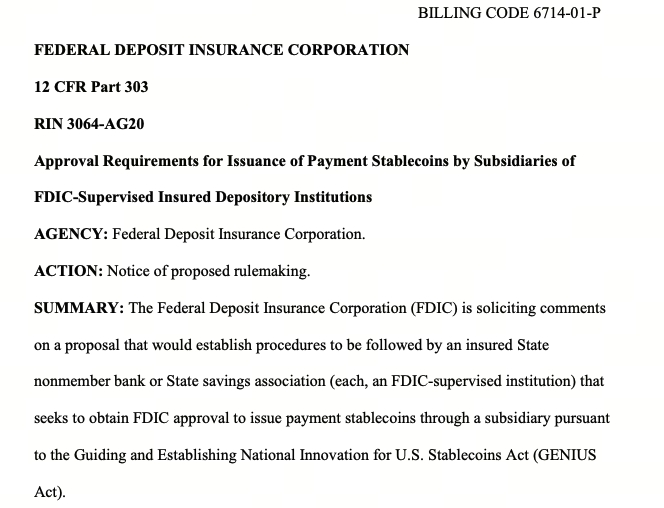
(Source: FDIC)
The policy shift by Vanguard is highly significant due to its large scale. This asset management firm, managing $11 trillion in assets, has long prohibited investments in crypto, with the CEO publicly stating “Bitcoin is not an investment.” However, in early December, the company changed its stance, allowing clients to trade third-party ETFs and mutual funds holding Bitcoin, Ethereum, and other digital assets.
Even though Vanguard refuses to launch its own crypto products, the approximately 50 million investors worldwide can access corresponding investment opportunities, demonstrating its substantial retail market coverage. Most of these clients are conservative, long-term investors whose decisions are based on asset allocation theory rather than short-term speculation. When such funds begin allocating to Bitcoin, it often signals that “smart money” considers the valuation attractive.
US Bank’s guidance operates differently but yields a similar outcome. Starting January 5, wealth advisors at Merrill Securities and Private Banking can proactively recommend crypto ETPs, not just execute client-initiated trades. This shift is extremely important—there is a huge difference between “passive execution” and “active recommendation.” When advisors actively recommend, it means crypto has been incorporated into standard asset allocation models.
The bank guides suitable clients to allocate 1% to 4% of their funds into major US bank Bitcoin ETFs. This conservative investment approach means hundreds of billions of dollars of wealth previously excluded are now potentially accessible. US Bank manages about $3 trillion in wealth management assets; if 10% of clients allocate 2% to Bitcoin, it could generate an additional demand of $6 billion.
Three Major Impacts of January Opening on Bitcoin
Unlocking New Capital Pools: Vanguard’s 50 million clients and US bank wealth management clients represent trillions of dollars in potential allocation funds.
Shift in Capital Nature: From leveraged speculative funds to retirement accounts and long-term holdings, with longer holding periods and less pressure to sell.
Seasonal Favorability Overlay: Historical data shows an average return of 15% in February, over 50% in the first quarter, resonating with the new pipeline opening.
This does not guarantee capital inflows. Model portfolio changes are slow, and compliance reviews will filter out the final investors. However, traditional retail investors can now invest in crypto through previously closed channels. The marginal buyers at the start of 2026 seem less like leveraged crypto funds and more like retirement accounts, increasing Bitcoin holdings by 2%.
A New Era of Bank Stablecoins Under the GENIUS Act
The rulemaking scope released on December 16 is narrow. It establishes application procedures for state banks supervised by the FDIC to issue “payment stablecoins” through their subsidiaries under the GENIUS Act. This structural shift could reshape the USD-based payment system on public blockchains later in 2026.
GENIUS defines payment stablecoins as digital assets used for payments, with issuers required to redeem at a fixed monetary value. The act mandates that payment stablecoins be backed 1:1 by high-quality reserves, with detailed public disclosures and monthly reports prepared by accountants. Rehypothecation is generally prohibited, except in special cases. Key elements include customized applications based on statutory factors: reserve maintenance, capital and liquidity, risk management, governance, and redemption policies.
The timing explains why this is not a primary driver in the first quarter. The proposed rulemaking notice (NPRM) opens a 60-day comment period, and the GENIUS system itself will not activate until January 18, 2027, or 120 days after the final implementation rules are published, whichever comes first. Even in the most optimistic scenario, the earliest realistic window for FDIC-regulated US bank subsidiaries to deploy on-chain USD is late 2026.
Bank-issued stablecoins will ultimately reshape liquidity. The GENIUS framework indicates that federally insured bank subsidiaries issuing USD tokens on public chains under unified federal rules will dominate. Even a few large banks adopting this approach can provide low-cost, programmable USD liquidity for Bitcoin trading. Stablecoins issued by bank subsidiaries can serve as collateral or settlement assets for ETF market makers and prime brokers, narrowing spreads and deepening derivatives markets.
The current landscape of offshore-dominated stablecoins versus the world of federally regulated on-chain USD issued by major US banks changes who trusts these tokens, who can hold them in custodial accounts, and what these tokens can do within institutional workflows.
First Quarter Buying Sources and Seasonal Adjustment Factors
The first quarter situation is much simpler than at the end of 2026. Vanguard’s 50 million clients and US bank wealth advisors represent dull but straightforward math: how many accounts increase their Bitcoin holdings by 1% to 2%, and how much capital flows? Seasonal patterns suggest that February and March typically trend upward. Historical data shows that since 2013, Bitcoin’s average return in February is around 15%, with the first quarter averaging over 50%.
However, 2025 broke this pattern, with Bitcoin declining 12% in the first quarter, marking the worst first quarter in a decade. The difference this time is that market positioning appears clearer, and sellers’ targets have been lowered. Standard Chartered significantly cut its end-of-2025 target from $200,000 to about $100,000, and its 2026 target from $300,000 to $150,000.
The next quarter will test whether distribution expansion and seasonal factors can stabilize Bitcoin after the turbulence at the end of 2025. Bitcoin’s success depends less on headlines and more on how many Vanguard clients click “Buy” in February, and whether the banks capable of issuing compliant GENIUS-standard stablecoins actually decide to issue.
Disclaimer: The information on this page may come from third parties and does not represent the views or opinions of Gate. The content displayed on this page is for reference only and does not constitute any financial, investment, or legal advice. Gate does not guarantee the accuracy or completeness of the information and shall not be liable for any losses arising from the use of this information. Virtual asset investments carry high risks and are subject to significant price volatility. You may lose all of your invested principal. Please fully understand the relevant risks and make prudent decisions based on your own financial situation and risk tolerance. For details, please refer to
Disclaimer.
Related Articles
Ethereum Foundation Offloads $10.2M ETH to BitMine in OTC Deal
The Ethereum Foundation has completed a direct OTC sale of 5,000 Ether to BitMine Immersion Technologies, a move valued at about $10.2 million at the agreed price of $2,042.96 per ETH. The deal was announced in a Saturday post on X, with proceeds earmarked to support the foundation’s core
CryptoBreaking53m ago
SEC and CFTC Reach New 2026 Cryptocurrency Regulatory Agreement to Jointly Clarify Market Rules
The U.S. SEC and CFTC signed a memorandum of understanding on March 11, planning to jointly coordinate cryptocurrency regulation by 2026, covering six priority areas to mitigate jurisdictional conflicts between the two agencies, providing a clearer market environment and compliance guidance.
GateNews1h ago
A Certain CEX's 24-Hour Trading Volume Reaches $1.369 Billion, XRP, BTC, ETH Rank in Top Three
According to CoinGecko data, on March 16, a certain CEX's trading volume reached $1.369 billion, up 72.28% from the previous day. The top five tokens by trading volume are XRP, BTC, ETH, TRUMP, and DKA.
GateNews1h ago
BlackRock Attracts $600 Million in Bitcoin ETF Inflows, ETH and SOL Rally in Tandem, XRP Under Pressure Against the Trend
This week, Bitcoin spot ETF net inflows were significant, with BlackRock's IBIT absorbing $600.1 million and solidifying its leading position, while Grayscale's GBTC saw outflows of $25.9 million. Meanwhile, Ethereum and Solana ETFs also performed well, but XRP ETF experienced capital outflows of $28.07 million. Analysis suggests that current capital flows indicate institutional demand for safe-haven positioning in mainstream crypto assets, while the cautious stance toward XRP may influence market trends.
GateNews1h ago
ETH Short-term Decline of 0.74%: Institutional Rebalancing and Short-term Profit-Taking Drive Selling Pressure
On March 16, 2026, from 06:00 to 06:15 (UTC), ETH experienced significant volatility within a 15-minute period, with a return of -0.74%. The price fluctuated between 2260.98 and 2281.3 USDT, with an amplitude of 0.89%. During this time, trading volume noticeably increased compared to the previous cycle, market volatility intensified, and community attention was drawn.
The main drivers of this volatility were large on-chain ETH transfers and substantial sell orders on the exchange, suspected to be institutional or whale portfolio rebalancing activities during this window, which directly led to short-term downward pressure on the price. Simultaneously, order book depth decreased, buy-side support diminished, and large individual trades further contributed to the market instability.
GateNews2h ago


