In the crypto world, the true determinants of victory or defeat have never been code, but rather the game between liquidity, power, and regulation. The rise and fall of BUSD is not just a tragic story of a stablecoin, but a financial war over how exchanges attempt to “unify the world.”
When BUSD was brought onto the stage of history, it carried not only a compliance narrative but also Binance’s ambition to reshape the stablecoin order through high-pressure tactics—by enforcing exchange rates and merging trading pairs, directly swallowing competitors’ depth into its own ledger.
The 2022 “Automatic Conversion” was a textbook-level lightning strike; meanwhile, the regulatory iron fist on Valentine’s Day 2023 caused this seemingly invincible empire to collapse instantly. The twin BUSD, the shadow-like Binance-Peg, and the misalignment of regulatory boundaries together form its Achilles’ heel.
But the story is not over.
From FDUSD to BFUSD, and then to United Stables ($U), Binance has not abandoned stablecoins. Instead, it has evolved from hegemonic unification to an aggregation-based swallowing approach, even paving the way for the AI economy in advance.
This is an article about stablecoins, and more a business war record of how exchange power attempts to tame the market and is countered by regulation.
Chapter 1: Passion and Hegemony—The “Great Unification” of BUSD
The story of BUSD is not just about the rise and fall of a compliant product, but also about the “imperial art” of how exchanges try to unify market liquidity through administrative means.
1.1 Recognized in Micro: CZ and Richmond Teo’s Dinner
In 2019, the stablecoin market was a wild west dominated by Tether. At that time, Richmond Teo, as co-founder and Asia CEO of Paxos, became a key bridge connecting New York regulators and Asian crypto giants.
There was a widely circulated but somewhat dubious rumor: shortly after Paxos published a blog post celebrating its compliance status before BUSD’s launch, Teo and CZ were spotted having dinner at an upscale restaurant overseas. After that dinner, the situation changed dramatically: HUSD from Huobi gradually lost favor, and Paxos established itself as the full-time custodian of BUSD. CZ handed Binance’s liquidity backing over to Teo, who used the NYDFS “Green List” license to armor Binance.
1.2 Passionate Moment: The 2022 “Exchange Rate Unification Blitz”
The most “passionate” and controversial moment in BUSD history occurred in September 2022. To challenge the dominance of USDT and USDC, Binance launched a jaw-dropping “liquidity unification” campaign.
Binance announced that existing user balances and new deposits of USDC, USDP (Paxos Dollar), and TUSD (TrueUSD) would be automatically converted 1:1 into BUSD.
Binance directly removed spot trading pairs for USDC, USDP, and TUSD. This meant that on Binance, the world’s largest liquidity pool, users could deposit USDC but only see and use BUSD on the books. (However, withdrawals could still be made in USDT, USDC))
This was a naked daylight plot. By forcibly merging liquidity, BUSD instantly gained trading depth that originally belonged to competitors. Circle (USDC issuer) CEO Jeremy Allaire claimed on Twitter that this helped increase dollar liquidity, but in reality, USDC’s brand presence in the Binance ecosystem was forcibly erased, becoming just “fuel” for BUSD.
This aggressive strategy proved effective. BUSD’s market cap soared to a historic peak of $23 billion in November 2022, once accounting for half of the trading volume on centralized exchanges. That was BUSD’s most glorious moment and the peak of Binance’s ambition to establish an independent financial closed loop.
1.3 The “Valentine’s Day Massacre” of Regulation
However, this “great unification” came to an abrupt end on February 13, 2023. The NYDFS pointed out that Binance-issued “Binance-Peg BUSD” (a shadow version issued for use on BNB Chain) exceeded Paxos’s regulatory scope and ordered a halt to minting. BUSD’s market cap plummeted from its peak of $23 billion to zero, and the empire built through “automatic conversion” collapsed under regulatory iron fists.
For Teo, this was undoubtedly a heavy blow. As the architect, he watched helplessly as the “child” he and CZ raised together was forcibly euthanized. Paxos was forced to sever ties with Binance, and Teo entered a low-profile period lasting over a year.
But the story is not over. Teo’s high-profile comeback in the Trump family’s crypto project World Liberty Financial (WLFI) is seen as a continuation of his story with CZ. Teo is leveraging new political capital to build a new compliant stablecoin (USD1), which heavily depends on BNB Chain liquidity. It seems that the two old friends are continuing their “liquidity alliance” in regulatory cracks through a more subtle and roundabout way.
Chapter 2: Achilles’ Heel—“Twins” and the Thunder of Regulation
2.1 Deadly Structural Flaw: Binance-Peg BUSD
Behind BUSD’s glory lies a structural hidden danger that ultimately led to its destruction. In fact, there are two completely different forms of BUSD circulating in the market:
- Paxos-issued BUSD (ERC-20): The true “compliant BUSD,” issued by Paxos on Ethereum, directly regulated by NYDFS, with reserves strictly stored in US segregated accounts.
- Binance-Peg BUSD (BEP-20, etc.): A “wrapped token” created by Binance to expand its ecosystem to non-Ethereum chains like BNB Chain, Polygon, Avalanche.
Theoretically, Binance-Peg BUSD’s mechanism is: Binance locks 1 Paxos BUSD on Ethereum, then mints 1 Binance-Peg BUSD on BNB Chain. But this “bridging” mechanism relies entirely on Binance’s internal operations, not Paxos’s direct management. NYDFS’s regulatory authority and “Green List” only cover Paxos BUSD on Ethereum, not Binance-Peg BUSD.
The problem erupts from the disconnection in reserve management. Investigations by Bloomberg and others revealed that during certain periods in 2020-2021, wallets supporting Binance-Peg BUSD showed severe “under-collateralization,” with a shortfall reaching up to $1 billion. Although Binance claimed this was merely “operational delay” rather than insolvency, it directly violated regulators’ bottom line: a stablecoin claiming NYDFS regulation but generating an unregulated “shadow version” with chaotic reserve management.
2.2 The Iron Fist of Regulation: The 2023 “Valentine’s Day Massacre”
BUSD’s fate ended abruptly on February 13, 2023. On that day, the New York State Department of Financial Services (NYDFS) issued an administrative order requiring Paxos to immediately cease minting new BUSD tokens.
The regulator’s reasoning was very clear and deadly: Paxos failed to effectively supervise its relationship with Binance, especially regarding the issuance of Binance-Peg BUSD, which made compliant BUSD serve as an endorsement tool for unapproved derivatives. NYDFS explicitly stated: “While we authorized BUSD on Ethereum, we never authorized Binance-Peg BUSD.”
Meanwhile, the U.S. Securities and Exchange Commission (SEC) issued a Wells Notice to Paxos, accusing BUSD of being an “unregistered security.” The logic was that BUSD is not just a payment tool but part of Binance’s profit mechanism (through Earn and other products), potentially constituting an investment contract. Although the SEC later abandoned this investigation in July 2024, the dual blow at that time was already fatal.
2.3 Fall and Retreat
“Ceasing minting” meant BUSD became a “zombie token” that could only be redeemed, not issued anew. For an asset intended as a liquidity medium, this was a death sentence. As Paxos announced the termination of its partnership with Binance, BUSD’s market cap began a free fall. Within days, hundreds of millions of dollars flowed out; within a year, its market cap shrank by over 90%.
Binance was forced into a painful retreat:
- Remove trading pairs: gradually delist BUSD spot and leverage trading pairs.
- Stop using BUSD as collateral: announced that BUSD would no longer serve as margin for contracts.
- Forced conversions: urged users to convert BUSD into other stablecoins (like FDUSD).
The once “passionate” stablecoin empire collapsed under the iron fist of regulation. Binance lost a stablecoin ace and was forced to rethink its stablecoin strategy.
Chapter 3: Transition in the Vacuum Period and the Rise of FDUSD, BFUSD
In the early days after BUSD’s fall, Binance was reluctant to lose its “own stablecoin” revenue, questioning why it should hand this profit to others. To fill the gap, Binance quickly supported First Digital USD (FDUSD), a stablecoin issued by Hong Kong’s First Digital Labs.
Binance’s support for FDUSD largely replicated its previous strategy with BUSD:
- Launching zero-fee trading pairs for FDUSD.
- Offering 1:1 lossless conversion from BUSD to FDUSD.
- Adding FDUSD as a mining option in Launchpool.
However, FDUSD is more like a strategic buffer. It solves the compliance location shift (from the US to Hong Kong), but remains a traditional, centralized stablecoin issued by a third party. It does not address the core issue: if regulators target the issuer again, Binance remains passive. Moreover, in an environment with up to 5% USD interest rates, FDUSD (and USDT/USDC) mode involves the issuer earning all interest, while users gain nothing. This is outdated in the DeFi era.
The era of new stablecoins has also passed. FDUSD’s main use case was participating in Launchpool, but as Launchpool activities declined sharply, its utility diminished. Plus, the scandal exposed by Justin Sun in April 2025 further challenged FDUSD’s growth.
To counter competitors’ “contract holding yield” features, Binance introduced BFUSD (Binance Futures USD).
Binance repeatedly emphasizes that BFUSD is a “reward-based margin asset,” not a true stablecoin.
Holders of BFUSD can earn 4-5% APY. The yield comes from a “Delta hedging” strategy.
BFUSD cannot be withdrawn; it can only serve as margin in Binance futures accounts. It is Binance’s “internal circulation” weapon, ensuring users do not withdraw funds even in bear markets, acting as an asset appreciation financial product disguised as a “stablecoin.” Although BFUSD has achieved good results (currently with an issuance of 1.8 billion), Binance knows it cannot leave the stablecoin within the exchange—only a “joy bean.”
Chapter 4: United Stables ($U) — The “Surprise” and New Pattern
If BUSD is “exclusive” hegemony, and BFUSD is “internal” defense, then the latest release United Stables ($U) brings a completely different surprise: “compatibility” and “future.”
4.1 No Longer “Creating Wheels,” But “Swallowing Wheels”
Unlike during BUSD’s era, which aimed to eliminate USDC, $U adopts a “meta-stablecoin” (Meta-Stablecoin) strategy.
$U is backed by a basket of assets. According to the December 18, 2025 announcement, its reserves include USDT, USDC, and USD1.
Continuing BUSD’s big unification strategy, whether you hold USDC, USDT, USD1, or USD, all become $U ’s underlying assets, but externally presented as U. By absorbing USDT and USDC with fragmented liquidity into $U ’s reserve pool, United Stables attempts to “unify” these assets on BNB Chain via an algorithm, issuing the most liquid $U, more akin to curveUSD. U is the unified name for these stablecoins, but users can choose other stablecoins when withdrawing/redeeming.
This is a higher-dimensional attack—since I issue dollars you dare not use, I will bundle the dollars you dare to use into my tokens.
4.2 Surprise Two: The Hidden Signal, Trump’s Concept Coin USD1 Enters
United Stables’ strategic surprise is that it has included USD1 into its reserves. (This is a stablecoin issued by Trump family’s crypto project World Liberty Financial (WLFI), whose stablecoin head is none other than BUSD’s old architect Richmond Teo. Is there a connection?)
After all, USD1 is several levels below USDC and USDT in size, and this support looks more like a political token pledge from the outside. It is foreseeable that United Stables provides huge usage scenarios for USD1 (as $U ’s underlying), though currently USD1’s use cases are still limited.
4.3 Surprise Three: The Currency Born for AI (The AI Economy)
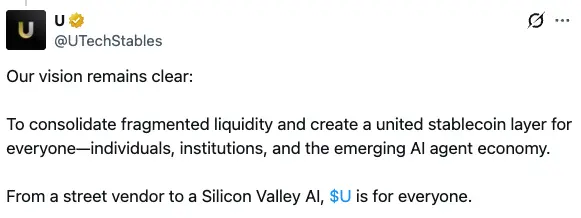
United Stables explicitly states that $U is “designed for the AI economy.”
As per United Stables’ tweet
EIP-3009 (Gasless Authorization): Allows “Gasless transfers.” This means future AI agents (Bots) can perform high-frequency micro-payments without holding BNB or ETH for fees. This solves the biggest pain point in machine-to-machine (M2M) economy.
x402 Delegated Execution: A standard allowing smart contracts to automatically execute fund transfers based on specific conditions. Paving the way for future “autonomous hedge funds” or “supply chain automatic payments AI.”
As of press time: U already has 55 million in circulation—thick accumulation or just a passing cloud?
https://x.com/UTechStables/status/2001667382444482708?s=20
###Epilogue: How Far Has the Journey from “Domination” to “Great Unity” Been?
Reviewing the evolution from BUSD to United Stables, we see a remarkable strategic evolution:
BUSD era (domination): Using exchange monopoly to forcibly eliminate competitors through “automatic conversion,” pursuing absolute market share. Although passionate, this approach is also prone to joint counterattacks from regulators and competitors.
United Stables era (great unity): Learning lessons, shifting to an “aggregation” strategy. Acknowledging USDT/USDC’s status but using $U to treat them as underlying assets, building “super applications” on top.
Preemptively deploying AI payments, jumping out of the current human trader’s game, and seizing the incremental market of future machine economies.
$U is not just a new aggregated stable token but an attempt by BUSD to redefine the stablecoin game rules with more sophisticated, more technically forward-looking methods after being beaten down by regulation. Risks and opportunities coexist—let’s wait and see!


