According to Token Terminal, stablecoin transfer volume on the Ethereum network has surpassed $8 trillion in Q4/2025, setting a new all-time high. This figure is nearly double that of Q2, when transfer volume was just over $4 trillion.
Stablecoin issuance on Ethereum also increased by approximately 43% in 2025, from $127 billion to $181 billion by the end of the year.
“This is not speculation; this is global payments happening directly on the blockchain. And this is occurring before full integration of SWIFT, complete RWA tokenization, and infrastructure for institutional adoption come into operation. The infrastructure is ready; only users need to catch up.” A user on X commented.
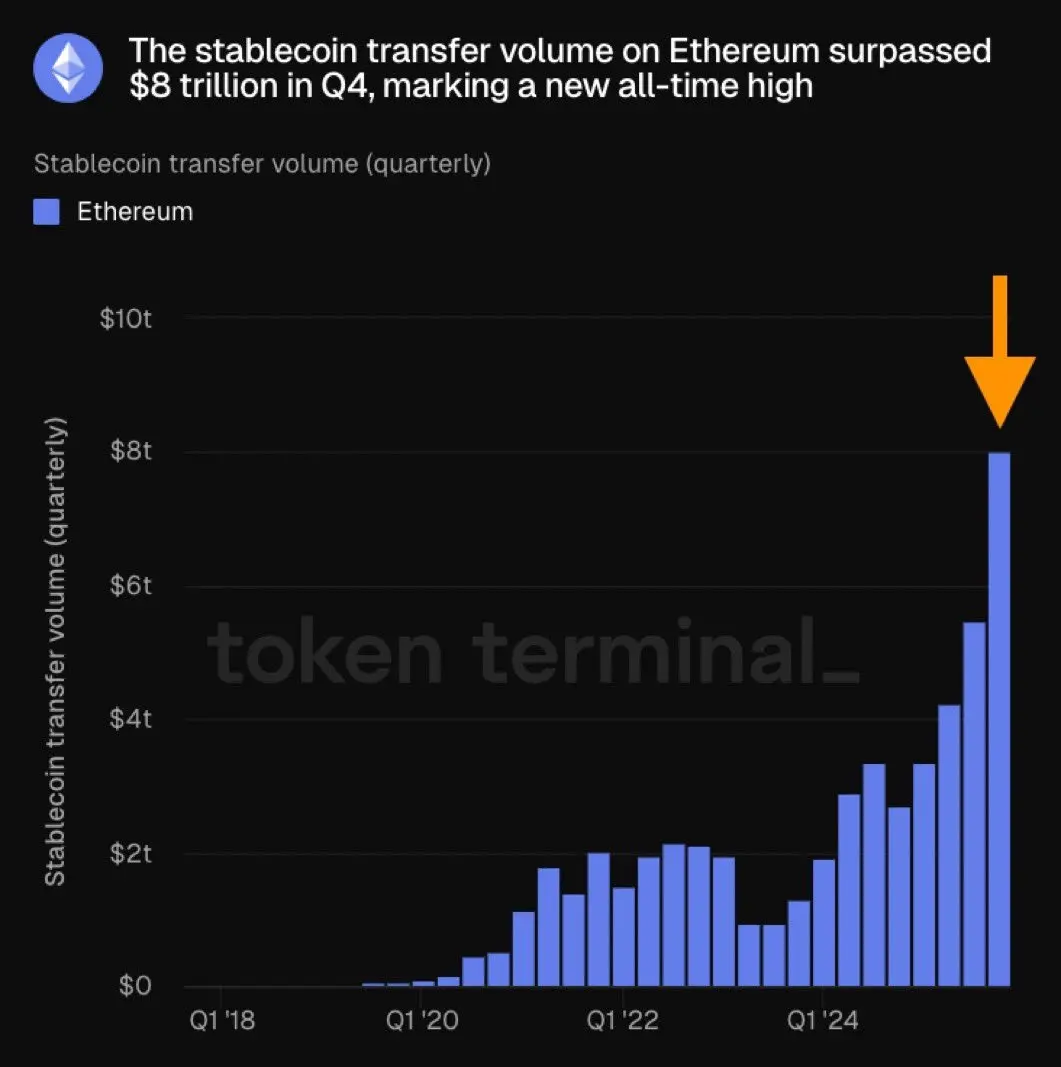 Stablecoin transaction volume on Ethereum surged in Q4 | Source: Token Terminal## Ethereum transaction and address peaks
The milestone in stablecoin transfer volume coincided with a record high in daily transaction volume on the Ethereum network, reaching 2.23 million transactions at the end of December 2025, a 48% increase compared to the same period last year, according to Etherscan.
Token Terminal reports that the number of active addresses on Ethereum also hit an all-time high of 10.4 million addresses in December. Additionally, the number of unique addresses participating in sending or receiving transactions daily exceeded 1 million by the end of December.
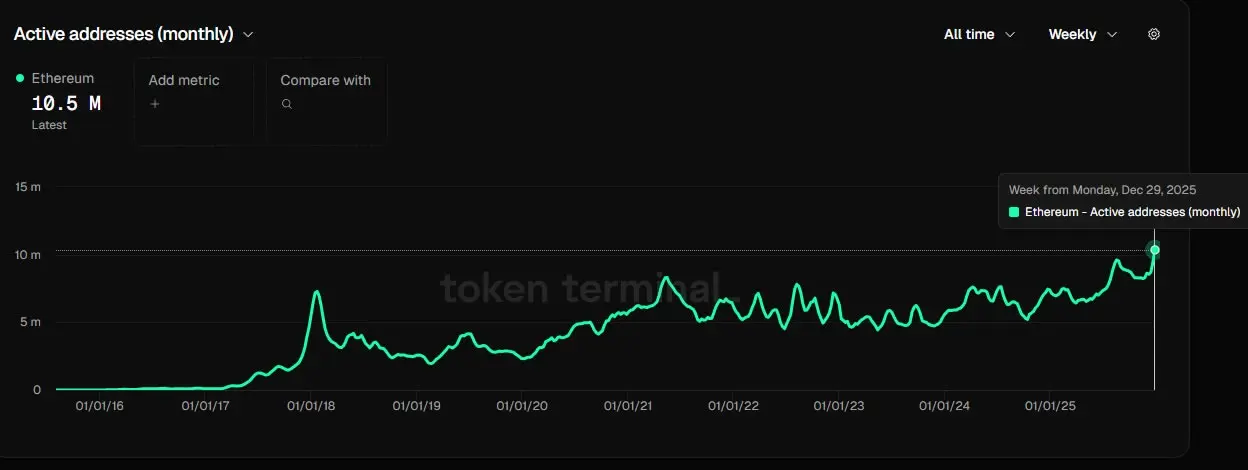 Monthly active IP addresses peaked in December | Source: Token Terminal## Ethereum continues to dominate RWA tokenization
Ethereum remains the primary layer for stablecoin and real-world asset (RWA) tokenization, accounting for about 65% of RWA value on-chain, equivalent to $19 billion, according to RWA.xyz. When including layer-2 networks and EVM-compatible chains, this figure exceeds 70%.
Currently, Ethereum accounts for 57% of total stablecoin issuance, with Tron in second place at 27%. Tether (USDT) remains the leading issuer with $187 billion, representing 60% of the total stablecoin market, with more than half of that on Ethereum.
Ethereum has successfully solved the “Impossible Trinity” of blockchain
Vitalik Buterin, co-founder of Ethereum, believes the network has “solved” one of the most challenging problems in crypto: the blockchain trilemma.
Buterin emphasizes the role of two key upgrades: Peer Data Availability Sampling (PeerDAS) and Zero-Knowledge Ethereum Virtual Machines (ZK-EVM), claiming they are transforming Ethereum into “a completely new and more powerful decentralized network.”
He states that with PeerDAS (to be deployed in 2025) and ZK-EVM (expected to be partially operational from 2026), Ethereum can simultaneously achieve decentralization, consensus, and high throughput. “The trilemma has been solved—not just in theory, but with actual running code,” Buterin affirms.
PeerDAS is an enhancement that expands data processing capacity, introduced in the Fusaka upgrade in December, enabling Ethereum to handle significantly larger data volumes.
Meanwhile, ZK-EVM are virtual machines compatible with both zero-knowledge proofs and the current Ethereum Virtual Machine. This technology has existed for some time, but according to Buterin, it is still in “alpha” stage: performance is ready, but security needs further refinement.
He outlines a roughly four-year roadmap for full deployment of ZK-EVM in Ethereum. Once achieved, the vision of “completely solving the trilemma” will be officially realized.
Buterin highlights key development milestones:
– 2026: Significantly increase gas limits independent of ZK-EVM through BALs and ePBS; initial opportunities to run ZK-EVM nodes emerge.
– 2026–2028: Adjust gas pricing, state structure, incorporate execution payloads into blobs, and other technical changes to ensure safety when raising gas limits.
– 2027–2030: Continue increasing gas limits as ZK-EVM becomes the primary method for block validation on the network.
What is the blockchain trilemma?
The blockchain (trilemma) is a concept introduced by Vitalik Buterin to describe the challenge of building a blockchain: a network cannot simultaneously optimize the following three factors without trade-offs:
- Decentralization (Decentralization):
– All users can participate in the network; no single organization or individual has complete control.
– Example: Bitcoin is highly decentralized because anyone can run a node and validate transactions.
2. Security (Security):
– The network resists attacks, fraud, and software bugs.
– Example: Bitcoin is very secure due to its robust proof-of-work mechanism.
3. Scalability (Scalability):
– The network can process many transactions simultaneously without slowdowns or congestion.
– Example: Visa or PayPal handle thousands of transactions per second, but older blockchains like Bitcoin only process a few transactions per second.
The issue:
Most blockchains can only optimize two of these three factors at once. For example:
- Bitcoin: highly decentralized + secure → but slow and hard to scale.
- Some fast blockchains: process many transactions per second → but are less decentralized and less secure.
Ethereum now aims to address the trilemma using technologies like PeerDAS (to increase scalability while maintaining decentralization) and ZK-EVM (to ensure security and scalability).
Disclaimer: The information on this page may come from third parties and does not represent the views or opinions of Gate. The content displayed on this page is for reference only and does not constitute any financial, investment, or legal advice. Gate does not guarantee the accuracy or completeness of the information and shall not be liable for any losses arising from the use of this information. Virtual asset investments carry high risks and are subject to significant price volatility. You may lose all of your invested principal. Please fully understand the relevant risks and make prudent decisions based on your own financial situation and risk tolerance. For details, please refer to
Disclaimer.


