Tether, the issuer of the world’s largest stablecoin USDT, generated an estimated $13 billion in profit in 2024, largely driven by interest income from U.S. Treasury holdings.
As global interest rates peaked, the company quietly became one of the most profitable entities in the digital asset industry. Rather than distributing those earnings, Tether has begun deploying billions of dollars into artificial intelligence infrastructure, positioning itself as a significant capital allocator in the emerging AI economy ahead of 2026.
How Tether Generated $13 Billion in Annual Profit
Tether’s profit engine is rooted in a straightforward but highly scalable model. USDT users deposit fiat currency, which Tether invests primarily in short-term U.S. Treasuries and cash-equivalent assets. Unlike banks or money market funds, Tether does not pay interest to users, allowing it to retain nearly all yield generated by its reserves.
By the end of 2024, Tether reported more than $130 billion in assets backing USDT, according to its quarterly attestations. With benchmark interest rates elevated, Treasury yields alone produced an estimated $13 billion in annual income. Public disclosures indicate that Tether operates with roughly 100 to 150 employees, resulting in one of the highest profit-per-employee ratios in the global financial sector.
For comparison, major AI developers such as OpenAI and Anthropic reported multi-billion-dollar revenues in 2024 but continued to post large net losses due to infrastructure and research costs. Tether’s low operating expenses allowed it to convert macroeconomic conditions directly into profit.
(Sources: Tether Website)
Redirecting Stablecoin Profits Into Artificial Intelligence
Beginning in 2024 and accelerating into 2025, Tether began allocating capital into AI-related ventures. Public records, company statements, and industry disclosures suggest total AI-related investments approaching $2 billion, with the potential to exceed $3 billion if pending transactions close.
Key areas of investment include compute infrastructure, data resources, and neural interface technology. Tether extended a loan of approximately $600 million to Northern Data, a European-based GPU cloud provider operating large-scale Nvidia H100 clusters used for AI training. Northern Data has ranked among the top global high-performance computing operators, placing Tether indirectly at the core of AI compute supply.
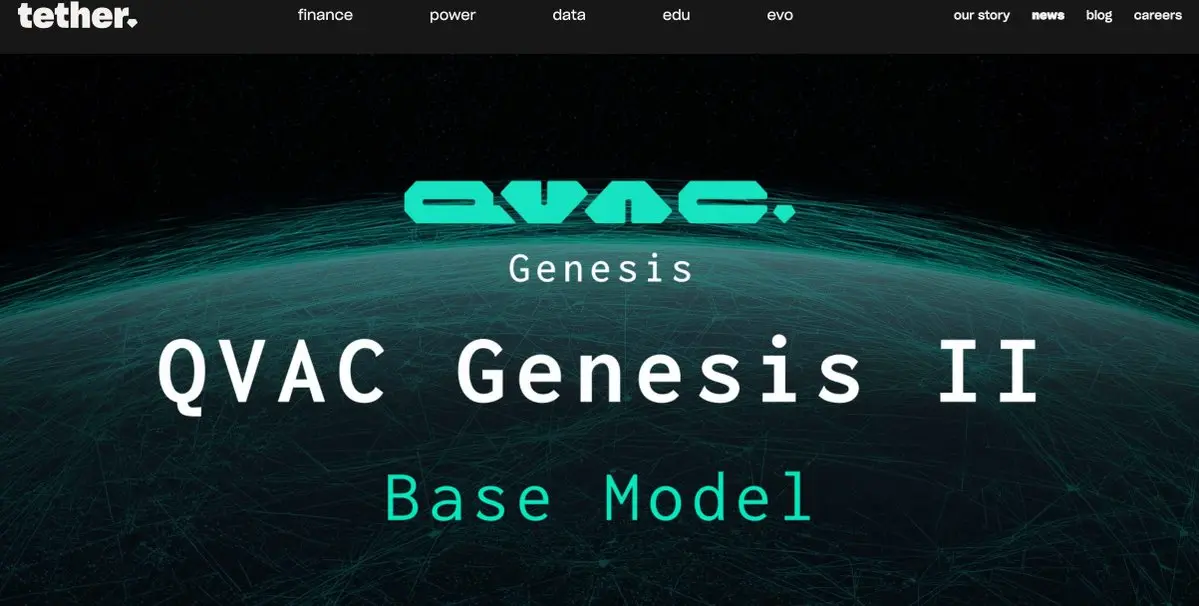
In parallel, Tether-backed entities released the QVAC Genesis II dataset, described as one of the largest open datasets designed for training advanced AI models across scientific and technical disciplines. The dataset spans mathematics, physics, chemistry, and computer science, reflecting a focus on foundational AI capabilities rather than consumer applications.
Tether also acquired a controlling stake in Blackrock Neurotech for roughly $200 million. The company is a long-standing developer of brain-computer interface technology and has been involved in the majority of implanted neural interface trials worldwide. This move places Tether in the emerging neurotechnology sector, an area attracting growing interest from governments and defense researchers.
Strategic Logic Behind Tether’s AI Expansion
Industry analysts note that Tether’s AI investments differ from those of traditional venture capital firms. Rather than funding early-stage applications, Tether has concentrated on infrastructure layers such as compute, data, and hardware. This mirrors its position in crypto markets, where USDT functions as a base-layer liquidity instrument rather than a consumer-facing product.
By reinvesting Treasury-derived profits into AI infrastructure, Tether avoids external fundraising, equity dilution, and venture time horizons. The strategy creates a feedback loop in which stablecoin adoption generates yield, yield funds long-term technology assets, and those assets may ultimately support decentralized computing and finance ecosystems.
Although Tether frequently describes its AI strategy as supporting “decentralized AI,” the company itself remains highly centralized. This contrast has drawn criticism, but supporters argue that capital concentration allows faster deployment in capital-intensive sectors such as AI hardware.
Risks and Governance Concerns
Despite its financial success, Tether continues to face scrutiny. The company relies on quarterly attestations rather than full independent audits, a point regulators and institutional investors have repeatedly highlighted. As Tether expands into AI and neurotechnology, transparency and governance standards may come under greater pressure.
There are also execution risks. AI infrastructure markets are competitive, capital-intensive, and sensitive to technological shifts. Investments in brain-computer interfaces and robotics carry regulatory, ethical, and clinical uncertainties. Additionally, a sustained decline in interest rates would reduce Treasury yields, potentially shrinking the capital available for future investments.
What Tether’s AI Push Signals for 2026
Tether’s transition from stablecoin issuer to AI capital allocator reflects a broader trend in crypto, where infrastructure players increasingly influence adjacent technology sectors. With billions in annual cash flow and minimal operating costs, Tether has become one of the most financially powerful entities in digital assets.
As 2026 approaches, Tether’s AI strategy may reshape how crypto-native firms participate in artificial intelligence development—not by competing with model builders, but by owning the foundational infrastructure they depend on. Whether this approach delivers long-term returns remains uncertain, but its scale already places Tether among the most influential private investors in AI today.
Disclaimer: The information on this page may come from third parties and does not represent the views or opinions of Gate. The content displayed on this page is for reference only and does not constitute any financial, investment, or legal advice. Gate does not guarantee the accuracy or completeness of the information and shall not be liable for any losses arising from the use of this information. Virtual asset investments carry high risks and are subject to significant price volatility. You may lose all of your invested principal. Please fully understand the relevant risks and make prudent decisions based on your own financial situation and risk tolerance. For details, please refer to
Disclaimer.


