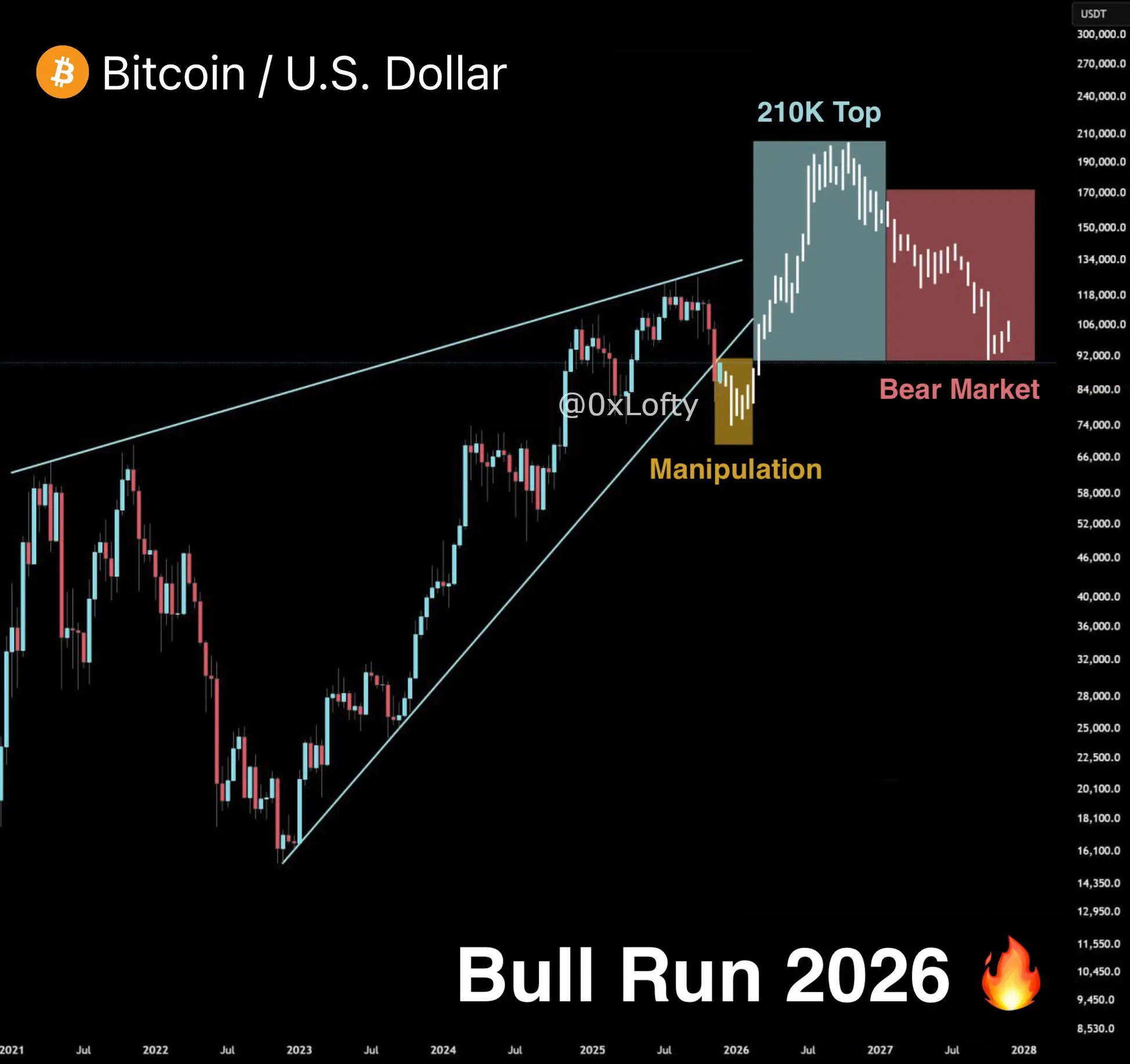
Not long ago, billionaire venture capitalist Chamath Palihapitiya confidently predicted Bitcoin would reach $500,000 by October 2025. That call famously missed the mark, joining a growing list of bold Bitcoin price forecasts that failed to materialize.
(Sources: TradingView)
As a result, the crypto market has largely moved past single-number predictions. Instead, analysts now frame Bitcoin’s outlook in scenario ranges—reflecting uncertainty around liquidity, regulation, and institutional demand. Still, this hasn’t stopped major banks, CEOs, and veteran traders from publishing ambitious views on where Bitcoin could head next.
According to research compiled by Wu Blockchain, forecasts for Bitcoin in 2026 span an unusually wide range—from deep downside scenarios near $10K Bitcoin-style crash narratives to aggressive upside projections above $200,000. The divergence underscores how fundamentally different the next cycle may look compared to Bitcoin’s past halving-driven rallies.
Bitcoin 2026 Outlook: Bull vs. Bear Scenarios
At a high level, market expectations cluster into two camps:
- Bullish scenario: Bitcoin reaches $150,000–$250,000, driven by ETF inflows, institutional allocation, and looser global monetary policy.
- Bearish scenario: Bitcoin retraces toward $70,000 or lower if liquidity tightens, demand fades, or macro risks resurface.
Notably, most analysts now agree that the four-year halving cycle alone is no longer sufficient to explain price action. Instead, liquidity conditions, regulatory clarity, and sustained institutional participation are viewed as the dominant forces shaping Bitcoin’s trajectory into 2026.
Bitcoin Tom Lee Forecast: $200,000–$250,000
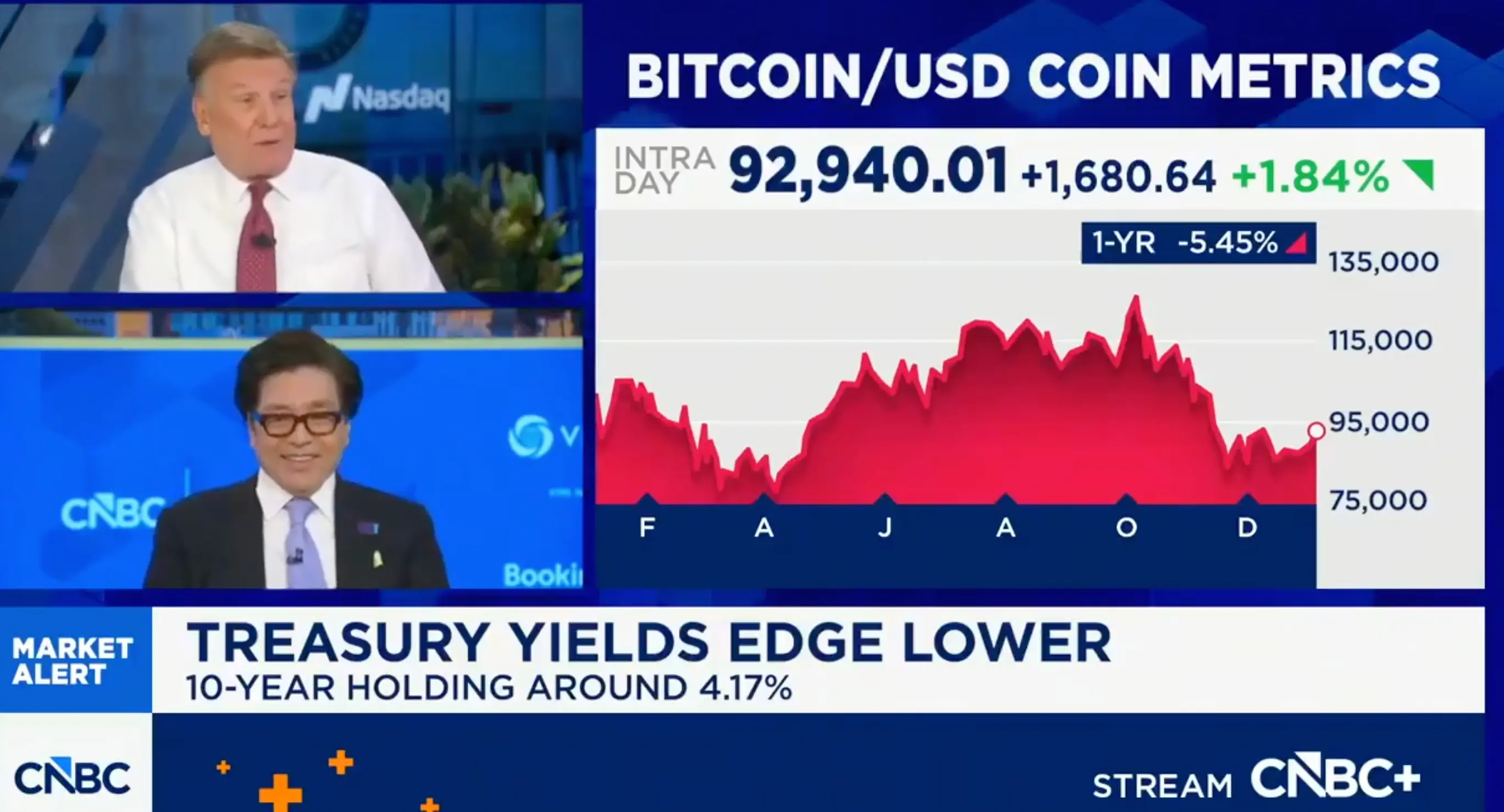
Few voices are as consistently bullish as Tom Lee. The Fundstrat co-founder and BitMine chair has reiterated that Bitcoin could reach $200,000 to $250,000 by the end of 2026.
Lee argues that spot Bitcoin ETFs fundamentally change market structure. In his view, steady institutional inflows—rather than speculative retail cycles—will smooth volatility and push Bitcoin into a new valuation regime. This thesis suggests Bitcoin may behave less like a high-beta asset and more like a long-duration store of value.
However, even within Fundstrat, opinions differ.
A Contrarian Take From Inside Fundstrat
Sean Farrell, Fundstrat’s Head of Digital Asset Strategy, has warned clients that Bitcoin could experience a sharp drawdown in early 2026, potentially revisiting the $60,000–$65,000 range.
Farrell emphasizes that forecasts depend heavily on time horizon. Tom Lee’s outlook is designed for institutions with small allocations and multi-year holding periods. Farrell’s analysis, by contrast, targets active crypto investors managing higher-risk portfolios. The disagreement highlights how Bitcoin’s future depends as much on positioning as on fundamentals.
(Sources: X)
CEO and Industry Leader Predictions
At Blockchain Week in late 2025, several industry leaders weighed in:
- Ripple CEO Brad Garlinghouse said Bitcoin could reach $180,000 by end-2026.
- Solana Foundation President Lily Liu projected Bitcoin trading above $100,000, stopping short of a specific target.
- CEO Richard Teng declined to give a number but stated prices would be “higher than today.”
These views reinforce a broad consensus: while timing is uncertain, most industry executives expect Bitcoin’s long-term trend to remain upward.
Bank Forecasts: More Conservative, Still Bullish
Major financial institutions have tempered their optimism—but remain constructive.
- JPMorgan estimates Bitcoin’s volatility-adjusted fair value near $170,000, based on a Bitcoin-to-gold relative valuation model. The bank frames this as a ceiling, not a guaranteed target.
- Standard Chartered now forecasts $150,000 in 2026, sharply down from earlier $300,000 calls, citing slower ETF inflows and fading catalysts.
- Bernstein also targets $150,000, arguing Bitcoin has entered a prolonged institutional bull phase decoupled from halving cycles.
- Citi outlines a base case of $143,000, with a bull case near $189,000 and a bear case around $78,500, flagging $70,000 as critical support.
Arthur Hayes and the Liquidity Thesis
Veteran trader Arthur Hayes sees Bitcoin breaking above $124,000 and potentially challenging $200,000 in 2026. His thesis centers on global liquidity cycles, arguing that renewed monetary easing could fuel another leg higher for risk assets, including Bitcoin.
From Bitcoin to Broader Crypto Questions
Bitcoin’s evolving outlook has also reignited broader debates across the crypto market. Retail investors increasingly ask questions like:
- Can Ethereum reach $10K as capital rotates beyond Bitcoin?
- Will meme assets survive—or will narratives like “will BONK coin reach $1” fade as liquidity concentrates?
- Could another macro shock revive extreme downside scenarios reminiscent of $10K Bitcoin fears?
What’s clear is that the market has matured. The era of simple, viral price targets is giving way to probabilistic thinking driven by macro data, regulation, and institutional behavior.
Final Take: Bitcoin’s 2026 Path Is No Longer About Hype
Bitcoin’s next chapter is less about bold promises and more about structural forces. ETF adoption, regulatory clarity, and monetary policy now matter more than narratives or halving math. Whether Bitcoin lands closer to $70,000 or $250,000 by 2026 will depend on liquidity and real capital commitment—not social media forecasts.
For investors, the lesson from missed calls by figures like Chamath Palihapitiya is clear: Bitcoin’s future is no longer a single-number story. It’s a range of outcomes shaped by institutions, not influencers.
Disclaimer: The information on this page may come from third parties and does not represent the views or opinions of Gate. The content displayed on this page is for reference only and does not constitute any financial, investment, or legal advice. Gate does not guarantee the accuracy or completeness of the information and shall not be liable for any losses arising from the use of this information. Virtual asset investments carry high risks and are subject to significant price volatility. You may lose all of your invested principal. Please fully understand the relevant risks and make prudent decisions based on your own financial situation and risk tolerance. For details, please refer to
Disclaimer.
Related Articles
BTC short-term decline of 0.76%: key price levels encountering resistance and long leverage liquidations triggering market sell-off
On March 5, 2026, from 14:30 to 14:45 (UTC), Bitcoin (BTC) experienced a short-term decline, with a return of -0.76%. The price ranged between 71,958.3 and 72,830.0 USDT, with an amplitude of 1.20%. Market attention significantly increased, and during the event window, trading volume expanded, volatility intensified, and price anomalies attracted many investors' focus on short-term risks and future trends.
The main driver of this anomaly was BTC encountering resistance in the key price zone of $73,750–$74,400. Historical data shows that this zone has repeatedly acted as a...
GateNews8m ago
Bitcoin: Real-Time Sentiment Gauge for Weekend Warmongering
The article analyzes Bitcoin's real-time sentiment as a gauge during weekend market fluctuations, emphasizing its role in reflecting broader economic trends and investor behavior in the crypto landscape.
CryptoBreaking9m ago
Ripple CTO Emeritus Shares Candid Truth about XRP and Crypto Market - U.Today
David Schwartz, former Ripple CTO, expressed mixed feelings about XRP's performance, reflecting broader crypto market sentiment. Despite recent struggles for altcoins, XRP showed signs of a potential recovery with a newly formed "golden cross" on its price chart, although market conditions remain cautious.
UToday35m ago
When the Asia-Pacific stock markets hit the circuit breaker, why does Bitcoin stand out as the best?
Author: Jae, PANews
On March 4th, as the situation in the Middle East suddenly worsened, global financial markets instantly entered a "wartime state." For global investors, this was a trading day worthy of being recorded in history.
Disruption of shipping through the Strait of Hormuz, a critical energy choke point, triggered a sharp surge in international oil prices. Panic quickly swept through traditional capital markets, and Asia-Pacific stock markets experienced an epic sell-off.
KOSPI in South Korea plummeted 12% in a single day, marking the largest decline in history; the Nikkei 225 dropped 3.7%, its worst performance in five months; Middle Eastern local stock markets once tumbled nearly 5% amid a correction; major European and American stock indices closed lower across the board.
However, an unusual phenomenon quietly emerged amid this sell-off.
The crypto market, often regarded as "high risk, high volatility," which tends to be the first asset class to collapse during any geopolitical crisis, surprisingly held steady this time.
Bitcoin experienced a brief panic
区块客52m ago
Here’s the Litecoin (LTC) Price If Investors Start Treating LTC as Crypto’s Digital Silver
The Litecoin price edged up a bit today. LTC is trading around $56.39, about 1.4% higher than yesterday. The move came as Bitcoin lifted the rest of the market.
The earlier decline slowed down around $55.33, and this is where buying emerged and halted the fall. Since then, it has been stuck ar
CaptainAltcoin54m ago
Bull and bear battle imminent! Bitcoin approaches the "watershed" between bull and bear markets—can it break through and become a key factor for the future market?
Bitcoin prices have recently surged, approaching the critical threshold of $73,750 to $74,400, which is seen as a key point determining market fate. The market's reaction at this level will decide whether Bitcoin enters a new bull market or continues to decline. Historically, this price range has been a turning point for support and resistance, so traders remain highly vigilant about future movements.
区块客56m ago


