Losses at CrossCurve underline the high risk of cross-chain bridges during periods of rising crypto attacks.
CrossCurve halted user activity after an attack targeted its cross-chain bridge. The incident forced developers to investigate a smart contract flaw. Partner protocols and and security firms issued warnings as funds were traced on-chain.
User Interactions Halted as CrossCurve Examines Contract Weakness
CrossCurve confirmed on Sunday that its cross-chain bridge was targeted by attackers. The team linked the incident to a flaw in one of the bridge’s smart contracts. Users were asked to pause all activity while developers began reviewing the issue.
Because assets are held across multiple smart contracts, moving them between networks increases risk when a single component fails.
⚠️ URGENT Security Notice
Dear users,
Our bridge is currently under attack, involving the exploitation of a vulnerability in one of the smart contracts used.
Please pause all interactions with CrossCurve while the investigation is ongoing.
We appreciate your patience and… pic.twitter.com/yfo1KvWoDd
— CrossCurve (@crosscurvefi) February 1, 2026
Curve Finance addressed its community shortly after the incident. Users with exposure to CrossCurve pools were advised to reassess their positions and decide whether to withdraw voting support. The statement urged careful judgment when interacting with external protocols during unstable conditions.
Early checks found damage limited to the bridge, with no issues detected across other protocol components. Alerts went out quickly, while the team kept access paused and tracked the movement of stolen funds.
Protocol Calls for Asset Returns After On-Chain Review
After tracing on-chain activity, the team found that funds from the exploit had moved into 10 wallet addresses. CrossCurve said it could not confirm whether those wallets belonged to the attackers and saw no clear hostile behavior at that point. Even so, the protocol acknowledged that users lost funds due to the exploit.
In response, project officials appealed directly to recipients to return the assets. The team described the transfers as improper and asked for cooperation. To support recovery efforts, CrossCurve activated its SafeHarbor WhiteHat policy, offering a reward of up to 10% of recovered funds if the rest is returned.
Details included a direct contact email for coordination. An alternative option allows anonymous returns through a designated wallet address. The team said recovered funds would be returned to affected users after review.
Moreover, CrossCurve shared a contact email to help coordinate the return of funds. A separate wallet address was also provided for those who prefer to send assets back without revealing their identity. After verification, the team said it plans to distribute recovered funds to affected users.
Recent Breaches Expose Ongoing Risks in Decentralized Finance
Crypto attacks have increased across the industry, with the CrossCurve incident adding to a growing list of breaches. Security firm CertiK recorded nearly $400 million in losses in January 2026, with more than 40 major incidents reported.
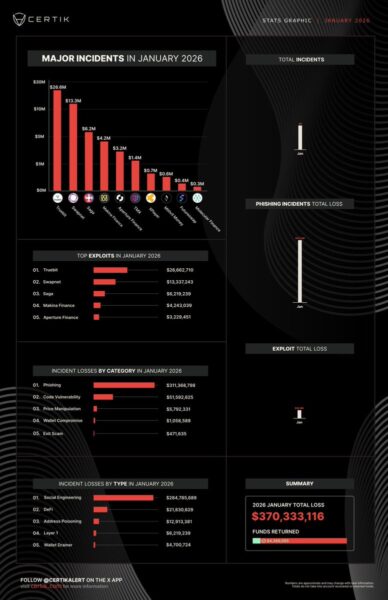
_Image Source: _X/CertiK
Cross-chain systems face a higher risk because they handle large amounts of funds and rely on complex structures. Recent incidents show how fast damage can spread once an exploit begins.
Other victims during the same period included Swapnet, which lost $13 million. Saga and Makina Finance reported losses of $6.2 million and $4.2 million. Step Finance also suffered a breach that drained several treasury and fee wallets, moving more than 261,000 SOL.
Losses across 2025 passed $1 billion, marking the worst year on record for crypto theft. The CrossCurve case adds another reminder of ongoing security gaps within decentralized finance.
Disclaimer: The information on this page may come from third parties and does not represent the views or opinions of Gate. The content displayed on this page is for reference only and does not constitute any financial, investment, or legal advice. Gate does not guarantee the accuracy or completeness of the information and shall not be liable for any losses arising from the use of this information. Virtual asset investments carry high risks and are subject to significant price volatility. You may lose all of your invested principal. Please fully understand the relevant risks and make prudent decisions based on your own financial situation and risk tolerance. For details, please refer to
Disclaimer.
Related Articles
GI-TOC Latest Report: USDT Becomes New Tool for Gold Laundering in Venezuela
The Global Initiative Against Transnational Organized Crime (GI-TOC) report indicates that Venezuela has become a major destination for illegal Amazon gold and conducts transactions through USDT (Tether), functioning as a money laundering hub. The article also discusses U.S. Congressional legislation targeting illegal gold mining, emphasizing the need to incorporate digital asset provisions to enhance effectiveness.
MarketWhisper3m ago
SlowMist: ClawHub Developers Need to Be Alert to Phishing and Credential Leakage Risks
Slowmist's Chief Information Security Officer issued a security warning, reminding ClawHub developers to be vigilant against phishing and credential exposure risks. The attack pathway involves credential theft leading to malicious code injection, which could result in system compromise.
GateNews1h ago
Vitalik Buterin Proposes "Duress Code" Security Solution to Protect Cryptocurrency Holders from Robbery
Ethereum co-founder Vitalik Buterin has proposed a new personal security solution that enhances the safety of cryptocurrency holders through a "duress code alert mechanism." Users can set a duress code in smart devices that, when triggered, automatically calls emergency services and transmits location information, thereby increasing rescue probability and reducing risks of kidnapping and robbery. This solution emphasizes passive triggering to protect civil liberties and reduce the potential for government surveillance, potentially offering new security protection ideas for crypto asset users.
GateNews1h ago
US Treasury Sanctions North Korean IT Fraud Network Facilitators, Crypto Industry Becomes Key Target
The U.S. Department of the Treasury has imposed sanctions on six individuals and two entities for allegedly assisting North Korean IT workers in conducting fraud and providing financial support to North Korean weapons programs. The sanctioned entities include a North Korean company and a Vietnamese company, involving approximately $2.5 million in transfers. Investigations reveal that such fraud schemes target multiple industries and pose serious security threats to the cryptocurrency sector.
GateNews1h ago
Ark Invest Discovers Over $480 Billion in Bitcoin Vulnerable to Quantum Computing Attacks
A new report from ARK Invest warns that approximately 6.9 million Bitcoin — equivalent to an estimated value of 483 billion USD at an average price of 70,000 USD — are at risk of being attacked by quantum computers in the future.
Risk from elliptic curve cryptography
This threat centers on the elliptic curve cryptographic system
TapChiBitcoin1h ago
A user experienced 89 address poisoning attacks within 30 minutes after completing two transfers
Etherscan recently issued a security warning alerting users to beware of address poisoning attacks. Attackers create fake addresses similar to addresses users have previously interacted with to trick users into sending funds to the wrong destination. It is recommended that users confirm the complete address when transferring funds and use address highlighting features to avoid risks.
GateNews3h ago


