Bitcoin plummeted 40.8% to $74,680, but four major indicators suggest it’s unlikely to fall further. U.S. Treasury yields remain stable at 3.54%, the futures basis is not inverted at 3%, ETF outflows amount to only $3.2 billion, representing just 3%, and MicroStrategy holds $1.44 billion in cash with no liquidation risk. Oracle’s plan to raise $50 billion alleviates concerns over tech stocks.
U.S. Treasury Yields and S&P 500 Indicate Limited Panic
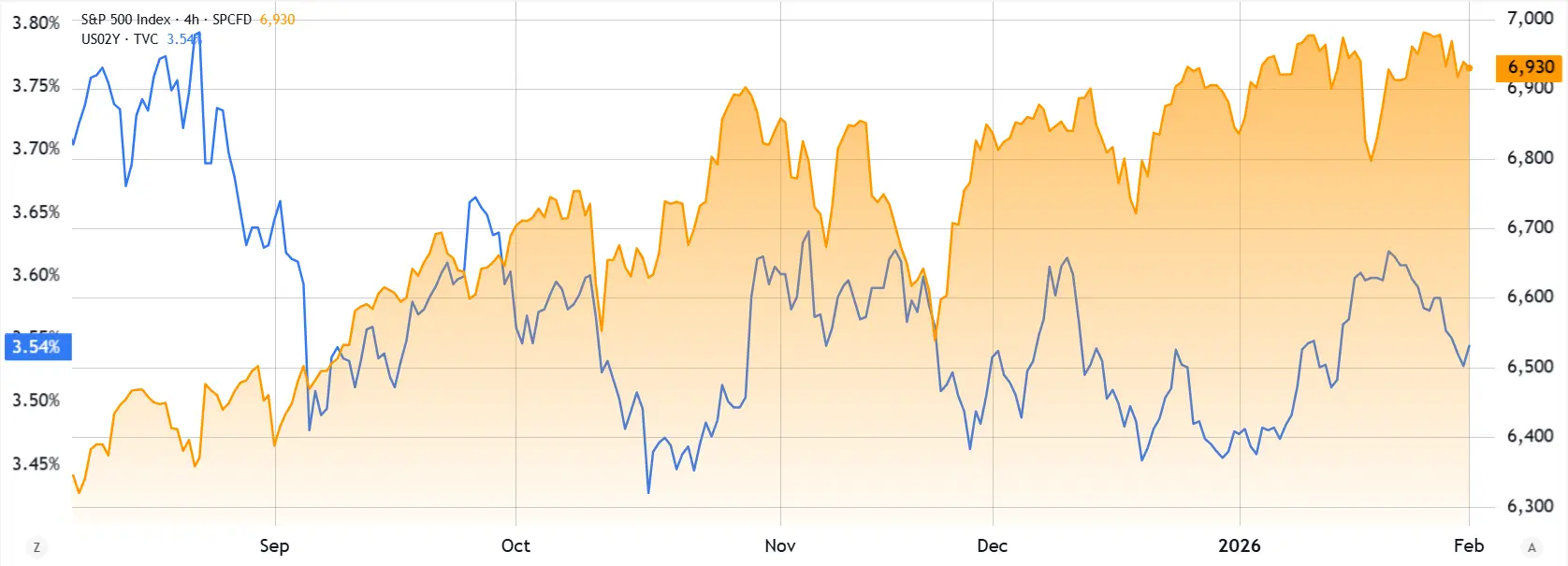
On Monday, the two-year U.S. Treasury yield stood at 3.54%, unchanged from three weeks ago. If demand for U.S. government-backed assets surges, yields could drop below 3.45%, similar to October 2025. Back then, the U.S. faced a prolonged government shutdown and weak non-farm payroll data. The two-year yield is a key indicator of short-term risk aversion; during market panic, funds flood into government bonds, causing yields to fall sharply. The current 3.54% level suggests some risk aversion, but not to the point of panic.
Similarly, the S&P 500 on Monday was only 0.4% below its all-time high, indicating market confidence that the latest partial government shutdown (started Saturday) can be resolved quickly. House Speaker Mike Johnson told Fox News that, despite limited Democratic support, an agreement is expected by Tuesday. This optimism about political gridlock weakens the macro environment for Bitcoin’s further decline.
After Oracle announced plans to raise up to $50 billion in debt and equity in 2026 to meet demand from its cloud clients with signed contracts, concerns over the AI industry eased gradually. Previously, Oracle’s aggressive AI expansion strategy caused investor unease, leading to a 50% drop in its stock price, according to CNBC. The financing plan proves Oracle’s AI business has genuine demand, not just hype, which is a major positive for the entire tech sector.
When the macro environment isn’t worsening to extreme levels, Bitcoin, as a high-beta asset, typically rebounds first after panic subsides. The stable two-year yield and near-record high S&P 500 suggest that the recent Bitcoin sell-off is more a technical correction and leverage washout rather than a fundamental collapse. In this environment, $75,000 should provide solid support.
Futures Basis at 3% Not Inverted Shows Professional Trader Confidence
(Source: Laevitas)
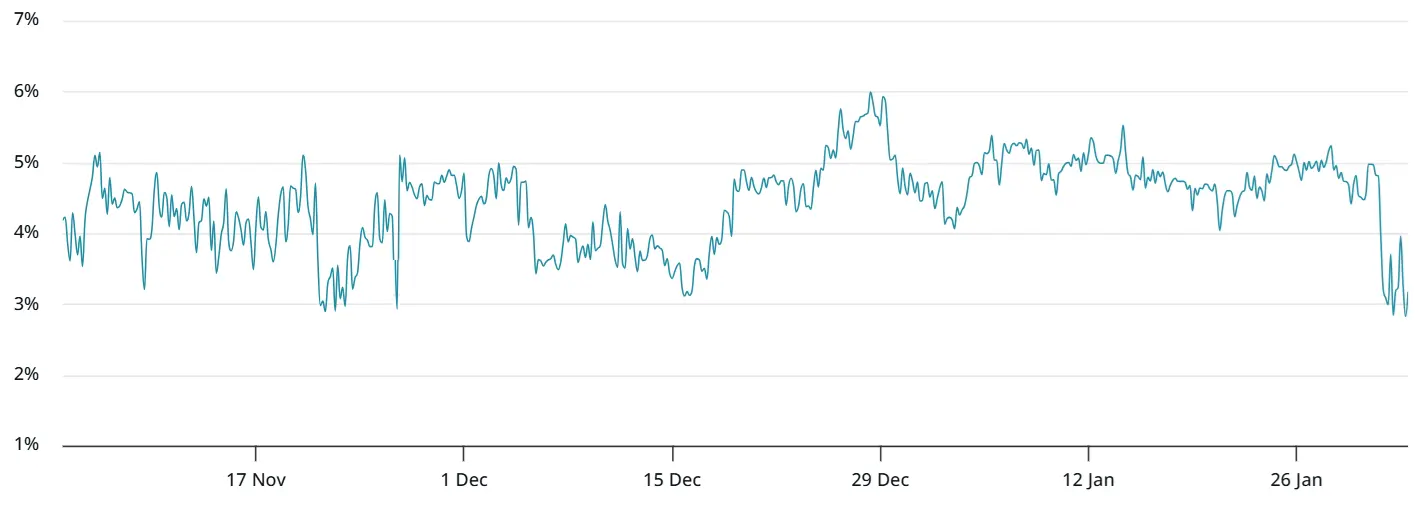
The resilience of Bitcoin derivatives indicates that, despite a 40.8% drop from the October 2025 high of $126,220, professional traders remain unwilling to turn bearish. Excessive demand for puts usually causes Bitcoin futures to invert, meaning futures prices fall below spot prices. However, on Monday, the annualized futures premium (basis) was 3%, showing leverage long positions are weak but not panicked.
In a neutral market, this indicator typically fluctuates between 5% and 10% to compensate for longer settlement cycles. A 3% basis, while below normal, remains positive. A positive basis means futures are trading above spot, indicating traders are still willing to pay a premium to go long. If panic truly set in, the basis would turn negative (futures below spot), which would be a real danger signal.
Nevertheless, the Bitcoin derivatives market shows no signs of stress; open interest remains healthy at $40 billion, down 10% over the past 30 days. This moderate decline indicates healthy deleveraging rather than panic selling. A 30%-50% drop in open interest would signal a market collapse. The current 10% reduction suggests cautious deleveraging by traders, with the overall market structure intact.
Three Key Indicators of Bitcoin Derivatives Health
Futures Basis 3%: Positive, indicating continued bullish sentiment, no inversion panic
Open Interest $40B: Down 10% from peak, healthy deleveraging, not collapse
Liquidations $1.8B: Concentrated liquidations completed, remaining positions healthier
On Monday, Bitcoin fell to $74,680 per ounce, after $1.8 billion in bullish leverage positions were liquidated since Thursday’s market decline. While painful, this thoroughly cleared excessive leverage. After weak hands are flushed out, remaining holders tend to be more confident and financially capable, creating a foundation for price support.
ETF Outflows of $3.2 Billion Account for Less Than 3% of AUM
(Source: Coinglass)
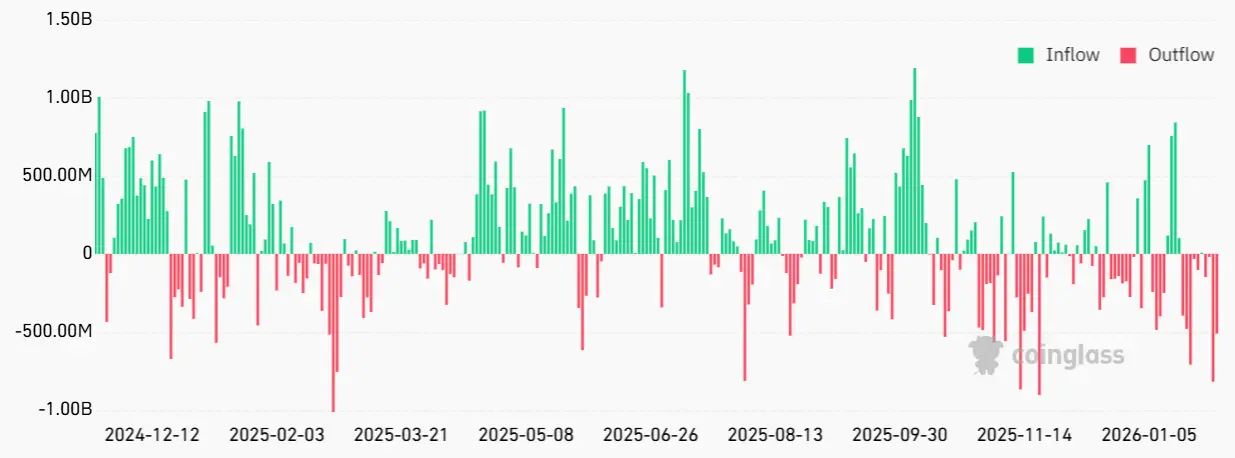
Since January 16, spot Bitcoin ETF net outflows have reached $3.2 billion, raising concerns among traders. However, this amount accounts for less than 3% of the assets under management of these products. According to Bianco Research, 12 ETFs hold about 1.29 million BTC, worth over $115 billion. The $3.2 billion outflow is roughly 43,000 BTC (at an average price of $75,000), only 3.3% of total holdings.
This proportion is within normal fluctuation ranges in asset management. During market corrections, funds typically redeem 3%-5%, which doesn’t indicate loss of confidence but normal rebalancing. A 10%-20% outflow would signal panic. Although record-breaking, the current outflow on a $115 billion base isn’t enough to pose systemic risk.
More importantly, the pace of outflows has slowed. After a record $817.8 million outflow on January 29, subsequent days saw a significant slowdown, with even a $561.9 million net inflow on Monday. This deceleration suggests selling pressure is easing. If ETFs can maintain net inflows or small outflows in the coming days, it will confirm that the most panic-driven phase has passed.
MicroStrategy Holds $1.44 Billion in Cash with No Liquidation Risk
MicroStrategy (MSTR) has become an unfounded speculative target as its stock price fell below net asset value per share, fueling fears it will sell some Bitcoin. However, these concerns lack factual basis. Besides no contracts requiring liquidation if Bitcoin drops below a certain price, MicroStrategy announced it has $1.44 billion in cash reserves as of December 2025, for dividends and interest payments.
MicroStrategy’s business model involves using equity and debt financing to buy Bitcoin, which is uncollateralized, with no margin calls or forced liquidations. Even if Bitcoin drops to $50,000, MicroStrategy wouldn’t be forced to sell a single Bitcoin. Its $1.44 billion cash reserve is enough to cover years of operational costs and debt interest, allowing it to withstand any price volatility.
Market concerns focus on its stock price falling below the net asset value of its Bitcoin holdings. This indeed shows a market discount, and investors can buy Bitcoin directly rather than through MicroStrategy. But this discount doesn’t force the company to sell Bitcoin; it only affects its future ability to raise funds via equity. Until prices stabilize, MicroStrategy might pause buying but will not sell.
As traders seek reasons for recent selling, Bitcoin may remain under pressure, but all signs point to the $75,000 support level being effective. The combined analysis of the four major indicators suggests that current selling is driven more by sentiment and technical factors than by deteriorating fundamentals. Once panic subsides, leverage is cleaned out, and ETF flows stabilize, the probability of a rebound from $75,000 is much higher than further decline.
Related Articles
Bitcoin Breaks Through $73,000! Outperforms Gold Amid US-Iran War, EF Sells 10.2 Million ETH
Bitcoin recently broke through $73,000 with strong performance, decoupling from tech stocks and gold. Analysts predict that if the market stabilizes, it could rise to $75,000 to $80,000. However, geopolitical risks and extremely fearful market sentiment continue to pressure prices. Meanwhile, the Ethereum Foundation sold Ether for approximately $10.2 million to maintain operations.
CryptoCity7m ago
On-chain activity is exploding, but Ethereum can't seem to gain momentum? Experts reveal the "fatal weakness": could drop to $1,500
CryptoQuant's latest report indicates that Ethereum is facing an "adoption paradox," where network activity reaches new highs, but the token price continues to decline. Analysts predict that if the bear market persists, Ether could fall to $1,500. Despite thriving on-chain activity, it has decoupled from the token price, and the high proportion of Ether flowing into exchanges suggests heavy selling pressure and weak investment demand.
区块客16m ago
Bitcoin Breaks Through $74,000! 24-Hour Surge of 3.68%, ETFs Continue to Attract Capital, Multiple Factors Provide Support
Bitcoin broke through $74,000 on March 16th, with a gain of 3.68%, primarily driven by ETF capital inflows, halving supply effects, and geopolitical safe-haven demand. While market sentiment remains optimistic, short-term volatility is intensifying, and investors should carefully manage risk and monitor future support levels and selling pressure.
動區BlockTempo22m ago
Price Spreads Exceed 50%, Pre-Market Arbitrage on Crypto Stocks to Become New Business in Bear Market
Mysten Labs CEO Evan Sui believes that "bear markets" are not beneficial for the development of the cryptocurrency industry, as many projects face cash flow crises and may withdraw. However, data shows that over 80% of crypto startups are still in development, and bear markets can help focus the project teams' development efforts. The article explores the demand and potential entrepreneurial directions in the pre-market trading sector of tokens, pointing out that the crypto market lacks "bridge platforms" to integrate price differences between various trading markets, and recommends creating new platforms that meet market needs.
PANews34m ago
10x Research: Unusual Adjustments in Bitcoin On-Chain Capital Flows and Position Changes
10x Research posted a message on the X platform stating that Bitcoin prices are rising slowly, with abnormal capital flows appearing in the market. Recently, funding rates and risk indicators have undergone significant adjustments, market trends are being influenced by position structures, and changes in positions for Ethereum and Bitcoin require attention, with options trading before the end of March being particularly critical.
GateNews36m ago
BTC Short-term Rise 1.25%: Whale Buying and Key Level Breakthrough Drive Market Acceleration Upward
During 2026-03-16 03:30-03:45 (UTC), BTC recorded a +1.25% return with a price range of 72,851.9 to 74,300.0 USDT, reaching an amplitude of 1.99%. The K-line candle showed significant volume expansion during this period, with increased market attention and notable short-term volatility. Investors rapidly entered the market, with trading volume exceeding daily average levels, reflecting capital-driven momentum behind the price movement.
The primary drivers of this unusual movement were concentrated whale fund buying and a breakout through key technical levels. On-chain monitoring data showed 4 transactions each exceeding 1,000 BTC during the anomaly period.
GateNews51m ago


