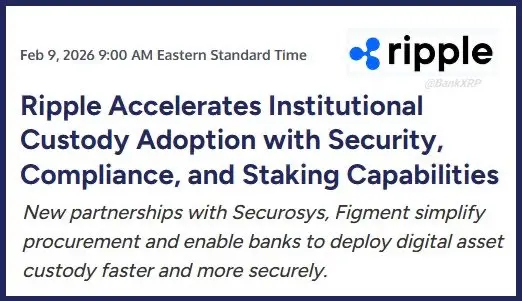
Ripple partners with Figment and Securosys to expand custody services. The staking feature supports ETH and SOL, with added HSM security options for on-premises or cloud deployment. However, XRP has fallen 32% month-over-month to $1.44, with total locked value dropping from $80 million to $49.6 million, and stablecoins totaling only $416 million, indicating that institutional infrastructure upgrades have not boosted the price.
Institutional Expansion of Figment Staking and Securosys HSM
(Source: BankXRP)
Ripple states that these collaborations aim to streamline procurement processes and enable regulated entities to deploy custody services more quickly. Recently, Ripple expanded its custody product suite through acquisitions of Palisade and integration of Chainalysis compliance tools. As part of the partnership with Figment, Ripple will launch a staking feature, allowing institutional clients to offer staking services without operating their own validator infrastructure.
This integration aims to help banks, custodians, and regulated entities gain exposure to proof-of-stake networks while maintaining security and governance standards. Through Figment’s infrastructure, Ripple Custody clients will be able to support staking on major networks like Ethereum (ETH) and Solana (SOL). Figment is a leading global staking service provider managing billions of dollars in staked assets.
Ben Spiegelman, Vice President and Head of Partnerships and Enterprise Development at Figment, said: “By combining Ripple’s enterprise-grade custody technology with Figment’s secure, non-custodial staking platform, we provide regulated institutions a way to offer staking rewards to their clients across multiple blockchain networks.” The advantage of this “one-stop” solution is that clients don’t need to contract separately with custodians and staking providers, reducing operational complexity and compliance costs.
Additionally, Ripple has partnered with Securosys to enhance the security of Ripple Custody. This collaboration adds support for CyberVault HSM and CloudHSM. HSMs (Hardware Security Modules) are dedicated hardware devices used to protect cryptographic keys and are core security components for enterprise custody. This allows institutions to choose on-premises or cloud-based HSM deployment options.
Three Key Features of Ripple’s Institutional Custody Upgrade
Staking Service: Supports ETH/SOL staking without running validators, via Figment partnership
HSM Security: On-premises or cloud deployment options with Securosys
Compliance Tools: Integration with Chainalysis to meet regulatory requirements
Ripple states that the integration with Securosys aims to address longstanding challenges in HSM applications, including high costs, complexity, and slow procurement processes. Ripple also notes that Securosys broadens the range of HSM providers supported on its custody platform, offering greater flexibility for institutions operating under various regulatory environments.
Robert Rogenmoser, CEO of Securosys, said: “By integrating our CyberVault HSM with Ripple Custody, institutions can access an out-of-the-box enterprise solution that can be deployed quickly, without added complexity, while maintaining full control over their cryptographic keys.”
XRPL Total Locked Value Halves from $80 Million to $50 Million
Despite Ripple’s ongoing efforts to strengthen its institutional infrastructure, on-chain metrics for the XRP Ledger show a moderate adoption rate. According to DeFiLlama data, XRPL’s total value locked (TVL) has declined from approximately $80 million in early January to about $49.6 million at the time of writing, indicating a slowdown in DeFi activity on the network. This nearly 40% drop in TVL far exceeds the declines seen in Bitcoin or Ethereum during the same period, suggesting a more severe capital outflow from the XRPL ecosystem.
TVL is a key indicator of blockchain ecosystem health, representing the total value of assets locked in DeFi protocols such as lending platforms, DEXs, and liquidity pools. Growth in TVL indicates increasing user and capital inflows; decline suggests capital leaving. The halving of XRPL’s TVL from $80 million to $50 million signals a shrinking rather than expanding DeFi ecosystem.
Stablecoin data also shows slow growth. According to DeFiLlama, the total market cap of stablecoins on XRPL is about $416 million, reflecting steady but limited growth. In comparison, stablecoins on Ethereum exceed $100 billion, Solana around $10 billion, and Tron approximately $60 billion. XRPL’s $416 million is very low among mainstream blockchains, indicating its adoption as a settlement layer for stablecoins is far behind competitors.
In other words, Ripple’s institutional strategy largely focuses on custody, settlement, and permissioned financial use cases, which may not always be reflected in traditional DeFi metrics like TVL. This argument has some validity, as Ripple’s target clients are banks and financial institutions whose transactions often occur via private channels, not visible on public blockchain data. But if these institutional use cases are truly large-scale, why haven’t XRP’s price and network activity shown corresponding growth?
Institutional Infrastructure Has Not Translated into Market Demand
It’s notable that so far, expansion of institutional use cases has had limited impact on XRP’s market performance. Over the past month, XRP’s price has fallen nearly 32%, tracking the overall market decline. At the time of writing, XRP trades at $1.44, down 0.66% from the previous day. This “institutional bullishness, price bearishness” disconnect has been a recurring pattern in Ripple’s history.
Ripple has long promoted its institutional partnerships and technological upgrades—from RippleNet’s bank collaborations, to On-Demand Liquidity for cross-border payments, to the launch of RLUSD stablecoin—all framed as major positives. Yet, XRP’s price performance has lagged the market for years, with a long-term downtrend since its 2018 high. This persistent disconnect raises a fundamental question: Is Ripple’s institutional strategy truly effective?
Possible explanations include: institutional use cases are smaller than advertised, institutions use Ripple’s tech but do not hold XRP (settling in fiat), or the market simply does not believe Ripple’s narrative. Regardless, the result is that XRP investors cannot benefit from Ripple’s commercial success. This “company profits, token stagnates” phenomenon is common among enterprise blockchain projects.
Clearly, Ripple is in a race to build out its infrastructure for institutional payments, custody, and staking services. But its actual adoption and price breakthroughs remain elusive. This “all talk, no walk” situation is eroding investor patience and confidence.
Disclaimer: The information on this page may come from third parties and does not represent the views or opinions of Gate. The content displayed on this page is for reference only and does not constitute any financial, investment, or legal advice. Gate does not guarantee the accuracy or completeness of the information and shall not be liable for any losses arising from the use of this information. Virtual asset investments carry high risks and are subject to significant price volatility. You may lose all of your invested principal. Please fully understand the relevant risks and make prudent decisions based on your own financial situation and risk tolerance. For details, please refer to
Disclaimer.
Related Articles
RLUSD Records 143% Surge in Volume as XRP Flips $1.40 Resistance - U.Today
Ripple USD (RLUSD) stablecoin volume surged 143% amid increased crypto activity and XRP's rise above $1.40. Demand is driven by investors buying XRP with RLUSD, contributing to its market cap growth. Ripple aims for global expansion, enhancing accessibility for institutional users.
UToday5m ago
Crypto Market Rebounds, South Korean CEX's Daily Trading Volume Surges 81.7%, XRP Accounts for 18%
Gate News reports that on March 17, as the crypto market warmed up, Korean investors showed a trend of capital flowing back from the stock market into the crypto space. According to CoinGecko data, a Korean CEX recorded 24-hour trading volume of $25.43 billion, surging 81.7% in a single day. Data shows that XRP was the most actively traded asset on the exchange, accounting for 18.07% of trading volume. XRP has recently outperformed typical altcoins, with a weekly gain of 11%.
GateNews9m ago
XRP Whale Funds Return: Exchange Supply Hits New High Since November 2025, Can Price Continue to Rise?
On March 17th, there was a significant change in the synchronization of on-chain and exchange data for XRP, with exchange reserves increasing to 2.78 billion coins and large whale funds flowing back in. The market is now facing a new test of balance. Although the increase in supply may lead to selling pressure, changes on the demand side indicate that whale funds have turned positive, suggesting increased market activity. If the supply and demand balance can be maintained, XRP's price is likely to stay high or rise further.
GateNews28m ago
XRP Ledger Activity Surges as Price Holds Near Key Resistance
Key Insights
XRP Ledger processed over 2.5 million transactions in 24 hours, reflecting rising network engagement while the asset price remained stable near resistance.
XRP price holds near $1.41 while forming higher lows, indicating buyers continue supporting the asset despite repeated resi
CryptoFrontNews38m ago
XRP Privacy Upgrade Expectations Heating Up: ZKP Introduction May Drive Institutional Adoption, Price Targets $2 Range
As the privacy technology of the XRP Ledger is upgraded, market attention to XRP's price movements has increased. The development of zero-knowledge proof (ZKP) technology is expected to safeguard transaction privacy while enabling compliant auditing, thereby attracting participation from financial institutions. Currently, XRP is priced at approximately $1.46, with a recent strengthening of its technical structure. If it breaks through the $1.50 level, it could further rise to higher targets. Market analysis indicates that the introduction of privacy features may offer new growth prospects for XRP's price.
GateNews47m ago
XRP reclaims the fourth position in market capitalization: open interest surges, leverage returns as traders bet on a new rally
On March 17, XRP's price surged to $1.53, up 11% for the week, reclaiming the fourth position by market cap with a total market capitalization of approximately $93.4 billion. Trading volume and derivatives market activity are robust, with open interest reaching 3.53 billion contracts, reflecting increased market participation but also heightened volatility risks. Key near-term observation lies in the $1.50 to $1.60 range, with price performance set to influence subsequent trends.
GateNews1h ago


