
The crypto company World Liberty Financial (WLFI), under the Trump family, released a new governance proposal on Wednesday, suggesting that token holders must stake WLFI for at least 180 days to participate in governance voting. The aim is to ensure that voting rights are held by “participants with long-term commitment to the protocol,” rather than speculators. Stakers who complete the staking and participate in at least two governance votes during the lock-up period can earn an annual percentage yield (APY) of 2%.
Core Mechanism Design of the Staking Governance Proposal
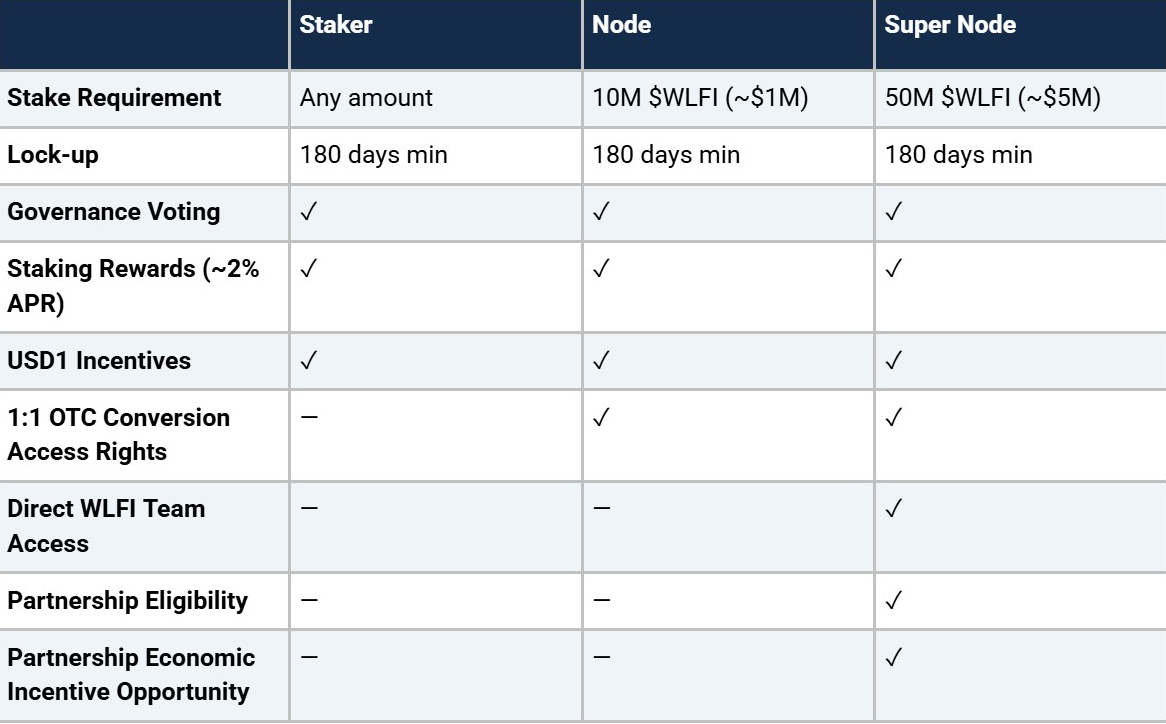
(Source: WLFI)
The core of this proposal is token locking to select governance participants with long-term commitment. The proposal details the following key design elements:
Key Points of the Staking Governance Proposal
Staking Requirement: To participate in governance voting, lock WLFI tokens for at least 180 days
Annual Percentage Yield (APY): Stakers who complete at least two governance votes during the lock-up period can earn 2% APY
Voting Power Calculation: Voting rights are dynamically calculated based on the amount staked and remaining lock-up time, with longer lock-up periods granting higher weight
Voting Threshold: Each proposal requires at least 1 billion tokens participating in voting and a majority approval
Compatibility with Existing Holdings: Users holding locked tokens can still vote normally, without affecting their current holdings
Super Node Qualification: “Super nodes” holding over 50 million WLFI tokens can access additional features
According to CoinGecko data, WLFI tokens currently have a circulating supply of over 27 billion tokens. The 1 billion token voting threshold accounts for approximately 3.7% of the circulating supply.
USD1 Incentive Strategy and Stablecoin Market Positioning
This proposal also promotes incentives for adopting USD1 stablecoin, extending WLFI’s long-term strategy to popularize USD1.
According to the proposal, users staking WLFI will receive “additional benefits related to USD1 usage”; users depositing USD1 on WLFI’s trading and lending platform WLFI Markets will receive unspecified “incentives” from DeFi protocol Dolomite. This integrated plan links WLFI token staking, USD1 deposits, and DeFi protocols into a complete ecological incentive cycle.
As of Thursday, DeFiLlama data shows the total stablecoin market cap surpassing $309 billion, with Tether USDT leading at over $183 billion (market share 59%), followed by Circle USDC at $75 billion. USD1’s current market cap is $4.7 billion, ranking as the fifth-largest stablecoin globally. While still far behind the top two, WLFI states it will continue to promote adoption through reward programs and institutional platform collaborations.
Three-Phase Launch Plan
If the proposal is approved, WLFI plans to implement it in three phases:
Phase 1: Launch staking rewards and USD1 deposit incentives to build a base of engaged users
Phase 2: Introduce 1:1 conversion functionality to further enhance USD1 liquidity and usability
Phase 3: Open opportunities for super node collaborations and revenue sharing frameworks to attract large holders to deepen ecosystem participation
Frequently Asked Questions
How does WLFI’s 180-day staking requirement differ from typical DeFi staking?
Most DeFi staking focuses on yield incentives with flexible lock-up conditions. WLFI’s proposal emphasizes “governance eligibility”: locking for 180 days is a prerequisite for voting rights, not just for earning rewards. This design aims to filter out short-term speculators and ensure that token holders participating in governance have a higher degree of long-term commitment.
What is the current market position of USD1 in stablecoins?
USD1 currently has a market cap of $4.7 billion, ranking fifth globally among stablecoins, far behind market leaders USDT ($183 billion) and USDC ($75 billion). WLFI’s incentive strategy aims to expand USD1’s use cases within DeFi and gradually narrow the market share gap.
What are the conditions for the proposal to pass?
According to the proposal, at least 1 billion WLFI tokens (about 3.7% of the circulating supply) must participate in voting, and the proposal must receive a majority of “yes” votes. With a circulating supply of over 27 billion tokens, reaching the quorum requires roughly 3.7% of tokens to participate, which is a critical threshold for the proposal’s implementation.
Disclaimer: The information on this page may come from third parties and does not represent the views or opinions of Gate. The content displayed on this page is for reference only and does not constitute any financial, investment, or legal advice. Gate does not guarantee the accuracy or completeness of the information and shall not be liable for any losses arising from the use of this information. Virtual asset investments carry high risks and are subject to significant price volatility. You may lose all of your invested principal. Please fully understand the relevant risks and make prudent decisions based on your own financial situation and risk tolerance. For details, please refer to
Disclaimer.
Related Articles
Vitalik Buterin Says Lean Ethereum Will Set ETH Apart
Ethereum co-founder Vitalik Buterin introduces the concept of Lean Ethereum, aiming to combine speed and security in blockchain design. This innovative dual system could shift the focus from speed to reliability, potentially changing how blockchains are evaluated in the crypto space.
Coinfomania6m ago
MiniMax releases the new generation of agent flagship large model M2.7, showcasing for the first time the model's self-evolution pathway
Gate News reported that on March 18, MiniMax released the next-generation Agent flagship large model M2.7, showcasing for the first time a "model self-evolution" pathway. M2.7 can independently construct complex Agent Harness and based on Agent Teams, complex Skills, Tool Search
GateNews29m ago
Pi Network completes Protocol 20 upgrade, with NFT and subscription contracts coming soon
Pi Network completed a mainnet upgrade to Protocol 20 on March 18, providing a smart contract execution environment to support upcoming NFT and escrow functionalities. Smart contracts will be rolled out in phases, with the first phase featuring subscription contracts, followed by escrow contracts and NFT tools in subsequent phases. Each step requires security audits and community verification to ensure safety and stability.
MarketWhisper35m ago
Pi Network Upgrades Mainnet to Protocol 20
Pi Network's latest upgrade to Protocol 20 establishes foundational support for smart contracts, focusing on real-world applications. The rollout emphasizes careful testing and community feedback while improving tools like Pi Wallet and SDK, marking a significant advancement for the ecosystem.
Coinfomania45m ago
Jupiter Wallet Launches the Auto Earn Automatic Income Feature
Gate News, on March 18, Jupiter Wallet announced the launch of Auto Earn feature. This feature allows users to set a trigger amount (minimum $10). When the wallet balance reaches the set threshold, the system will automatically deposit tokens into the Jup Lend protocol. This process requires no gas fees from users, and idle tokens can automatically generate yields.
GateNews1h ago
Aster launches privacy Layer 1 mainnet, with ASTER price rebounding despite a 76% decline in trading volume
Decentralized derivatives platform Aster launched Aster Chain on March 18, a high-performance privacy blockchain designed specifically for perpetual futures, supporting cross-chain asset deposits and emphasizing account-level privacy protection. Although the mainnet launch drove a brief surge in ASTER price, trading volume and total locked value declined significantly. Whether it can attract liquidity in the future will be key to its growth.
GateNews1h ago


