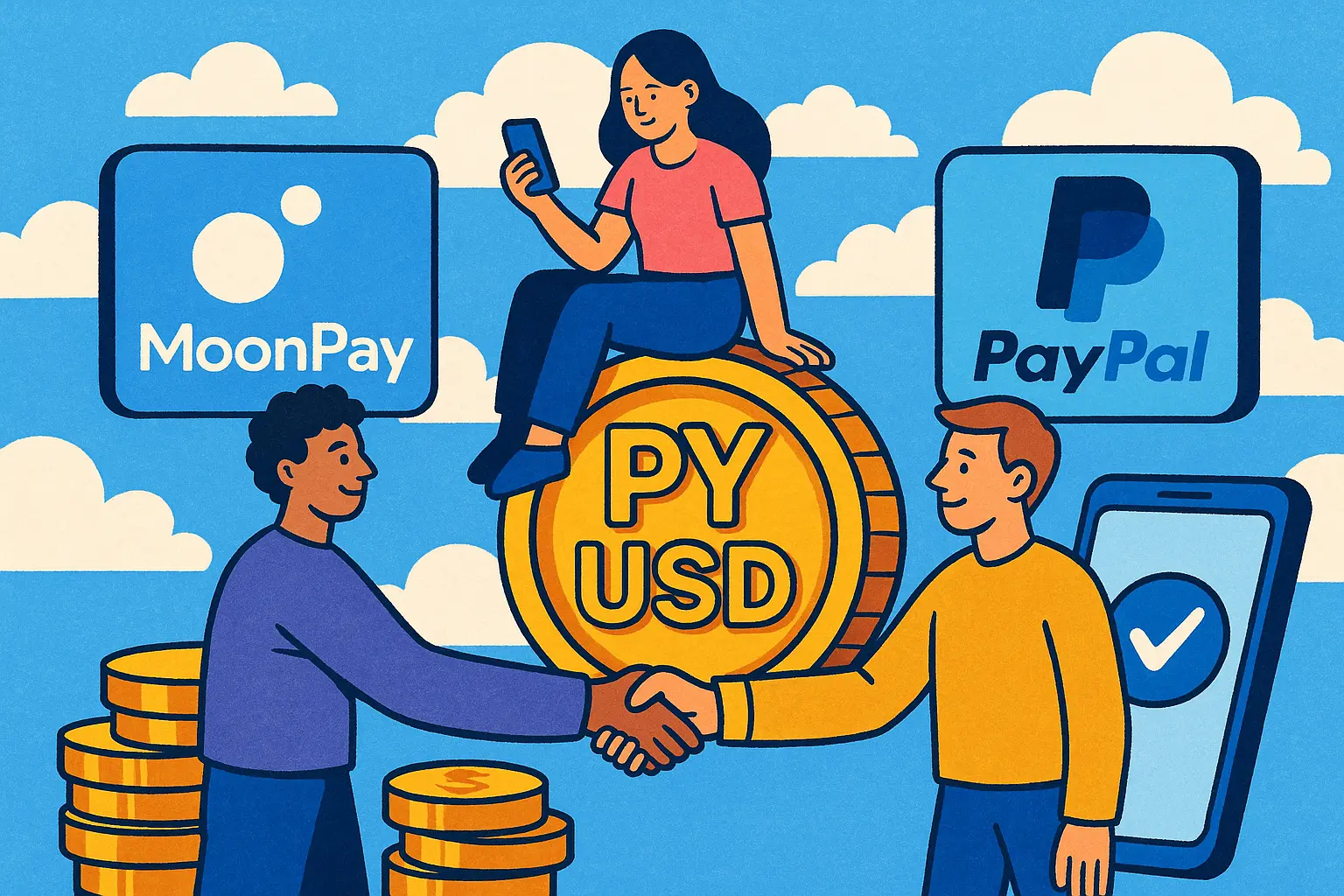
MoonPay and M0 announced the launch of the PYUSDx framework on February 27, allowing developers to quickly issue application-specific branded stablecoins using PayPal dollars (PYUSD) as a reserve asset, with the goal of reducing deployment time from months to days without the need to build issuance, custody and liquidity infrastructure themselves.
PYUSDx Framework: Infrastructure that lowers the barrier to entry for branded stablecoin deployment
PYUSDx’s core value proposition is to significantly lower the technical and compliance threshold for developers to launch their own stablecoins. Through this framework, developers can directly utilize PYUSD as a reserve asset, with MoonPay’s subsidiary MoonPay Digital Assets Limited as an independent tokenization and issuance framework operator, and PYUSD itself is issued and managed by the federally regulated Paxos Trust Company.
It is worth noting that tokens created through PYUSDx are two different assets from PYUSD itself - these branded tokens do not support storage or trading in PayPal or Venmo accounts, and their usage scenarios are defined by the deployed application party. This design allows PYUSD to extend to third-party ecosystems without directly integrating into PayPal’s consumer applications - PYUSD has long lagged behind USDC and USDT in circulation, and PYUSDx provides a differentiated expansion path.
MoonPay’s two-line layout: the stablecoin framework and AI agents are advancing in tandem
The launch of PYUSDx is not an isolated event but the latest step in MoonPay’s accelerated transformation. Just earlier that same week, MoonPay announced the launch of “MoonPay Agents,” a non-custodial layer designed to empower AI systems to autonomously create crypto wallets and execute transactions, representing MoonPay’s official foray into the AI-driven financial infrastructure space.
The two-line layout (PYUSDx framework + MoonPay Agents) shows that MoonPay’s positioning is shifting from a traditional fiat-to-crypto entrance to a middle-layer infrastructure provider between regulated stablecoin issuers and AI-driven financial application developers.
PYUSDx framework key architectural essentials
Reserve assets:P YUSD (issued by Paxos Trust Company, federally regulated)
framework operator:MoonPay Digital Assets Limited (a subsidiary of MoonPay)
Deployment velocity targets: Complete branded stablecoin deployment within a few days (compared to months of traditional processes)
Important Limitations:P YUSDx token is a different asset from PYUSD and does not support PayPal or Venmo account storage/trading
partners:M0 (technical partner of the collaborative launch framework)
Market Background:P YUSD circulation has been lower than USDC and USDT for a long time; PYUSDx offers a differentiated expansion path
Frequently Asked Questions
How does the PYUSDx framework relate to and differ from PYUSD itself?
PYUSDx is a tokenized issuance framework for PYUSD-based reserve assets, operated by MoonPay Digital Assets Limited as a standalone framework, while PYUSD itself is issued and managed by Paxos Trust Company. Branded tokens created through PYUSDx are separate assets that are not supported for use in PayPal or Venmo accounts, and their functionality is defined by the application party deploying the token.
How is MoonPay’s PYUSDx strategically connected to MoonPay Agents?
Together, the two form MoonPay’s infrastructure transformation strategy: PYUSDx allows developers to quickly deploy branded stablecoins, and MoonPay Agents enables AI systems to conduct crypto transactions autonomously. MoonPay is trying to become an intermediary layer between regulated stablecoins and AI-driven applications, serving the infrastructure needs of fintech developers and AI builders.
Why is PYUSD in circulation lower than USDC and USDT, and can PYUSDx improve this situation?
PYUSD lags behind in circulation, partly due to its primary channels being confined to the PayPal and Venmo ecosystems. The PYUSDx framework allows third-party developers to create their own branded tokens with PYUSD as a reserve, expanding its reach in the broader ecosystem without directly integrating PYUSD, but the ultimate effect depends on the scale of developer adoption.
Disclaimer: The information on this page may come from third parties and does not represent the views or opinions of Gate. The content displayed on this page is for reference only and does not constitute any financial, investment, or legal advice. Gate does not guarantee the accuracy or completeness of the information and shall not be liable for any losses arising from the use of this information. Virtual asset investments carry high risks and are subject to significant price volatility. You may lose all of your invested principal. Please fully understand the relevant risks and make prudent decisions based on your own financial situation and risk tolerance. For details, please refer to
Disclaimer.
Related Articles
Solana ecosystem DeFi protocol Drift will launch cross-chain deposit functionality on March 12.
Gate News Announcement: On March 11, the Solana ecosystem DeFi protocol Drift announced that on March 12, it will launch cross-chain deposit functionality, allowing users to transfer funds from any major trading platform and start trading.
GateNews1h ago
VanEck: Bitcoin mining companies are transitioning to AI infrastructure, with valuation potential undervaluation
VanEck Research Director Matthew Sigel pointed out that Bitcoin mining stocks are attractive to investors, as mining companies are shifting toward the AI market to enhance value. Core Scientific plans to sell Bitcoin assets to expand its AI business, and Riot Platforms expects to achieve a strategic transformation by 2025. Over the past 12 months, both Core and Riot stocks have increased by 90%, while MARA has fallen 35% due to rising costs. NODE ETF has risen over 30% since its launch.
GateNews1h ago
Ferra Early Deployment Guide: Sexy Sui Chain, Distributing Rewards Online
Ferra is an all-in-one DEX on the Sui blockchain, utilizing a dynamic liquidity layer and multiple AMM engines. It has completed $2 million in funding. Users can earn points through liquidity mining and trading to participate in airdrops. The project is simple and easy to operate, with low early participation costs and strong growth potential.
PANews1h ago
Elon Musk: Macrohard is a joint project between xAI and Tesla that can simulate the entire operation of the company.
Elon Musk revealed that xAI, in collaboration with Tesla, is developing the Macrohard or Digital Optimus project, which combines Grok and AI technologies to process computer operations in real time. This system simulates the entire company's operations and is jokingly called "Giant Hard." Its goal is to create a unique and low-cost real-time intelligent AI system.
GateNews2h ago
Brera Stock Plunges Amid Growing Solana Pivot as 'Solmate' Firm Dumps Soccer Teams
In brief
Shares of Brera Holdings (SLMT) have dumped more than 19% on Wednesday.
The firm announced its intentions to shift focus to a UAE-centered Solana infrastructure firm late Tuesday.
One of its largest institutional shareholders, Ark Invest, began offloading small portions of its
Decrypt2h ago


