Written by: Eddie Xin, Chief Analyst at OSL Group
“They were f*cking us the whole time.”
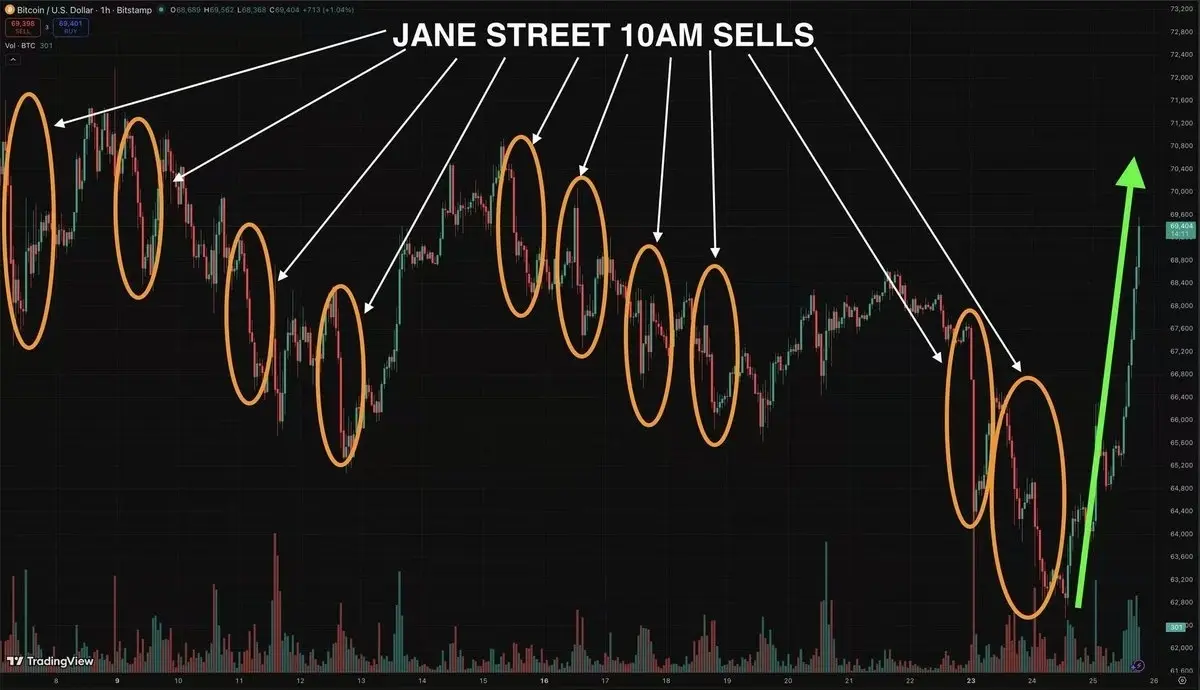
This phrase, circulated on Reddit and Crypto Twitter (CT) after the lawsuit, accompanied by an epic short squeeze with over $240 billion in liquidations, has directed market anger toward the same target: Jane Street Capital.
At 10 AM, a point of liquidity freeze in Asian markets over the past few months, the US Department of Justice’s complaint finally revealed a glimpse of the iceberg. It all started with Wall Street’s top market maker, Jane Street Capital, founded in 2000, which is accused of orchestrating a months-long “smoke and mirrors” scheme by exploiting the ETF arbitrage mechanism—using the creation and redemption process between spot and derivatives markets.
Until this lawsuit brought the controversy into the public eye, discussions around ETF arbitrage mechanisms and price discovery structures heated up rapidly, leading to a market rebound and an epic short squeeze with over $240 billion in liquidations.
But is Jane Street really the mastermind pressing the suppression button? That’s a question worth at least $1 billion.
1. Did Jane Street Really Suppress the Price of BTC?
This question deserves an accurate answer, and the most important point to understand first is that this isn’t just about Jane Street.
It’s a question about the structural features of Bitcoin ETF architecture, which equally apply to every authorized participant (AP) in the ecosystem. For example, the list of authorized participants for BlackRock’s iShares Bitcoin Trust (IBIT) includes Jane Street Capital, JPMorgan, Macquarie, Virtu Americas, Goldman Sachs, Citadel Securities, Citigroup, UBS, and ABN AMRO.
These institutions are deeply misunderstood by the public—and even among seasoned industry veterans—and before drawing any conclusions, this misconception needs correction.
Regarding APs, it’s crucial to understand that they occupy a marginal exception within the regulatory framework of Reg SHO (the SEC’s naked short selling regulation). For instance, Reg SHO requires short sellers to locate and borrow securities before shorting, but APs are exempted from this requirement due to their contractual rights to participate in creation and redemption.
While this sounds procedural, the real consequence is significant: any AP can freely create or redeem shares—without borrowing costs, without traditional shorting capital constraints, and aside from reasonable business timeframes, with no hard deadline for closing positions.
This is the gray area: a regulatory exemption designed for orderly ETF market making, which structurally cannot be distinguished from perpetual regulatory arbitrage. This exemption isn’t unique to any one company; it’s a prerequisite for becoming a member of the AP club.
2. What Does This AP Exemption Mean?
Typically, if the trading price of IBIT is below its net asset value (NAV), arbitrageurs would step in, redeem shares to buy Bitcoin, and arbitrage the difference. But any AP is essentially that arbitrageur—they control the pipeline—meaning their motivation to close the gap differs from third-party trading desks without redemption rights.
It sounds complex, but a simple analogy helps:
First Layer: What is a normal “arbitrage gap” correction?
Suppose there’s a blind box (the IBIT ETF), and everyone knows it contains a voucher worth $100 in Bitcoin (the NAV). Today, panic selling causes the ETF to trade at $95.
A rational arbitrageur would buy the ETF at $95, redeem it with the issuer, and receive the $100 Bitcoin voucher, making a $5 profit.
Because many are rushing to arbitrage, the ETF’s price quickly rises back to $100. That’s the “gap correction.”
Second Layer: The “monopoly channel” AP
In the real world of Bitcoin ETFs, ordinary traders and retail investors cannot directly redeem the ETF for Bitcoin (no redemption rights). Only a few Wall Street giants (APs) have this privilege—they monopolize the only channel to exchange ETF shares for real Bitcoin (they control the pipeline).
Third Layer: Why don’t APs follow the “rational” arbitrage?
A regular arbitrageur would exploit the riskless $5 difference immediately. But APs are different—they might think: “Since I’m the only one who can redeem, why rush? If I deliberately don’t push the price back to $100, and instead exploit the $95 low by doing other trades (like shorting or longing Bitcoin futures), I could make $20.”
In short: the market has an automatic correction mechanism (buying the dip to push prices up), but because the “only switch” to trigger this correction is controlled by APs, and they find maintaining the gap more profitable elsewhere, they have no incentive to correct the price.
Retail investors wait for arbitrageurs to save the day, unaware that the “arbitrage army” (APs) is nearby, profiting from the gap in other markets.
3. The Issue Isn’t Jane Street, But the AP Architecture
IBIT’s short exposure can theoretically be hedged with long Bitcoin spot positions, but it’s not necessary—any instrument with a strong correlation suffices.
The obvious alternative is Bitcoin futures, especially considering their capital efficiency. This means if the hedging instrument is futures rather than spot, the spot market is never actually bought, and because natural arbitrageurs choose not to buy spot, the price gap can’t be closed through natural arbitrage.
Note that the spot/futures basis itself is a core theme for basis traders, who aim to keep this relationship tight. But every divergence between the hedge instrument and the underlying introduces “dirty basis risk,” which accumulates throughout the structure—especially under stress, where basis risk is a key source of market dislocation.
The last piece involves the SEC’s recent approval of in-kind creation and redemption. Under the previous cash-only system, APs were required to deliver cash to the fund, which the custodian then used to buy Bitcoin spot—acting as a structural regulator of sorts, forcing spot purchases.
In-kind redemption eliminates this requirement: now, any AP can directly deliver Bitcoin, sourcing it from OTC desks, negotiated prices, or minimal market impact.
This flexibility means APs can maintain derivative positions while earning funding rates or volatility profits during the window between shorting and physical delivery—while still operating within the legal bounds of AP activities.
And this is precisely where the core problem lies: what appears as normal market making behavior at first glance, and also ends as such, but the intermediate process is hard to classify clearly. This isn’t a single company’s fault. Every AP on the IBIT list, and by extension every Bitcoin ETF AP, operates within the same structural framework, enjoying the same exemptions and possessing the same theoretical capabilities. Whether anyone has exercised this ability in a way that skirts the edges of coordinated activity is a question entirely within the SEC’s oversight when approving ETFs.
Whether these monitoring agreements sufficiently capture behaviors crossing spot, futures, and ETF markets (including offshore venues) remains an open question.
In short, Jane Street is just the spotlighted target. The real issue lies deep within the underlying architecture of Bitcoin ETFs, designed by Wall Street veterans. No AP is explicitly suppressing Bitcoin’s price; what they can suppress is the integrity of the price discovery mechanism itself—and that impact could be far more profound.
Therefore, the real question isn’t whether a particular company is the villain, but whether a regulatory framework built for 20th-century traditional finance is suitable for managing a 21st-century asset whose value lies in being unregulated.
This may be the tuition fee for the crypto market’s entry into the “big institution era.” After all, while we crave Wall Street liquidity, we don’t want to passively accept their black-box games built on regulatory exemptions.
This isn’t just about Jane Street; it’s the ultimate question facing the Bitcoin ETF era.


