
Chief Investment Officer Iggy Ioppe of Theo pointed out that once the US futures market closes over the weekend, the public pricing of gold shifts to the blockchain network. Chicago Mercantile Exchange (CME) gold futures cease trading at 5 PM Eastern Time on Friday and resume at 6 PM Sunday, creating nearly a 49-hour “gold pricing gap,” making tokenized gold assets PAXG and XAUt the new global tracking assets.
CME Gold Futures Weekend Closure and Pricing Gap
(Source: CEX.IO)
Ioppe stated, “In terms of publicly visible price discovery, on-chain markets are almost 100% responsible for weekend gold price discovery.” After CME futures reopen, prices tend to align closely with the trends established on the blockchain markets over the weekend.
During CME’s closure, although OTC trading in Asia continues, these transactions are not publicly disclosed, lacking transparency. In contrast, all transactions of tokenized gold are visible on-chain in real-time, making it the only public channel for institutions to track weekend gold price movements.
This weekend’s Middle East crisis is a prime example. As the US and Israel launched military strikes on Iran, tokenized gold prices surged significantly: XAUT briefly broke above $5,450, and PAXG approached $5,536, while Bitcoin declined, demonstrating the independent safe-haven function of tokenized gold amid geopolitical crises.
Advantages and Use Cases of Tokenized Gold’s Weekend Pricing
Unique Public Pricing: During CME weekend closures, PAXG and XAUt nearly monopolize the public gold price discovery function.
Institutional Signal Tracking: Macro and cross-asset trading desks monitor on-chain markets to track gap risks before CME reopens.
Real-Time Rebalancing: Traders can immediately adjust positions during geopolitical events when traditional markets are closed.
Arbitrage-Driven Liquidity: Market makers maintain pricing efficiency by arbitraging price differences between digital and traditional markets.
Explosive Growth and Future Outlook of the Tokenized Gold Market
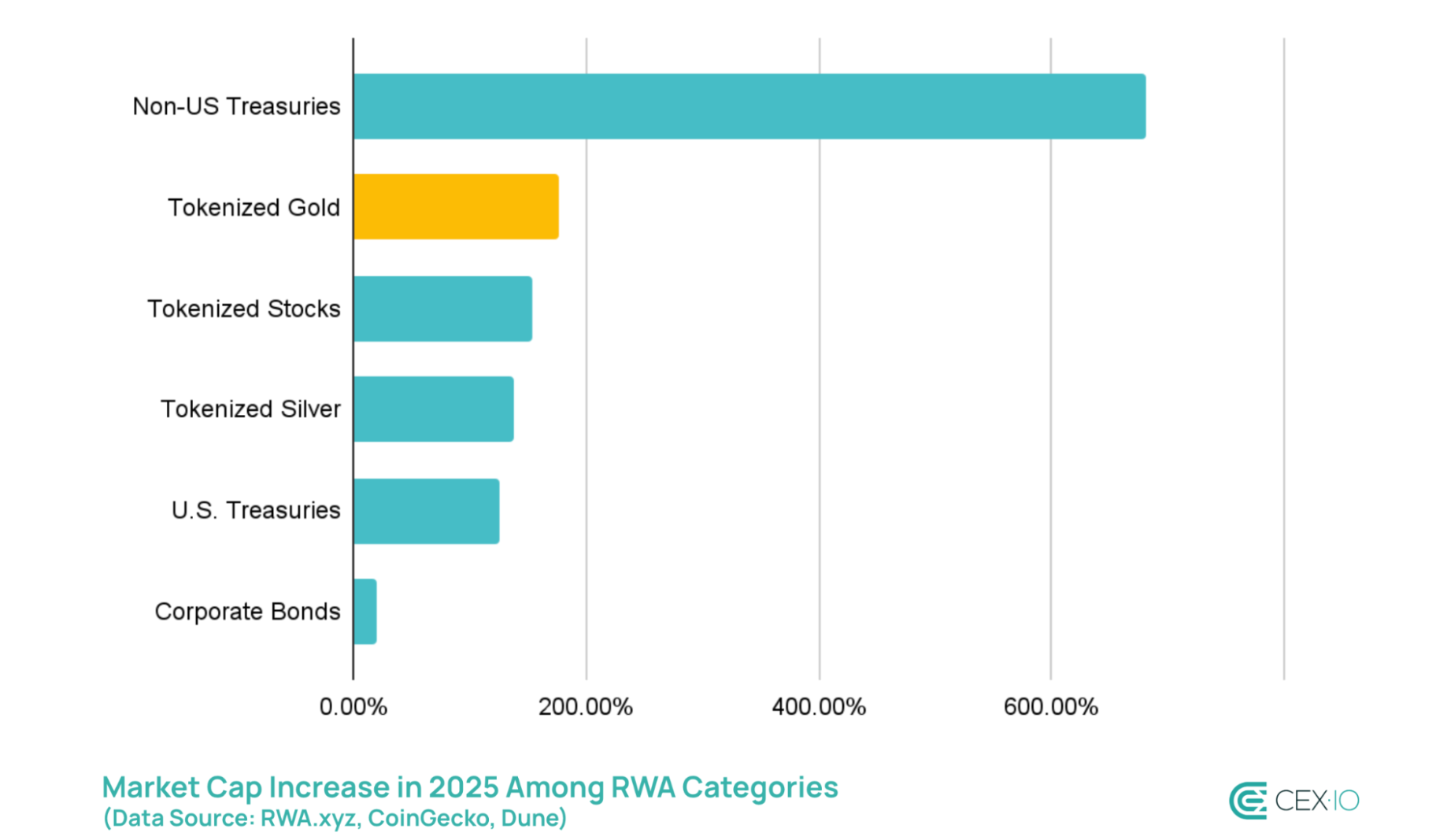
The market cap of tokenized gold grew from about $1.6 billion to $4.4 billion over the past year, an increase of 177%, far surpassing the overall gold market growth and most major physical gold ETFs. The number of holders nearly tripled, adding over 115,000 wallets, accounting for about a quarter of net inflows in the RWA sector, exceeding the combined growth of tokenized stocks, corporate bonds, and non-US government bonds.
In terms of trading volume, tokenized gold is projected to reach approximately $178 billion by 2025, with a peak of over $126 billion in Q4, making it the second-largest gold investment product globally, after SPDR Gold Trust.
However, Ioppe noted that there are still obstacles: liquidity for tokenized gold remains below that of futures or ETFs, making large transactions difficult; regulatory frameworks vary significantly across jurisdictions, hindering large-scale institutional adoption. He expects the tokenized market and traditional markets to coexist, each serving different functions.
Frequently Asked Questions
Q: Why is tokenized gold important during CME weekend closures?
CME gold futures are closed for nearly 49 hours over the weekend. During this period, Asian OTC trading continues but is not publicly disclosed. Tokenized gold (PAXG, XAUt) is among the few assets that continue trading and are publicly visible, thus nearly 100% responsible for weekend gold price discovery.
Q: How fast has the market cap of tokenized gold grown?
Over the past year, the market cap surged from about $1.6 billion to $4.4 billion, an increase of 177%, far exceeding most major gold ETFs’ growth during the same period. The number of holders nearly tripled, adding over 115,000 wallets, making it one of the largest growth engines in the RWA sector.
Q: What are the main challenges facing tokenized gold?
Major challenges include: liquidity still below that of traditional futures and ETFs, making large trades difficult; significant regulatory differences across jurisdictions; and disparities in custody, accounting, and capital rules worldwide, hindering large-scale institutional deployment.
Disclaimer: The information on this page may come from third parties and does not represent the views or opinions of Gate. The content displayed on this page is for reference only and does not constitute any financial, investment, or legal advice. Gate does not guarantee the accuracy or completeness of the information and shall not be liable for any losses arising from the use of this information. Virtual asset investments carry high risks and are subject to significant price volatility. You may lose all of your invested principal. Please fully understand the relevant risks and make prudent decisions based on your own financial situation and risk tolerance. For details, please refer to
Disclaimer.
Related Articles
Bitcoin Breaks Through $73,000! Outperforms Gold Amid US-Iran War, EF Sells 10.2 Million ETH
Bitcoin recently broke through $73,000 with strong performance, decoupling from tech stocks and gold. Analysts predict that if the market stabilizes, it could rise to $75,000 to $80,000. However, geopolitical risks and extremely fearful market sentiment continue to pressure prices. Meanwhile, the Ethereum Foundation sold Ether for approximately $10.2 million to maintain operations.
CryptoCity19m ago
On-chain activity is exploding, but Ethereum can't seem to gain momentum? Experts reveal the "fatal weakness": could drop to $1,500
CryptoQuant's latest report indicates that Ethereum is facing an "adoption paradox," where network activity reaches new highs, but the token price continues to decline. Analysts predict that if the bear market persists, Ether could fall to $1,500. Despite thriving on-chain activity, it has decoupled from the token price, and the high proportion of Ether flowing into exchanges suggests heavy selling pressure and weak investment demand.
区块客28m ago
Bitcoin Breaks Through $74,000! 24-Hour Surge of 3.68%, ETFs Continue to Attract Capital, Multiple Factors Provide Support
Bitcoin broke through $74,000 on March 16th, with a gain of 3.68%, primarily driven by ETF capital inflows, halving supply effects, and geopolitical safe-haven demand. While market sentiment remains optimistic, short-term volatility is intensifying, and investors should carefully manage risk and monitor future support levels and selling pressure.
動區BlockTempo34m ago
Price Spreads Exceed 50%, Pre-Market Arbitrage on Crypto Stocks to Become New Business in Bear Market
Mysten Labs CEO Evan Sui believes that "bear markets" are not beneficial for the development of the cryptocurrency industry, as many projects face cash flow crises and may withdraw. However, data shows that over 80% of crypto startups are still in development, and bear markets can help focus the project teams' development efforts. The article explores the demand and potential entrepreneurial directions in the pre-market trading sector of tokens, pointing out that the crypto market lacks "bridge platforms" to integrate price differences between various trading markets, and recommends creating new platforms that meet market needs.
PANews46m ago
10x Research: Unusual Adjustments in Bitcoin On-Chain Capital Flows and Position Changes
10x Research posted a message on the X platform stating that Bitcoin prices are rising slowly, with abnormal capital flows appearing in the market. Recently, funding rates and risk indicators have undergone significant adjustments, market trends are being influenced by position structures, and changes in positions for Ethereum and Bitcoin require attention, with options trading before the end of March being particularly critical.
GateNews48m ago
BTC Short-term Rise 1.25%: Whale Buying and Key Level Breakthrough Drive Market Acceleration Upward
During 2026-03-16 03:30-03:45 (UTC), BTC recorded a +1.25% return with a price range of 72,851.9 to 74,300.0 USDT, reaching an amplitude of 1.99%. The K-line candle showed significant volume expansion during this period, with increased market attention and notable short-term volatility. Investors rapidly entered the market, with trading volume exceeding daily average levels, reflecting capital-driven momentum behind the price movement.
The primary drivers of this unusual movement were concentrated whale fund buying and a breakout through key technical levels. On-chain monitoring data showed 4 transactions each exceeding 1,000 BTC during the anomaly period.
GateNews1h ago


