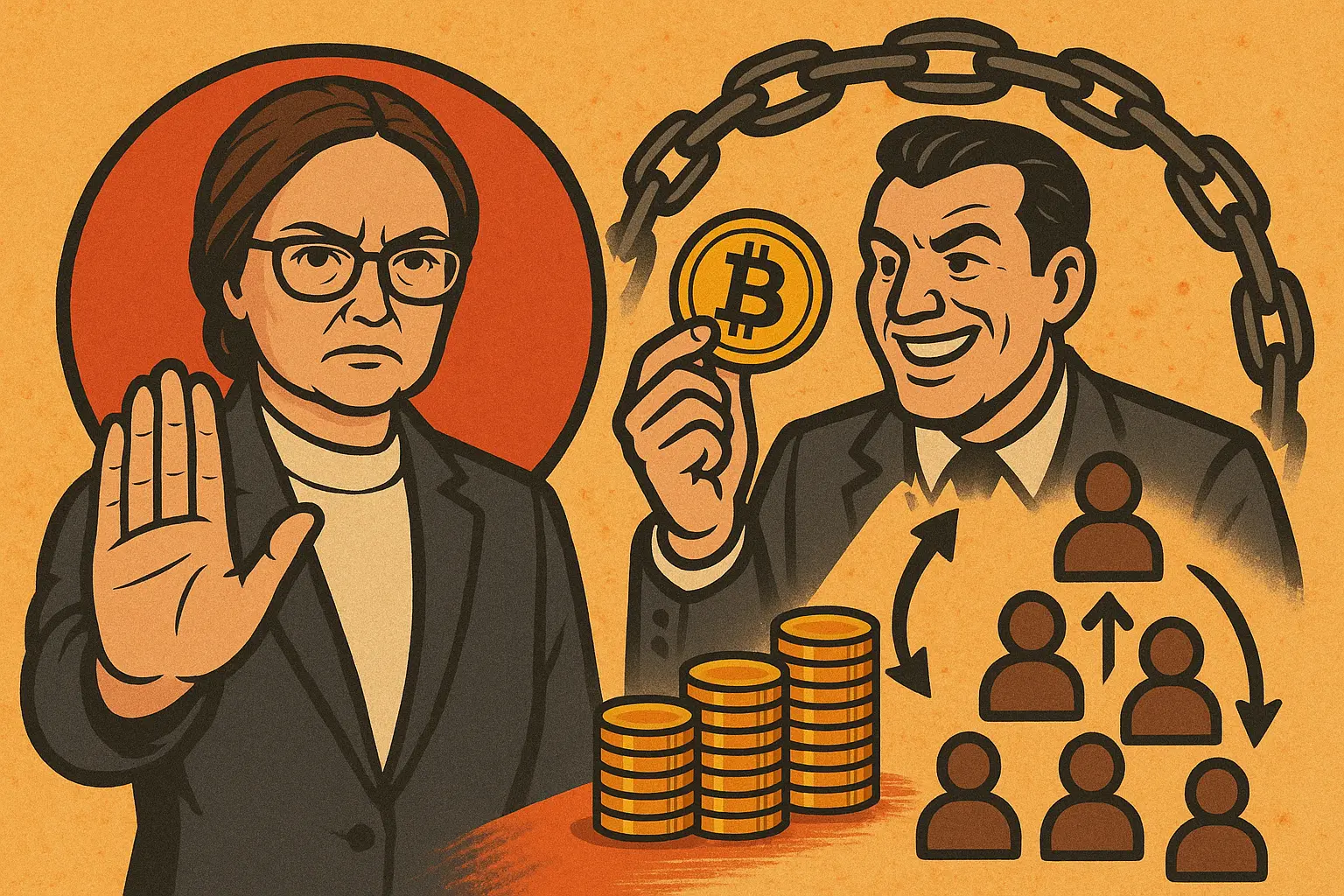
The Russian Central Bank recently issued a report warning that organizers of financial pyramid schemes are increasingly using cryptocurrencies as their main fundraising tool, with the proportion rising from 77% in 2024 to 84% in 2025. Last year, the central bank identified a total of 7,087 financial pyramid scams, disguised brokers, and other fraudulent schemes, of which 80% operated online, and most used cryptocurrencies and money mules for transferring funds.
Key Findings from the Russian Central Bank
According to the report, the scale and organizational structure of these scams demonstrate a clear trend of systemic transformation:
Scale of scams: Among the 7,087 scams identified last year, financial pyramids, fake legitimate brokers, and high-yield fraudulent crypto investment projects were involved.
Online operation rate: 80% of pyramid schemes operate entirely online, with no physical offices; they primarily contact potential victims through social media, messaging apps, and phone calls.
Cryptocurrency adoption rate: In 2025, 84% of scammers raise funds via cryptocurrencies, up from 77% in 2024.
Fake crypto investment projects: Approximately 1,500 companies sell false cryptocurrency investment schemes to potential clients.
Fund transfer tools: Mainly cryptocurrencies, supplemented by networks of money mules, to perform multi-layered, dispersed transfers that obscure the flow of funds.
Bank officials noted in the report that scammers “prefer cryptocurrencies because tokens allow them to remain anonymous and evade punishment,” making cryptocurrencies the top tool for pyramid schemes to avoid detection.
Countermeasures and Market Regulation Strengthening
In response to the rapid growth of crypto scams, the Russian Central Bank has taken specific actions:
Blocking measures: Ordered the blocking of 21,500 websites and social media posts related to crypto scammers and other financial frauds.
Consumer warnings: The central bank explicitly reminds the public that only companies with legitimate licenses are authorized to offer investment products to Russian retail investors. It also commits to continuously identifying increasingly complex financial pyramids and online scams, and to intensify efforts to publicly combat crypto fraud.
These regulatory actions occur amid a rapid increase in overall crypto adoption in Russia. According to the Russian Ministry of Finance, Russians spend up to $648 million daily on cryptocurrencies. The ministry is currently accelerating the development of new regulations, which may soon include blocking access to overseas crypto exchanges, indicating that Russia is tightening control over foreign platforms while expanding domestic crypto use.
Frequently Asked Questions
Q: Why are Russian pyramid schemes shifting heavily toward cryptocurrencies?
The Russian Central Bank explicitly states in the report that the main reason scammers prefer cryptocurrencies is their anonymity and difficulty to trace. Compared to traditional bank transfers, on-chain fund flows can be quickly dispersed through multiple intermediate addresses, and cross-border transfers are not directly regulated by traditional financial oversight, greatly increasing law enforcement challenges.
Q: How does the Russian Central Bank identify and track these fraudulent crypto wallets?
The central bank monitors abnormal fund flow patterns, analyzes wallet addresses reported by victims, and collaborates with on-chain data analysis firms to identify scam wallets. In this report, the bank marked over 4,600 addresses controlled by scammers, though specific technical methods for tracking are not fully disclosed, indicating that the monitoring system is still being improved.
Q: What impact might upcoming Russian crypto regulations have on foreign exchanges?
The Russian Ministry of Finance is accelerating the development of regulations that could block access to overseas crypto exchanges. If enacted, foreign platforms not licensed within Russia may be blocked, potentially forcing Russian crypto users to turn to domestic regulated platforms, further shrinking existing offshore trading channels.
Disclaimer: The information on this page may come from third parties and does not represent the views or opinions of Gate. The content displayed on this page is for reference only and does not constitute any financial, investment, or legal advice. Gate does not guarantee the accuracy or completeness of the information and shall not be liable for any losses arising from the use of this information. Virtual asset investments carry high risks and are subject to significant price volatility. You may lose all of your invested principal. Please fully understand the relevant risks and make prudent decisions based on your own financial situation and risk tolerance. For details, please refer to
Disclaimer.
Related Articles
DeFi Lobbying Group Withdraws Airdrop Lawsuit Against US SEC, Citing Changed Regulatory Landscape for Crypto Industry
Texas apparel company Beba and DeFi Education Fund voluntarily withdrew their lawsuit against the U.S. SEC, as statements from the SEC's crypto task force and Commissioner Peirce may influence regulatory treatment of airdrops. The withdrawal preserves the right to refile the case in the future.
GateNews29m ago
Argentina Orders Polymarket Blockade, Accurate Inflation Predictions Suspected of Insider Trading
Argentina has blocked the prediction market platform Polymarket, citing unusual market reversals that occurred before official inflation data releases, which raised insider trading concerns. A court ordered internet service providers to execute the block, bringing the number of countries restricting the platform to over 30. The legal basis for the block involves consumer protection and gambling regulation issues.
MarketWhisper1h ago
# Are Influencer Trading Experts Fake? US-Based TJR Exposed for Course Income Reaching $2 Million
US trading influencer ImanTrading has accused fellow trading influencer TJR of performance fabrication, over-enrolling in courses, and profiting from promoting and then dumping cryptocurrencies, which has garnered widespread attention. The video points out that TJR's trading records appear to be manually entered rather than from actual accounts, and accuses him of creating illusions through exaggerated wealth narratives and simulated account displays. These issues are similar to long-standing phenomena in Taiwan's crypto community, reminding investors to carefully assess the true capabilities of trading influencers.
MarketWhisper3h ago
Polymarket Iran Missile Prediction Sparks Journalist Death Threats, Platform Bans Users Behind Reports
Decentralized prediction market platform Polymarket has blocked multiple bettors due to death threats issued against journalist Fabian. The incident stemmed from a report about Iranian missile strikes. The threatened journalist stated that people attempted to pressure him into modifying the report to influence betting outcomes. The incident has sparked discussions about prediction market regulation, highlighting potential threats to press independence and professional ethics.
MarketWhisper3h ago
South Korea Police Agency Sets First-Ever Dark Coin Management Guidelines, Virtual Assets Compressed by Approximately 54.5 Billion Korean Won Over Past 5 Years
Korea's National Police Agency completes draft virtual asset management directive, first time including dark coin management and clarifying software wallet solutions. Over the past 5 years, virtual assets worth approximately 54.5 billion won have been seized, with police planning to select private custodian institutions. Experts recommend establishing a government-led custody system.
GateNews3h ago
SEC Unveils Dual Regulatory Reform, OTC Quote Restrictions and Quarterly Reports Risk Disappearing
The U.S. Securities and Exchange Commission (SEC) has proposed two regulatory measures: First, revising Rule 15c2-11 to apply only to equities, explicitly excluding other asset classes, which would have a positive impact on the cryptocurrency market; Second, considering the elimination of mandatory quarterly financial reports in favor of semi-annual reporting, which could reduce corporate costs but raises concerns about transparency and market volatility. Both proposals are currently under review.
MarketWhisper4h ago


