 Trusted Editorial content, reviewed by leading industry experts and seasoned editors. Ad Disclosure
Arthur Hayes argues that a deeper US conflict with Iran could ultimately become a bullish macro setup for Bitcoin, not because war is constructive for markets, but because it may push the Federal Reserve toward cheaper and more abundant money.
Trusted Editorial content, reviewed by leading industry experts and seasoned editors. Ad Disclosure
Arthur Hayes argues that a deeper US conflict with Iran could ultimately become a bullish macro setup for Bitcoin, not because war is constructive for markets, but because it may push the Federal Reserve toward cheaper and more abundant money.
Why Bitcoin Could Surge
In his March 2 essay iOS Warfare, the BitMEX co-founder laid out a simple thesis: if President Donald Trump commits the US to a prolonged and expensive campaign tied to Iran, the political and fiscal strain could raise the odds of monetary easing. For Hayes, that matters more than the conflict itself. “The longer Trump engages in the extremely costly activity of Iranian nation-building,” he wrote, “the higher the likelihood the Fed lowers the price and increases the quantity of money to support Pax Americana’s latest bout of Middle Eastern adventurism.”
Related Reading: Bitcoin Dumps On Geopolitical Shock Again: History Shows How This Might Play OutHayes’ argument rests on a historical pattern rather than a direct forecast on oil, geopolitics or battlefield outcomes. He points to prior US military engagements in the Middle East and says major conflicts were followed, or accompanied, by easier monetary policy. In his reading, wars do not just damage confidence and strain public finances; they also create conditions in which the Fed has cover to cut rates, support liquidity and help stabilize asset markets.
To support that view, Hayes cites several episodes going back to 1990. After the Gulf War began, he notes, the Fed initially stayed put but signaled that worsening conditions could force a shift. From the August 21, 1990 FOMC discussion, he quotes: “The heightened uncertainties and the prospectively less satisfactory performance of the economy stemming from events in the Middle East had greatly complicated the formulation of an effective monetary policy. In the opinion of several members, events appeared likely to unfold in a direction that would require an easing of policy at some point to counter weakening tendencies in the economy that had been in train before the oil price increase.”
Related Reading: Bitcoin Spot ETFs Record $787 Million Inflows To Break 5-Week Negative StreakHe also highlights the Fed’s response after the September 2001 attacks and the launch of the Global War on Terror. In an emergency meeting, then-Chair Alan Greenspan said: “It’s clear that the events of last week, at a minimum, have created a heightened degree of fear and uncertainty that is placing considerable downward pressure on asset prices, increasing the probability of an asset price deflation, with its obvious impact on the economy. Therefore, I propose a 50-basis point cut in the federal funds rate target.”
For Hayes, those episodes show that geopolitical shocks can become monetary events. His framing is blunt: when war dents confidence, threatens growth or pressures markets, the policy answer tends to be lower rates and more liquidity. That, in turn, is the backdrop he believes tends to favor Bitcoin.
Still, Hayes is not calling for an immediate risk-on trade. He says the market does not yet know how long Trump would stay committed to reshaping Iran, nor how much market or political pain the administration can absorb before changing course. Because of that, he argues the cleaner trade is to wait for confirmation from policy rather than front-run the thesis too early.
“The prudent action is to wait and see,” Hayes wrote. “The time to back up the truck and buy Bitcoin and high-quality shitcoins like HYPE is immediately after the Fed cuts rates and or prints money to support the government’s goals in Iran.”
At press time, Bitcoin traded at $66,218.
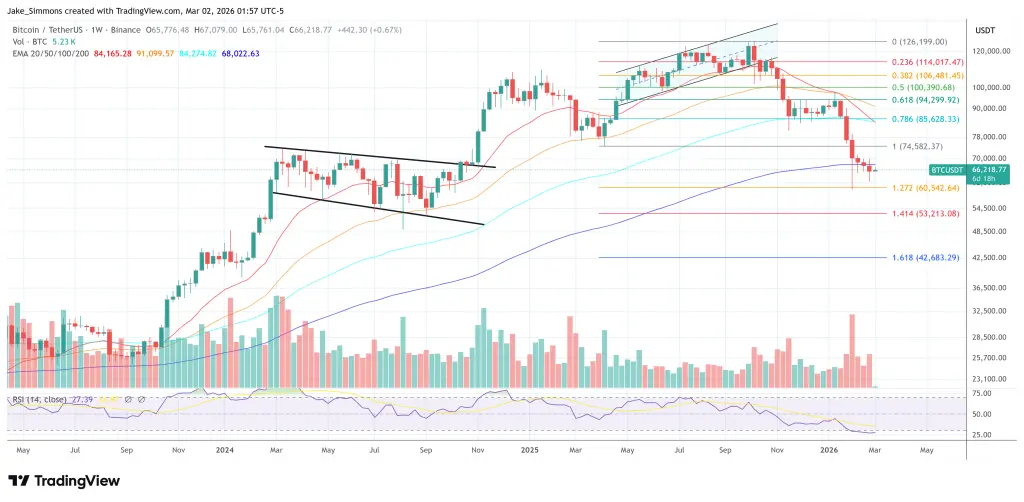 Bitcoin must reclaim the 200-week EMA, 1-week chart | Source: BTCUSDT on TradingView.comFeatured image created with DALL.E, chart from TradingView.com
![]() Editorial Process for bitcoinist is centered on delivering thoroughly researched, accurate, and unbiased content. We uphold strict sourcing standards, and each page undergoes diligent review by our team of top technology experts and seasoned editors. This process ensures the integrity, relevance, and value of our content for our readers.
Editorial Process for bitcoinist is centered on delivering thoroughly researched, accurate, and unbiased content. We uphold strict sourcing standards, and each page undergoes diligent review by our team of top technology experts and seasoned editors. This process ensures the integrity, relevance, and value of our content for our readers.
Disclaimer: The information on this page may come from third parties and does not represent the views or opinions of Gate. The content displayed on this page is for reference only and does not constitute any financial, investment, or legal advice. Gate does not guarantee the accuracy or completeness of the information and shall not be liable for any losses arising from the use of this information. Virtual asset investments carry high risks and are subject to significant price volatility. You may lose all of your invested principal. Please fully understand the relevant risks and make prudent decisions based on your own financial situation and risk tolerance. For details, please refer to
Disclaimer.
Related Articles
Numerical Analysis of Asset Performance from 2026 to Present: Bitcoin Worst Performer, Crude Oil Best
Author: Coingecko
Compiled by: Felix, PANews
Following a turbulent end to 2025, Bitcoin continued to fluctuate downward in early 2026. Meanwhile, geopolitical and macroeconomic events have driven the rise in gold, silver, and recently crude oil prices. As cryptocurrencies continue to be adopted by the mainstream as an asset class, many Wall Street investors may be experiencing their first crypto bear market. Coingecko examined how cryptocurrencies performed relative to other traditional asset classes at the beginning of 2026.
With the outbreak of the Iran war, crude oil prices have surged faster than all other asset classes since early 2026.
Since the start of 2026, crude oil prices have been gradually increasing due to escalating tensions in the Middle East and critical shortages in market supply. However, as the United States and Israel launched operations on February 28,
PANews5m ago
Bernstein: 60% of Bitcoin Unmoved for Over a Year, Long-Term Holders Remain Steadfast
A Bernstein report shows that Bitcoin retail holders have recently engaged in panic selling, but long-term holders remain steadfast, with over 60% of Bitcoin unmoved for more than a year, demonstrating confidence in Bitcoin and its characteristics as a store of value.
GateNews6m ago
Michael Saylor's Strategy Trims Losses as Bitcoin Tops $74,000 - U.Today
Strategy Inc. has reduced its losses from Bitcoin's decline to $62,553 as the price rebounded to $74,000, improving its portfolio by 8.7%. Despite ongoing volatility, Michael Saylor remains optimistic about Bitcoin's recovery, aiming for a million BTC holdings.
UToday14m ago
Jane Street-affiliated address received 205.36 BTC over the past 2 hours
Gate News report: On March 16, according to Lookonchain monitoring, a Jane Street-associated address received 205.36 Bitcoin from a certain CEX within the past 2 hours, valued at approximately $15.08 million.
GateNews20m ago
Glassnode: BTC Options Market Shows Concentrated Negative Gamma Positions Near $75,000, Potentially Amplifying Upside Volatility
Gate News reported on March 16 that blockchain data analytics firm Glassnode stated on social media that the Bitcoin options market has a significant concentration of negative gamma positions around the $75,000 strike price. Data shows that market makers are widely holding structural call option short positions at this price level. Glassnode noted that when Bitcoin spot price approaches this region, hedging operations by market makers could intensify, potentially amplifying upward price volatility.
GateNews24m ago
If starting from 2018, buying one BTC deep out-of-the-money put option every month, can you make money long-term?
# Author: Michel Athayde, Bitget Wallet BD Ambassador
## Abstract
In traditional financial markets, long-term purchases of deep out-of-the-money (OTM) puts are often viewed as a classic "black swan insurance" strategy: consistently losing premium in normal times, but breaking even or making significant profits in a single event when extreme risks occur. The question is: does this logic still hold in the crypto market with higher volatility and more frequent crashes?
The backtesting results presented in this report provide a nuanced answer. Based on historical data from 2018-01-01 to 2026-03-14, we conducted an analysis of
PANews27m ago


