Prediction markets cool in February, but high trading volume signals continued demand and sector maturity.
Industry data shows the first monthly decline of prediction markets since August 2025. Even so, activity remained historically high. Total traded volume reached $23.4 billion in February 2026, pointing to sustained user interest despite the cooldown.
Prediction Markets Post First Monthly Decline Since August
After several months of rapid growth, prediction markets cooled in February. Trading activity dipped slightly, but overall participation remained high. Data from Artemis shows the total volume reached $23.4 billion during the month.
That figure marks the first monthly decline after several months of aggressive gains across leading venues. Even with the drop, February’s activity still ranks among the strongest periods on record. Analysts say such slowdowns are common after fast expansion.
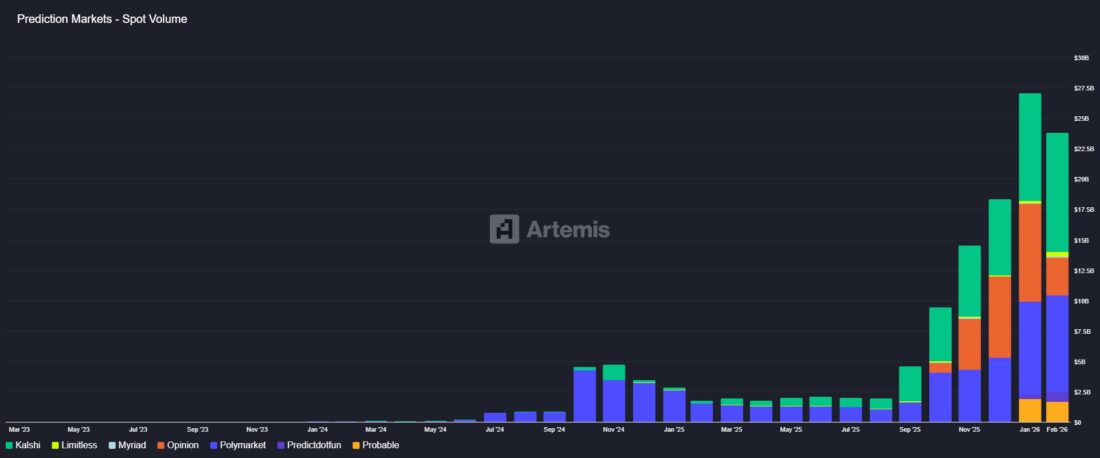
_Image source: _Artemis
Among major platforms, Kalshi extended its lead. February trading volume climbed to $9.8 billion, up from $8.9 billion in January. Growth at Kalshi stood out against broader moderation across the sector.
Regulated status in the United States continues to attract both institutional and retail traders. On the other hand, activity at Polymarket was steadier. Monthly volume reached $7.6 billion, broadly flat or slightly lower than January.
Stabilization followed a period of sharp gains in prior months. Market watchers describe February as a pause within a longer uptrend. Polymarket’s on-chain settlement model and global access remain central to its appeal.
Meanwhile, Opinion Labs saw the sharpest decline in February. The platform’s trading volume dropped to $3.1 billion from $8.1 billion the month before. It indicates fewer traders were active than in earlier months. Some users may have reduced their positions after a period of fast growth.
Strong Baseline Activity Keeps Markets Resilient After Pullback
Momentum across prediction markets remains firm despite February’s decline. Event-based trading platforms have evolved into a distinct segment of the digital asset market, where users take positions on real-world outcomes. Elections, economic releases, and geopolitical developments continue to attract steady activity.
Elevated baseline volume suggests traders still rely on these venues for price discovery and risk management. February’s slowdown appears to be a market reset and not a breakdown. Even though growth has cooled, participation remains well above mid-2025 levels.
Leading platforms are competing on market structure, access, and regulatory clarity, signaling a shift toward sustainability over rapid expansion. If current volumes hold, the industry could transition into a more stable growth phase after months of aggressive gains.
Disclaimer: The information on this page may come from third parties and does not represent the views or opinions of Gate. The content displayed on this page is for reference only and does not constitute any financial, investment, or legal advice. Gate does not guarantee the accuracy or completeness of the information and shall not be liable for any losses arising from the use of this information. Virtual asset investments carry high risks and are subject to significant price volatility. You may lose all of your invested principal. Please fully understand the relevant risks and make prudent decisions based on your own financial situation and risk tolerance. For details, please refer to
Disclaimer.
Related Articles
Polymarket Data: The probability of BTC surpassing $75,000 in March has increased to 83%, and the probability of ETH surpassing $2,400 is 70%
Polymarket data shows that BTC has an 83% probability of breaking through $75,000 in March, while the probability of falling below $65,000 is 32%. ETH has a 70% probability of breaking through $2,400, breaking through $2,600 is 34%, and falling below $1,800 is only 9%.
GateNews2h ago
Polymarket predicts probability of US-Iran ceasefire before April 30 drops to 36%, down 43% this month
Gate News reports that on March 16, according to Odaily Seer's Oracle Channel monitoring, the probability of a ceasefire between the US and Iran on Polymarket before April 30 has dropped to 36%, down 43% this month. This probability had reached a peak of over 75% in early March before experiencing a sharp decline.
GateNews2h ago
Incorporate Trump into Investment Models? Taiwan Entrepreneur Open-Sources "Trump Code" to Analyze US Stocks with Over 60% Accuracy Rate
President Trump's comments have profound impacts on the stock market. Taiwan entrepreneur TK Lin launched the "Trump Code" project, which utilizes big data and machine learning to analyze the correlations between his tweets and market movements, successfully establishing an effective trading signal system. The current accuracy rate is 61.3%, with the project open-sourced on GitHub and supporting integration with trading bots.
ChainNewsAbmedia3h ago
Crypto Researcher: 70% of Top 20 Profitable Traders on Polymarket Are Bots
Gate News reports that on March 16, crypto researcher Stacy Muur disclosed on the X platform that among the top 20 profitable traders on Polymarket, 14 are bot accounts, accounting for 70%. Stacy Muur believes that building dedicated prediction market platform infrastructure for AI Agents could likely become a project direction worth billions of dollars.
GateNews3h ago
Israeli journalist faces death threats from prediction platform users for accurately reporting Iranian missile attack
An Israeli Times reporter faced harassment and death threats for accurately covering Iran's missile attack, with threateners attempting to coerce report modifications due to failed bets. The reporter has filed a complaint, stating commitment to professional ethics while expressing concern that others could be tempted.
GateNews4h ago
Kalshi platform revenue reaches $110 million in the past 30 days, topping the prediction market revenue rankings
Gate News reports that on March 16, prediction market data platform Parity released data showing the top 6 prediction market revenues over the past 30 days as follows: Kalshi leads with $11 million in revenue; Polymarket with $4.2 million; a certain CEX with $4.17 million; Opinion Labs with $1.36 million; Limitless with $1.17 million; and IBKR with $600,000.
GateNews4h ago


