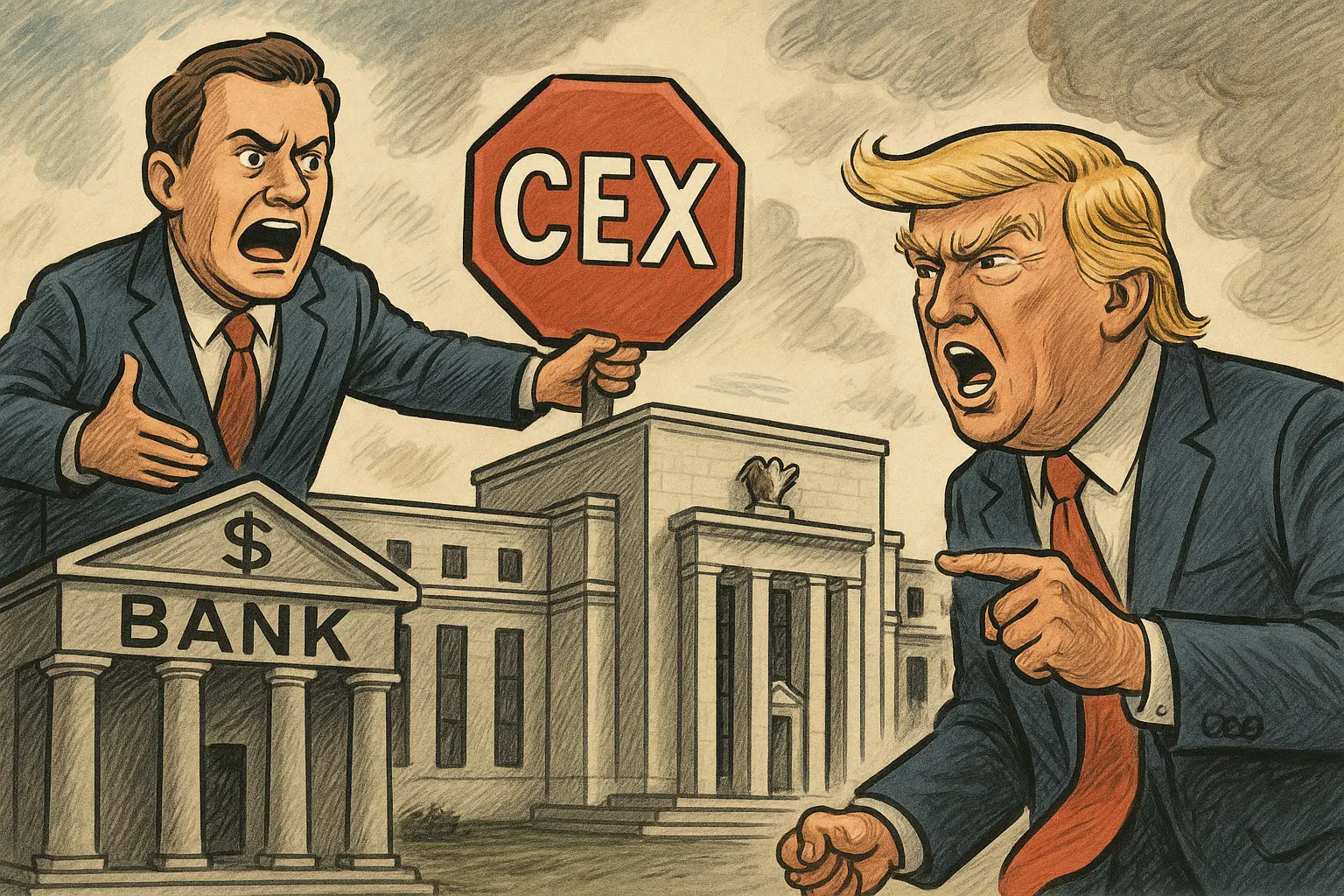
Cryptocurrency exchange Kraken has become the first crypto company to obtain a main account with the Federal Reserve, allowing it to settle U.S. dollar transactions directly through the Fed; the Independent Community Bankers of America (ICBA) and the Bank Policy Institute (BPI) immediately issued strong opposition statements, while President Trump publicly accused banks of obstructing cryptocurrency legislation progress.
Kraken’s Federal Reserve Main Account: Banking Industry Claims It Threatens Financial Stability
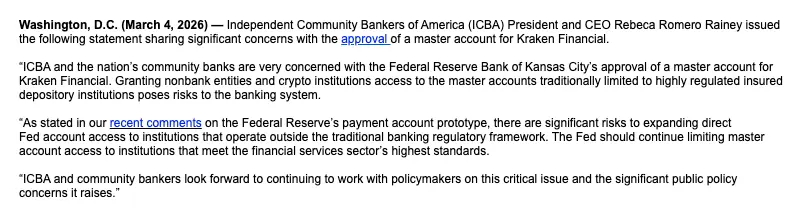
(Source: ICBA)
Kraken becomes the first crypto company directly connected to the Federal Reserve’s core payment infrastructure, meaning it can settle U.S. dollar transactions directly through the Fed, effectively bypassing traditional intermediary banks. However, Kraken has not received all the benefits that traditional banks enjoy from the Fed, such as reserve interest.
Hours after the announcement, ICBA CEO Rebeca Romero issued a statement: “Allowing non-bank entities and crypto firms to use main accounts traditionally limited to highly regulated depository institutions poses risks to the banking system.” BPI criticized the Fed for “ignoring the public consultation process previously required for this framework,” and for a lack of transparency in approval procedures and risk mitigation measures.
Stablecoin Interest Dispute: Structural Concerns Over $6.6 Trillion in Deposits Outflow
The banking industry’s resistance to Kraken’s main account is the latest chapter in broader regulatory debates. In April last year, a U.S. Treasury Department report estimated that stablecoins could lead to a deposit outflow of up to $6.6 trillion. One month after the passage of the GENIUS Act, five banking associations, including ICBA and BPI, jointly wrote to Congress urging to close regulatory loopholes that allow stablecoin issuers to pay interest indirectly through exchanges, warning that such actions could increase borrowing costs and reduce credit for businesses and households.
Currently, the core controversy surrounding the CLARITY Act centers on whether cryptocurrency exchanges can offer returns similar to interest on stablecoins. Trump publicly stated on Truth Social: “Americans should let their money earn more. Banks are creating historic profits, and we will not allow them to undermine our strong crypto agenda, or else cryptocurrencies will eventually flow to China and other countries.”
Key Disputes Between Banking Industry and Trump’s Crypto Agenda
Kraken’s Main Account: First crypto firm connected to Fed payment infrastructure; ICBA and BPI claim it poses stability risks and lacks transparency in decision-making
Stablecoin Deposit Risks: Treasury estimates stablecoins could cause $6.6 trillion in deposit outflows from traditional banks
GENIUS Act Loophole: Banking groups urge banning exchanges from indirectly paying interest to stablecoin holders
CLARITY Act Controversy: Whether crypto exchanges can provide interest-like returns remains a key unresolved issue
Trump’s Public Stance: Accuses banks of obstructing crypto agenda, posts after private meeting with Coinbase CEO Brian Armstrong at the White House
FAQs
What is the significance of Kraken obtaining a Federal Reserve main account?
A Fed Main Account allows the holder to settle U.S. dollar transactions directly with the Federal Reserve, a privilege previously limited to highly regulated depository institutions. Kraken becoming the first crypto company with this access means it can directly connect to the U.S. payment system shared by thousands of banks and credit unions, bypassing intermediaries, reducing settlement costs and times, and marking a major step for cryptocurrencies entering traditional financial infrastructure.
Why are U.S. banks concerned about the development of stablecoins, and is there evidence?
Banks’ main concern is deposit outflow—if users transfer funds into interest-bearing stablecoins, traditional bank deposits could shrink significantly. The Treasury estimates this could be as much as $6.6 trillion, which would weaken banks’ lending capacity, raise borrowing costs, and impact credit availability for businesses and households. These concerns are documented in the joint letter from five banking associations.
What are the political motives behind Trump’s strong involvement in crypto legislation disputes?
The Trump family holds stakes in several crypto companies, and his push for the CLARITY Act to pass before the midterm elections in November is clear—these elections could shift control of Congress. After a private meeting with Coinbase CEO Brian Armstrong at the White House, Trump posted on Truth Social his strongest stance on crypto to date, indicating this is both a policy position and a politically motivated move ahead of the elections.
Disclaimer: The information on this page may come from third parties and does not represent the views or opinions of Gate. The content displayed on this page is for reference only and does not constitute any financial, investment, or legal advice. Gate does not guarantee the accuracy or completeness of the information and shall not be liable for any losses arising from the use of this information. Virtual asset investments carry high risks and are subject to significant price volatility. You may lose all of your invested principal. Please fully understand the relevant risks and make prudent decisions based on your own financial situation and risk tolerance. For details, please refer to
Disclaimer.
Related Articles
Comtus Holdings Pushes For Standardization Of Won Stablecoin Transfers
Comtus Holdings proposed a standardized framework for won-backed stablecoins in South Korea to enhance adoption and regulatory compliance. This initiative aligns with the ongoing discussions of the Digital Asset Basic Act, aiming to bolster domestic currency demand while ensuring user protection and financial stability.
Blockzeit26m ago
Japanese PM Sanae Takaichi Under Scrutiny, Crypto Supportive Admin in Trouble?
Japanese PM Sanae Takaichi faces scrutiny over alleged pressure on the central bank regarding monetary policy, coinciding with her pro-crypto stance. Her policies have aimed to support the crypto industry amid ongoing geopolitical tensions impacting market behavior.
TheNewsCrypto35m ago
CFTC: The US is becoming the global "crypto capital"
Chairman Michael Selig of the U.S. Commodity Futures Trading Commission announced a new regulatory approach to position the U.S. as a global crypto hub. The "Project Crypto Initiative" aims to enhance coordination with the SEC and clarify crypto asset classification while ensuring transparency in digital markets.
TapChiBitcoin1h ago
CME Data: The probability of the Federal Reserve cutting interest rates in March has decreased to 2.6%, and the probability of holding rates steady in April is 85.3%.
CME data from March 10th indicates that due to Middle East geopolitical tensions and rising oil prices triggering inflation risks, the market's expectation of the Federal Reserve cutting interest rates has weakened. Currently, the probability of a 25 basis point rate cut in March is only 2.6%, while the probability of holding rates steady is as high as 97.4%. It is expected that by April, the Federal Reserve will maintain steady rates with an 85.3% probability.
GateNews3h ago
CRCL stock price increased by 87% in a month, driven by short squeeze and the dual factors of US-Iran conflict
CRCL stock price rose about 10% on March 9, with a total increase of 87.18% over the past month. Mizuho Bank analysts pointed out that this surge was driven by Middle East geopolitical conflicts leading to high oil prices, which boosted inflation expectations and increased the earnings of stablecoin issuers. Another analysis suggests that the stock price increase was mainly due to short covering. Valuation analysis indicates that CRCL's current stock price is above its intrinsic value, posing a risk of overvaluation.
MarketWhisper4h ago
Oil Prices Make Case for Lower Rates, Crypto Prices Surge in the Multifaceted Scenario
The essay discusses the potential for rate cuts by the Federal Reserve due to rising oil prices and inflation concerns, alongside a surge in crypto prices following President Trump's comments on the Iran war. Gold prices have also risen in response to market shifts.
TheNewsCrypto4h ago


