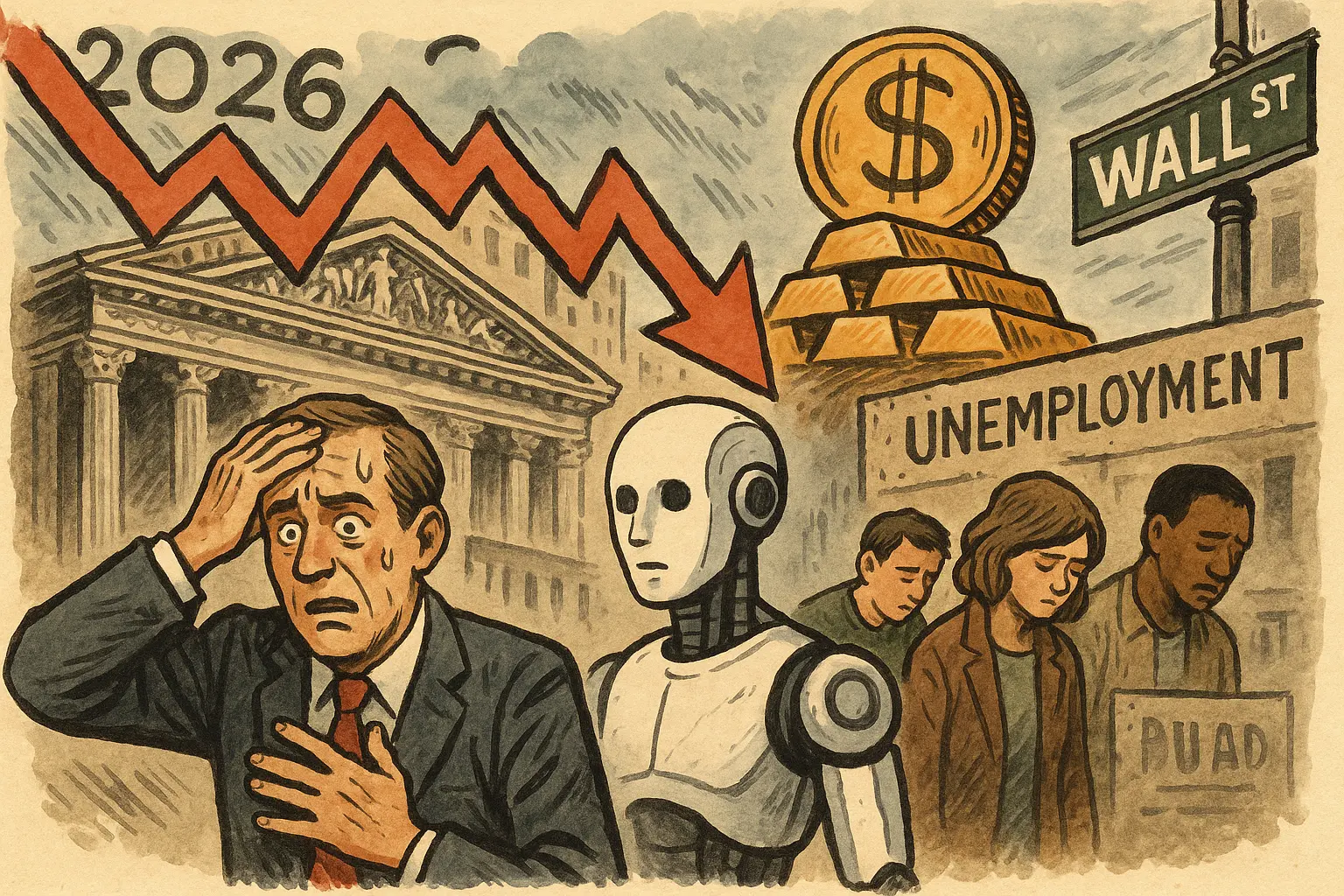
Wall Street’s forecasts for 2026 are highly polarized: Goldman Sachs predicts the S&P 500 will reach 7,600 points, while the bearish camp warns of a 20% crash. Economist Jim Rickards calls for gold prices to hit $10,000, AI pioneer Geoffrey Hinton warns of unemployment waves, quantum computing could wipe out Bitcoin, and Musk’s SpaceX valuation is approaching $800 billion with an IPO countdown.
US Stock Bull-Bear Battle: Goldman Sachs forecasts S&P up to 7,600 points, short sellers warn of a crash
Morgan Stanley predicts the S&P 500 will rise to 7,800 points in the next 12 months, about 14% higher than the current 6,858. Goldman Sachs sets a target of 7,600 points, JPMorgan Chase at 7,500, and if the Federal Reserve’s easing exceeds expectations, it could break through 8,000. US Bank is the most conservative, expecting only a 4-5% increase to 7,100.
However, bearish analyst Sean Williams from Motley Fool stated on January 1 that US stocks will decline at least 20% this year. The core reason is that the Shiller P/E ratio of the S&P 500 has reached the second-highest level in history, only below the dot-com bubble burst. Since 1871, this P/E ratio has only exceeded 30 six times, with the previous five declines each at least 20%.
Notably, in 2025, US stocks underperformed the international markets. The MSCI Global Index, excluding US companies, rose about 29% for the year, significantly outpacing the 16% gain of the S&P 500 — the largest gap since 2009. This divergence suggests US stock valuations may already be overinflated.
AI Bubble Burst or the Beginning of a New Industrial Revolution
Renowned economist and Rockefeller International Chairman Ruchir Sharma pointed out at the end of December that the AI bubble might burst sometime in 2026. He said, “All bubbles burst for the same reason: higher interest rates. Once US inflation rebounds and forces the Fed to tighten, the current overinvestment bubble driven by AI capital expenditure will come to an end.”
Lazard Asset Management warned that AI-related capital spending increasingly relies on debt financing, and related assets could become obsolete quickly, risking overcapacity and delayed returns. If tech companies’ profits fall short of expectations, markets could experience a sharp correction.
Optimists believe AI has ushered in a new industrial era. Google Brain co-founder Andrew Ng cited Harvard economist Jason Furman data on December 26, stating that in the first half of 2025, data center and AI investments contributed entirely to US GDP growth. Infrastructure booms created real jobs and sales, marking the start of the “new industrial era.”
Wedbush identifies 5 major AI winners in 2026
Microsoft (AI growth turning point)
· Other companies are actively deploying Microsoft applications
· Cloud AI service revenue will explode
· Market share of enterprise AI solutions will expand
Apple (24 billion device advantage)
· Possesses 1.5 billion iPhones worldwide, the largest consumer base
· AI commercialization could contribute $75-100 per share in the coming years
· Cook will remain CEO until the end of 2027 to push AI transformation
Tesla (valuation shifting towards AI)
· FSD adoption and CyberCab autonomous vehicle development
· Market cap expected to reach $2 trillion within a year
· Optimistically, by the end of 2026, it could hit $3 trillion
Palantir (candidate for trillion-dollar valuation)
· Booming demand for AI solutions in business and government sectors
· Expected to grow into a trillion-dollar company
CrowdStrike (beneficiary of cybersecurity AI)
· Cybersecurity is a core beneficiary sector of the AI revolution
· Product suite continuously expanding into enterprise markets
· Growth potential underestimated by the market
Quantum computing to wipe out Bitcoin and three major super IPOs
Jamie Garcia, Director of Strategic Growth and Quantum Collaboration at IBM, said 2026 will be a milestone year for quantum computing, with quantum computers surpassing traditional computers for specific tasks, achieving “quantum supremacy.” However, Neil Wilson, strategist at Sanford C. Bernstein, warned on December 2, that when the “quantum day” arrives, a fully operational quantum computer will break current digital security standards, making emails, bank transfers, and crypto wallets insecure, potentially crashing Bitcoin prices close to zero.
Motley Fool analyst countered that the quantum computing bubble is already in danger, with four listed quantum companies having price-to-sales ratios of IonQ (146x), Rigetti Computing (981x), indicating a high valuation bubble risk.
In IPO news, SpaceX is valued at $800 billion, OpenAI at $500 billion, and Anthropic at $30 billion, all planning to go public in 2026. PwC noted that IPOs in 2025 were delayed due to government shutdowns, creating a backlog of over 800 unicorns, which may be released in the first half of 2026.
Federal Reserve personnel uncertainty and Rogers’ warning of an economic crisis
Jerome Powell will step down as Fed Chair in May 2026, but his term as a board member still has two years remaining, making his potential reappointment a key market concern. Nomura strategist Naka Matsuzawa pointed out on December 29 that the policy direction of the new Fed Chair is uncertain, and the market may see a “flight from dollar assets” between July and November, leading to lower US Treasury yields, a stock correction, and a weaker dollar.
Jim Rogers predicted on December 23 that a major economic crisis could occur in 2026. He said, “Next year, the US and the world will face major problems. The US will fall into an unprecedented low. Japan also faces debt issues. The whole world will suffer.” Standard Chartered listed four risks: underperformance of AI sector, credit default events, Fed rate hike restrictions, and the Bank of Japan’s unexpected hawkish stance pushing the yen sharply higher.
AI pioneer Geoffrey Hinton warned on December 28 that AI will have the “ability to replace many jobs” in 2026, capable of replacing call centers and more jobs. He added, “In a few years, AI will be able to complete months-long software engineering projects, and by then, almost no humans will be needed.” Deloitte’s chief economist Diane Swonk pointed out that in the AI era, companies will need to do more with fewer employees.
Related Articles
IEA Announces Release of Emergency Oil Reserves, Asia-Pacific Inventory Immediately Available
Gate News reported that on March 15, the International Energy Agency (IEA, an international organization responsible for coordinating energy policies among member states) stated that oil from the IEA's emergency reserves will soon begin flowing into global markets. Inventory from Asian and Oceanian countries will be immediately available for use, while inventory from European and American countries will be available by the end of March.
GateNews6h ago
US Energy Secretary: Iran Conflict Will End in "Coming Weeks," Oil Supply Will Recover
Gate News reported that on March 15, U.S. Energy Secretary Wright stated in an interview with ABC News that the Iran conflict will end "in the coming weeks," after which oil supply will recover and energy prices will decline.
GateNews8h ago
DeFi enters a "winter of yields": liquidity stagnation, leverage contraction, and the disappearance of arbitrage opportunities
Since September 2025, the DeFi market has entered a "interest rate winter," with the annualized deposit yields of mainstream stablecoins dropping to lows, and supply and demand imbalances causing excess liquidity. As borrowing demand declines, stablecoin lending rates have also decreased, and the reduced risk appetite in the crypto market has led investors to shift toward more stable assets. Some protocols, such as Sky, offer stable returns through real-world assets, but the overall trend still indicates a period of adjustment and structural reform in DeFi.
区块客8h ago
Tom Lee: Rising oil prices are relatively bullish for US stocks; the US stock market may bottom out this month.
BitMine Chairman Tom Lee stated in an interview that rising oil prices are beneficial for the U.S. stock market, and investors tend to hold growth stocks, particularly the Magnificent 7. He believes the U.S. stock market may be forming a bottom and pointed out that current private credit issues will not lead to systemic risk.
GateNews11h ago
US First Batch of 86 Million Barrels of Strategic Petroleum Reserve to Hit Market Next Week, Using Loan-for-Oil Premium Model
The U.S. Department of Energy issued a solicitation on March 15, planning to allocate 86 million barrels from the Strategic Petroleum Reserve to stabilize the market and replenish reserves. Over the next year, about 200 million barrels will be added to maintain energy security. The current reserve level is 415.4 million barrels.
GateNews12h ago
2026 World Cup Could Become the Event with the Highest "AI Concentration," Expected to Consume 160 Trillion Related Tokens Daily
Gate News reports that on March 15, according to Caixin.com, the 2026 FIFA World Cup, set to begin in June, may become the World Cup with the highest "AI concentration" ever. Industry insiders estimate that during the World Cup period, global daily Token consumption could reach approximately 5.35 quadrillion, with World Cup-related Token consumption accounting for about 1.6 quadrillion. In comparison, global Token consumption at the beginning of this year was approximately 2 trillion per day.
GateNews13h ago


