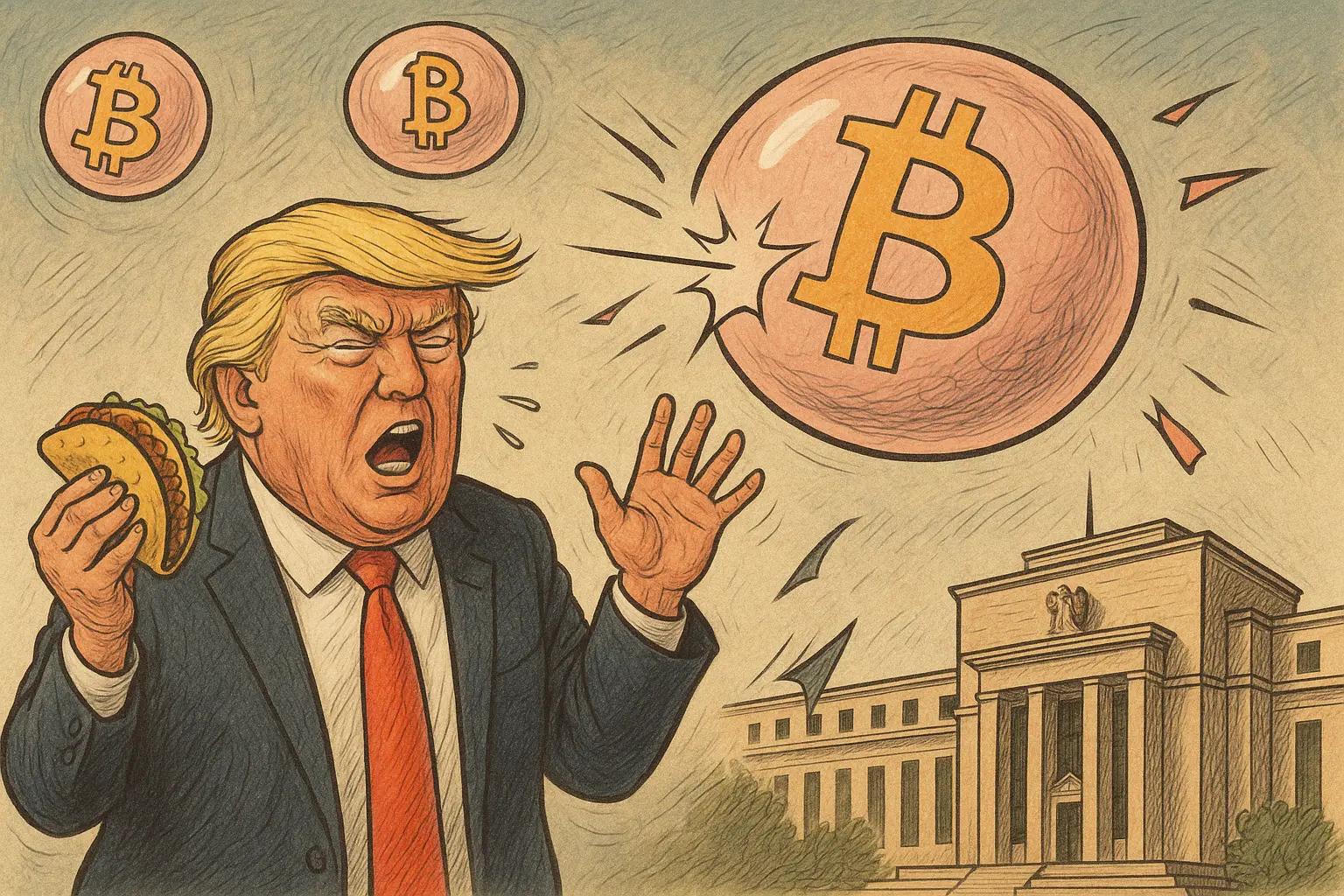
Federal Reserve Board Governor Christopher Waller stated on February 9 that recent sharp fluctuations in Bitcoin indicate that the TACO trading frenzy that accompanied the Trump administration’s rise has subsided. Bitcoin fell to around $60,000 on February 5, nearly erasing the gains since Trump’s election. Waller pointed out that the volatility surge was driven by regulatory uncertainty and institutional risk management, with companies entering through ETFs being forced to close positions.
TACO Trading Bubble: The Rise and Fall of Trump’s Crypto Honeymoon
After Trump took office last year, he promised to implement crypto-friendly policies, fueling market optimism about cryptocurrencies. This investment craze, dubbed “TACO Trading” (Trump Always Chickens Out), drove large amounts of capital into the crypto market via traditional financial channels like Bitcoin ETFs. Bitcoin’s price soared from about $70,000 at Trump’s election, briefly surpassing $110,000, setting a record high.
The core logic behind this rally was based on Trump’s policy commitments. During his campaign, Trump repeatedly expressed support for the crypto industry, promising to dismiss SEC Chairman Gary Gensler, establish a national Bitcoin reserve, and promote crypto-friendly legislation. These policies were expected to attract traditional financial institutions and corporate finance sectors, with publicly traded companies like MicroStrategy and Tesla continuously increasing their Bitcoin holdings, and record-breaking inflows into spot Bitcoin ETFs.
However, Waller noted at a conference in La Jolla, California, that this optimism has recently waned. He said, “I think the recent sell-off in the crypto market comes from those companies entering through mainstream financial markets, which have had to unwind risk positions and sell assets.” This institutional selling resonated with retail panic selling, accelerating Bitcoin’s decline.
The dissipation of TACO trading reflects a reassessment of the actual policy implementation power of Trump’s crypto stance. Although Trump’s administration did push some friendly policies, including rescinding or settling multiple SEC lawsuits against crypto firms, larger promises like a national Bitcoin reserve remain conceptual. Additionally, conflicts of interest arising from Trump’s own crypto ventures (including meme coins and DeFi platforms) have undermined market confidence in policy continuity.
Bitcoin Breaks Below $60K: Chain Reaction of Institutional Risk Management
On February 5, Bitcoin dropped to about $60,000 per coin, nearly wiping out all gains since Trump’s election. This sharp correction not only shook retail investors’ confidence but also exposed structural issues in institutional risk management. Waller emphasized that the recent surge in Bitcoin volatility might be driven by regulatory uncertainty and risk management measures of major financial institutions.
Traditional financial institutions involved in crypto typically have strict risk protocols. When Bitcoin prices fall sharply, these protocols automatically trigger liquidation mechanisms, requiring institutions to reduce their crypto exposure to control losses. This mechanical selling, combined with market panic, creates a vicious cycle: falling prices trigger liquidations, which further depress prices.
Data on cash flows into spot Bitcoin ETFs confirm this trend. As Bitcoin’s price retreated from its highs, several mainstream ETFs experienced continuous net outflows. These outflows came not only from retail redemptions but also from tactical reductions by institutional investors. For these institutions, Bitcoin holdings are subject to maximum allocation limits, and when prices fluctuate beyond preset thresholds, rebalancing is required.
Three Major Triggers for Institutional Selling
Exceeding Risk Exposure Limits: Falling Bitcoin prices cause asset allocation to become unbalanced, triggering forced reductions
Margin Calls: Leveraged institutions face margin requirements and are forced to sell assets
Quarterly Earnings Management: Some institutions reduce volatile assets before earnings reports to lower apparent losses
This scale of institutional selling far exceeds previous cycles. During the 2021 bull market, Bitcoin markets were primarily retail and crypto-native institutions. But after the launch of spot ETFs, traditional asset managers, family offices, and corporate finance departments entered en masse, fundamentally changing the participant structure. While these new entrants brought significant capital, they also introduced traditional risk management logic, making Bitcoin’s price more sensitive to macro risks.
The Myth of Digital Gold Crumbles: The Risk Asset Narrative Faces Tests
Cryptocurrencies have been hailed as “digital gold” and hoped to hedge inflation risks. However, recent market volatility shows that, unlike physical gold, cryptocurrencies have failed to serve as safe havens. Instead, they appear highly susceptible to market pressure, disappointing investors.
When Trump announced a 100% tariff on Chinese imports, sparking market panic, gold prices rose against the trend, briefly surpassing $3,700 per ounce, a record high. In contrast, Bitcoin plummeted over 20% during the same period, performing worse than Nasdaq tech stocks. This divergence challenged the “digital gold” narrative.
A safe-haven asset should maintain or increase its value during systemic risks. Gold’s role stems from its thousands of years of monetary history, physical properties, and low correlation with financial systems. While Bitcoin’s scarcity and decentralization are attractive, its short 16-year history is insufficient to establish it as a crisis asset.
More critically, Bitcoin’s liquidity profile makes it behave more like high-beta tech stocks during risk events. When institutional investors face liquidity pressures, they prioritize selling highly liquid but volatile assets to meet cash needs. Bitcoin fits this profile, often being the first to be sold in panic. This pattern repeated during the March 2020 pandemic onset, the 2022 Fed rate hikes, and the recent Trump tariff shock.
Trump’s 15% Economic Growth Target: Unrealistic Political Pressure
Trump claimed that the nominee he supports for Fed Chair could stimulate the economy to grow at 15%. This highly optimistic target highlights the immense pressure Kevin Warsh would face if appointed. It’s unclear whether Trump refers to annual growth or other metrics.
The US economy is projected to grow 2.4% this year, with an average annual growth rate of 2.8% over the past fifty years. Since the 1950s, US GDP has only exceeded 15% growth a few times, including during the third quarter of 2020 when businesses reopened after pandemic shutdowns. These statements clearly show Trump’s hope that Warsh, once appointed, could inject momentum into the economy to navigate the historically challenging midterm elections.
Such unrealistic economic goals also impact the crypto market. If the Fed adopts overly loose monetary policies to fulfill Trump’s political ambitions, risk assets including Bitcoin could temporarily rally. But in the long run, such policies risk runaway inflation and a dollar credit crisis, ultimately damaging financial stability. Market concerns about these policy risks may be a deep reason behind the fading of TACO trading.
The Federal Reserve’s Simplified Main Account: A Systemic Breakthrough for the Crypto Industry
According to The Block, Waller indicated that the Fed plans to launch a “simplified main account” proposal by the end of the year. This proposal would allow non-traditional financial companies to access parts of the US payment system but would not offer interest on balances or allow borrowing through discount windows.
Traditional “main accounts” enable direct connection to the Fed’s payment system and provide the most direct dollar liquidity channels. For crypto firms, obtaining a main account means lower-cost, more efficient dollar settlement, which is especially important for stablecoin issuers and exchanges. However, the Fed has historically been cautious in granting main accounts to crypto companies, with only a few approvals.
The rollout of a simplified main account could represent a systemic breakthrough for the crypto industry. Waller said, “We need to address these issues properly, but if progress is smooth, I hope to complete this work as early as the end of the year.” Public consultation on this proposal ended last Friday, revealing disagreements among crypto industry participants and community banks over whether non-traditional financial firms should be allowed access to parts of the US payment system.
Despite the fading of TACO trading and Bitcoin’s price correction, this regulatory progress indicates ongoing integration between the crypto industry and traditional finance. In the long term, systemic access is more strategically significant than short-term price fluctuations.


