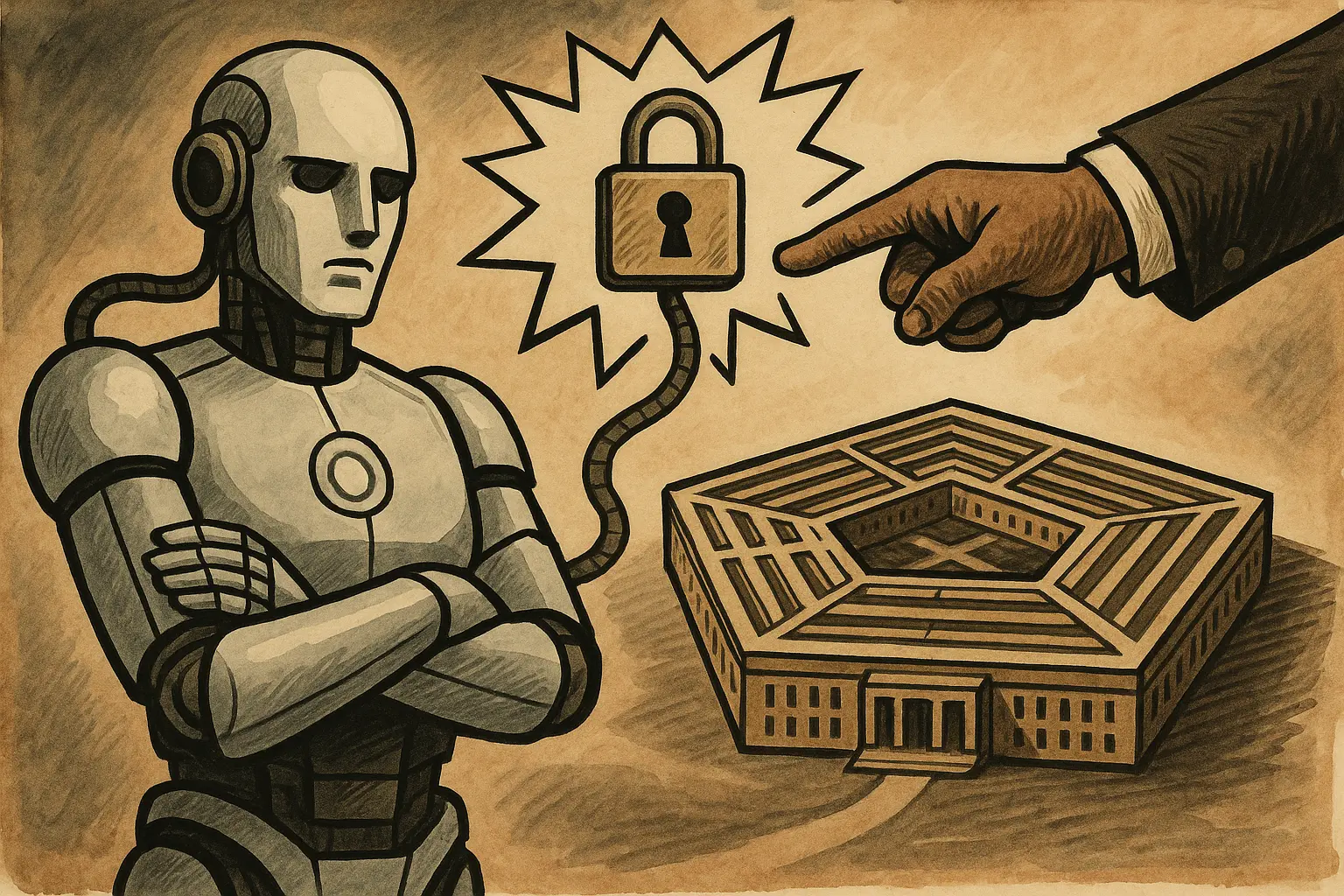
Anthropic CEO Dario Amodei publicly refused the U.S. Department of Defense’s ultimatum on February 26, 2026, rejecting unrestricted military use of Claude AI. The DoD, citing the 1950 Defense Production Act (DPA) to force technology transfer, created the first control boundary dispute between tech companies and the government.
The Confrontation: Anthropic’s Two Red Lines and Pentagon’s Three Threats
The core of this dispute is Anthropic’s two restrictions on military use of Claude: prohibiting autonomous targeting of enemy combatants and banning large-scale surveillance of U.S. citizens. The Pentagon views these restrictions as unacceptable barriers to legitimate military operations.
The escalation timeline: On Tuesday, Amodei met directly with Defense Secretary Pete Hegseth, who listed three consequences—removing Anthropic products from military systems; classifying them as supply chain risks, banning other defense contractors from using their products; and forcing technical transfer under the DPA. On Wednesday evening, the Pentagon presented a “final plan,” which Anthropic’s spokesperson said was “full of legal jargon, allowing arbitrary disregard of safeguards.” On Thursday, Defense Department spokesperson Sean Parnell issued a public ultimatum on X, demanding a response by 5:01 PM Friday.
In a blog post, Amodei described the Pentagon’s threats as “fundamentally contradictory,” noting that “cutting-edge AI systems lack the reliability to drive fully autonomous weapons,” and systems without proper oversight cannot demonstrate the critical judgment required by trained professional teams daily.
Potential Precedents for Cryptocurrency and Decentralization Insights
The Pentagon’s invocation of the DPA could have far-reaching implications beyond AI. If the government can, under national security grounds, legally compel AI companies to remove safety restrictions, the same framework could theoretically be used to force crypto companies to modify privacy features or weaken transaction protections.
Key Takeaways for the Cryptocurrency Market from This Dispute
Legal Precedent Risks: The use of the DPA as a legal pathway for government-mandated modifications to core security features in tech companies could set a precedent, posing similar pressures on crypto infrastructure providers.
Decentralization Resilience Argument: Centralized AI providers can be forced to remove security protections under government pressure, whereas decentralized architectures offer greater resistance to such coercion, validating the infrastructure advantages of decentralization.
Competitive Landscape Shift: Elon Musk’s xAI has signed an agreement allowing Grok AI for confidential systems; OpenAI and Google are accelerating efforts in secure AI domains. Anthropic’s early lead faces fundamental challenges.
Direct Cryptocurrency Connections: Anthropic’s $380 billion valuation and AI-driven software disruption are already impacting private credit flows related to Bitcoin; additionally, FTX’s bankruptcy estate held significant early shares in Anthropic, later sold to pay creditors.
FAQs
What is the Defense Production Act (DPA), and why does its invocation pose a major threat to tech companies?
The DPA, passed in 1950, is a U.S. federal law granting the executive branch broad powers to prioritize and direct private industry in emergencies, including mandatory technology transfer. If invoked against tech firms, it could force companies to hand over technology or modify products without market negotiations, posing potential threats to AI and crypto sectors.
What are the direct business risks for Anthropic in this confrontation?
The immediate risk involves a $200 million military contract. However, the more profound impact is the supply chain risk designation—requiring all contractors working with the U.S. Department of Defense to verify whether they use Anthropic’s products—potentially excluding Anthropic systematically from the vast defense supply chain, with impacts far beyond a single contract.
What specific lessons does this dispute offer for privacy protection in cryptocurrency?
This conflict reveals a legal pathway for government intervention in private tech companies’ core functions under national security pretexts. For crypto, it underscores that centralized infrastructure providers could be forced to alter privacy protections or transaction designs under similar pressures, further strengthening the case for decentralized architectures as more resilient to coercion.
Disclaimer: The information on this page may come from third parties and does not represent the views or opinions of Gate. The content displayed on this page is for reference only and does not constitute any financial, investment, or legal advice. Gate does not guarantee the accuracy or completeness of the information and shall not be liable for any losses arising from the use of this information. Virtual asset investments carry high risks and are subject to significant price volatility. You may lose all of your invested principal. Please fully understand the relevant risks and make prudent decisions based on your own financial situation and risk tolerance. For details, please refer to
Disclaimer.
Related Articles
OpenAI in talks with four private equity firms to establish joint venture, potentially securing $4 billion investment
Gate News: On March 16, OpenAI is in deep negotiations with TPG, Bain Capital, Advent, and Brookfield regarding the establishment of a joint venture to distribute artificial intelligence products. Private equity firms may commit $4 billion in equity investment to the joint venture, valued at $10 billion. OpenAI plans to provide preferred shares in the joint venture, while Anthropic has proposed providing common shares.
GateNews21m ago
Trump will hold a press conference today before the board meeting at the "Trump Kennedy Center"
Gate News reports that on March 16, U.S. President Trump will hold a press conference today before the board meeting at the Trump Kennedy Center.
GateNews22m ago
Federal Reserve holds policy meeting this week, Iran conflict causes one-fifth of global oil supply to stall
Federal Reserve officials will discuss the impact of the Iran conflict on global oil supplies and the economy at their policy meeting on March 16. Facing high inflation and rising oil prices, officials are likely to take a cautious approach. The market expects interest rates to remain unchanged, and new economic projections will help determine the direction of future monetary policy.
GateNews23m ago
Bank of America: If Middle East conflict persists, Brent oil could rise to $130 per barrel
Gate News, on March 16, the Bank of America stated that if the Middle East conflict continues into the second half of this year, the bank's team expects the average price of Brent crude oil to reach $130 per barrel.
GateNews24m ago
Iran's Foreign Minister: The US and Israel's war against Iran must end in a way that guarantees no further aggression
Gate News reports that on March 16, Iran's Foreign Minister Araghchi stated that the war waged by the United States and Israel against Iran must end in a way that guarantees "aggression" will not happen again. Araghchi said that the US and Israel have "learned their lesson" and realize they are facing a country that will unhesitatingly defend itself and is prepared to continue the war. (Xinhua News Agency)
GateNews1h ago
Wall Street's Three Major Investment Banks Maintain Bullish Outlook on US Stocks, S&P 500 Target Price Eyes 7800 Points
Despite geopolitical risks from the Iran conflict, strategists at the three major Wall Street investment banks remain bullish on U.S. stocks, citing earnings growth and valuation support for the market. The S&P 500 index target range is 7600 to 7800 points, with anticipated upside potential. Rising crude oil and inflation concerns are intensifying, but the stock market's pullback has been modest, and technical performance remains reasonable.
GateNews1h ago


