


Why do we always become "speechless" in cryptocurrency-related cases? An criminal defense lawyer's attempt to break the deadlock
Original Author: Lawyer Deng Xiaoyu
(February 2026 marks exactly one year since I was entrusted by a major domestic crypto exchange. I became involved in the second trial of this case. Although the result did not overturn the conviction and I am somewhat dissatisfied, achieving a rare reversal in the second instance is noteworthy. I record this as a memory and as motivation for my work this year.)
Engagement
In early 2025, my lawyer relationship was still transitioning to Mankun. I met with the client’s family members at Shenzhen.
During the meeting, I learned this was a well-known case (likely the largest domestic exchange), where the client, responsible for the perpetual contract division, was accused of running a gambling operation. In the first instance, they hired a criminal law professor from a university to defend, and also engaged two leading legal scholars, Zhang and Chen, to provide expert opinions. All experts agreed that—perpetual contracts are not gambling, and this case does not constitute running a casino crime.

(Image source from the internet, unrelated to the case)
However, the first-instance verdict did not meet the family’s expectations. They wanted to replace their criminal lawyer with someone knowledgeable about Web3 for the second trial, so they contacted me.
The communication was smooth. The family understood the difficulty of overturning the verdict but was very willing to try further. Because I needed to submit some documents due to my transfer to another firm, I also arranged for another criminal lawyer from Mankun—Lawyer Gao Mengyang—to meet with the family and review the case files, so we could analyze the case promptly.
Private Investigation Company
Soon, Gao and I met with Leo (later referred to as Second Brother) in this city without high-speed rail. After over a year of detention, he was accustomed to the environment, in good spirits, and thinking clearly.
Since both of us understand Web3, many concepts were quickly trusted and understood. He voluntarily explained the background of the offshore fishing operation involved in the case (which I documented in previous articles)—for example, during early detention, he was subjected to torture and was unjustly held in the intensive care unit. If he didn’t cooperate, he would be transferred to an infectious disease ward. After the meeting, we verified these details with the family, who confirmed that during the first trial, they reported these conditions to the authorities—there is even a recording where Second Brother and his family say, “You give the equipment in XXX to the police, or I’ll be beaten to death”—but there was no response from the authorities.
According to him, at that time, the authorities were just after money. Initially, the private investigation company thought his assets were close to ten million yuan, and the investigators told him to withdraw some, leaving about a million for his family’s living expenses, so the case would be easier to handle. But after handing over the assets in the safe, his virtual currencies, which had nothing to do with the case before, also became targets, and the amount involved in his case reached over a hundred million yuan.
He mentioned that the private investigation company is a malignant presence in the industry—referring to certain on-chain technical analysis firms in mainland China. On the surface, they survive on cybersecurity services, but in reality, they cooperate with law enforcement agencies to conduct intelligence gathering and clue-distribution businesses. Their heinous practices even include deploying personnel into project teams (such as overseas crypto exchanges’ mainland teams) to investigate the identities of colleagues and the status of project funds, then extort or sell this information to law enforcement agencies. During subsequent virtual currency disposal processes, they share profits with law enforcement.
Based on this, in our subsequent defense arrangements, Gao and I advised the family to continue reporting these issues upward—right and wrong must be clarified. I have always believed that the success of any case depends on the joint efforts of lawyers, clients, and families. There are few strategies in second-instance defense, but procedural violations are always a key point to challenge.
The Strange Phenomenon of Pretrial Conviction
After the meeting, we went to the Intermediate Court to retrieve the case files. The court arranged an assistant to coordinate with us, given the offshore fishing background and the restrictions on lawyer visits. We were initially very tense about whether the court system could safeguard lawyers’ rights. Fortunately, reviewing the files went smoothly, and we found a suspicious document—an initial social risk assessment conducted at the start of investigation, which scored various aspects of the case.
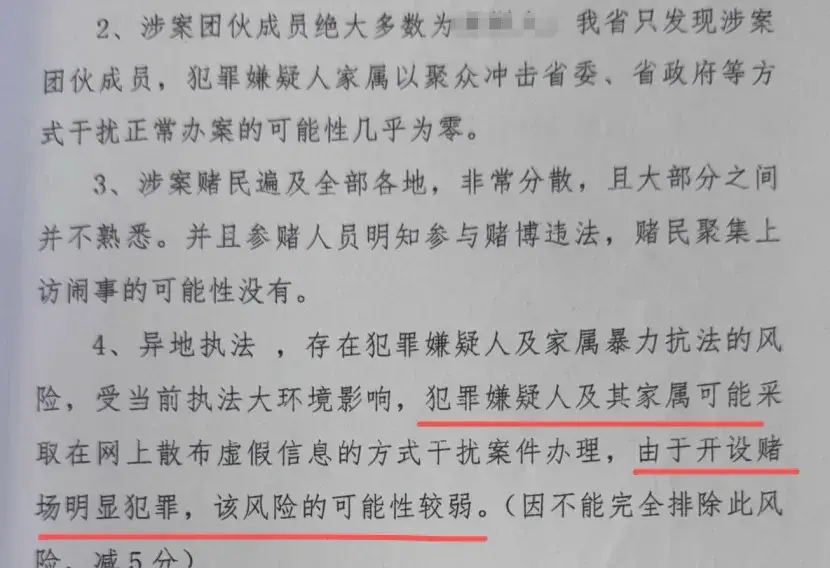
(Image source from the internet, unrelated to the case)
This assessment report, using Panda Exchange as an example, concluded that there was no dispute that the case involved running a casino, and all departments cooperated actively. The report explicitly confirmed the suspects’ roles as principal and accessory. This made us realize—this is a pretrial conviction, and since the second instance appeal stage (where the reversal rate is about 10%), defending against such a case will be a very tough fight.
The Case of Police Re-Interrogation During the Second Trial
Gao and I quickly reviewed the case files together. Afterward, we met with Second Brother again. We found that the data used to determine the amount involved in the crime was not attached to the case files. Upon checking with Second Brother, we discovered that the first trial also had issues with missing data. Many witness statements were scattered across different case files (the case was split into multiple files for dozens of people).
We then went straight from the county to the city court, submitted applications for supplementary review and trial, and returned to meet Second Brother again. He told us he had been re-interrogated—initially, we thought it was by the judge or the second-instance prosecutor, but then we realized it was unlikely, as we had been in contact with the case handlers at the court and prosecutor’s office during that time.
Second Brother said it was the police officers involved in the case who came to re-interrogate him unexpectedly, and they kept hinting that he should return money to facilitate a better case outcome. This behavior was highly irregular and caused psychological distress. When the family learned of this, they became determined to file complaints about illegal conduct.
We Are Conducting Out-of-Court Defense
Postponing the trial.
Two months after the second-instance case was filed, the court agreed to our trial application but scheduled the hearing for April. Both defense lawyers refused, citing the case’s complexity and, more importantly, the fact that our previous requests for supplementary review had not been responded to. We could not see several key materials that the first-instance court relied on for its judgment.
We filed complaints.
At the same time, we informed the court that we, as lawyers, had reported the forensic agency that provided the evidence—some of the forensic reports used in the first trial might be unreliable. The family also filed complaints against the police, as some prior statements might have been obtained through torture and thus could be inadmissible. We asked for some time for the case, and the judge agreed, promising to help us contact the authorities and forensic agencies to review the case files.
At this point, we are grateful to the female judge in the second trial for her responsibility. Over the next two to three months, we communicated extensively about supplementing the case files. We obtained over 70GB of electronic data from the police and forensic centers, which showed that the company’s technical staff recovered and downloaded the data from cloud servers to establish their case.
We also coordinated with the second-instance court to retrieve materials from three other cases that had been separated out. The company’s financial statements clearly indicated that the criminal proceeds from our client were not as large as the audit reports suggested, which was contradictory.
We Are Conducting Research
During this period, I did not slack off. I wrote several articles arguing that perpetual contracts are not gambling. I asserted that perpetual contracts are fundamentally different from gambling, not just under certain conditions but in principle. This was based on a deep understanding of the difference between investment activities and gambling, reinforced by the encouragement from two legal scholars.
Today, I saw a judge in Shanghai also published an article explaining that perpetual contracts are not gambling.
Even if, in 2025, the case involving the exchange’s perpetual contracts was recognized as running a casino, I firmly believe history will give the correct answer. Because I am convinced that I am not wrong. But I also have to remind Web3 entrepreneurs: do not step into perpetual contracts at this moment.
Pre-Trial Confrontation
After the case files were supplemented, the family’s complaints about the police also attracted the attention of the supervisory department. The process was so sensitive that this article might be taken down. Basically, during a normal visit to Second Brother, we were refused access and told to go to the police station for a “chat,” which made us quite nervous and we reported safety concerns to our law firm. Later, we met with police leadership, and after several rounds of friendly communication, we helped the family recover some assets.
We also managed to meet with Second Brother normally, explaining the outside situation and conveying that many of his acquaintances abroad and at home were concerned about him. Our interim work was recognized by Second Brother.
We then presented the defense strategy approved by Second Brother to the second-instance prosecutor. In the appeal, the prosecutor’s role differs from that in the first trial. The first-instance prosecutor mainly supported the prosecution, while the second-instance prosecutor also supervises the first trial. We genuinely believe there are serious issues with the case. We shared our opinions openly—after listening, the prosecutor said that Panda Exchange’s case was handled by him and considered that this case was not much different from Panda’s.
Gao and I had previously researched Panda Exchange and discussed the contract models with Second Brother. He directly stated that Panda’s data was fabricated and that accusing them of fraud was not an exaggeration. He said their exchange, apart from some high-leverage segments, used data from Binance, following Binance’s model.
But that was the extent of our discussion. We do not expect the second-instance case files to change easily through simple communication. But we still want to say more—to let the case handlers hear more, and to let the concepts and seeds of Web3 be planted as deeply as possible into the judicial world. This is not a monster to be feared; even if it is a fierce beast, judicial personnel should understand it better to build a better regulatory framework.
Morning Court Session
Before the court session, we hurriedly visited Second Brother in this remote county without high-speed rail. We discovered a hidden gem hotel—extremely affordable but with star-level amenities. We saw notices about the hotel’s bankruptcy procedures, realizing it was part of a slow recovery plan arranged by the bankruptcy administrator, which explained the high cost-performance ratio.
A lawsuit is like a major operation; after the procedure, there is a recovery period. Are we doing a second operation? But lawyers can never be the chief surgeon—the knife is always in the court’s hands.
The judge borrowed the courtroom of the first-instance court, and the trial was held in the county instead of the city. Interestingly, despite the end of the mask era, the trial was conducted via video link. Second Brother was quite accustomed to the court environment and saw the long-missed family members.
We noticed many unfamiliar faces in the audience—later learned they were personnel involved in various stages of the first trial. Gao and I divided responsibilities: I asked questions, he handled objections and evidence presentation. During questioning and cross-examination, we raised issues about police torture and illegal handling of virtual currencies—Second Brother found that the more he cooperated, the more he was targeted, and ultimately he refused to let the police force a third-party company to dispose of virtual currencies, which the police forcibly did. This was a key point we kept pressing in the second trial.
Time flew by. The morning session did not reach the debate stage. The judge called for a lunch break, and the trial resumed at 1 pm, urging us to speed up so they wouldn’t have to stay overnight in the county. Near the end of the session, I wanted to add the WeChat contact of the court clerk and share a long video about futures trading by “Xiaolin Says,” which explained the development of futures and how perpetual contracts are a new form of futures. I had prepared several PPT slides to demonstrate that perpetual contracts are not gambling—just like futures, where losing or winning is not certain until the bet is settled. If only one times leverage is used, the position can never be forcibly closed, and the core difference between financial speculation and gambling is whether participants control the risk. Leverage is not the key—there are both high-leverage financial activities and non-leveraged gambling.
However, I saw that the cover of Xiaolin’s futures video was titled “What is a ‘Financial Casino’…”, which could be misunderstood by the judges. So I decided not to forward it. The defense would continue in the afternoon.

In our extensive experience with economic crimes, we have heard many extreme claims. Some law enforcement officers equate stock and futures trading with gambling, and the crypto community jokingly calls contracts “gambling dogs.” But these descriptions emphasize the speculative nature of these financial activities, not that they are truly akin to betting on horse races or casino games.
What is the difference? What exactly? If you’ve read this far, it’s worth pondering deeply.
Afternoon Court Session
Lunchtime was tight; I took a few bites but had no appetite and kept smoking. When the court reopened at 1 pm, we entered through the lawyer’s passage and overheard a case handler on the corridor making a call seeking outside assistance to understand perpetual contracts. I was quite confident in my pre-trial preparations—using Binance’s demo platform to simulate perpetual contracts and printing several PPTs for on-site presentation.
During the continuation of the trial, Gao read out evidence. We brought in policies from the US, Singapore, and Hong Kong regulating perpetual contracts, and case studies—they all did not treat these as gambling. We also mentioned our complaints about the forensic agency, which had not responded, casting doubt on the evidentiary basis of the first trial. We repeated the expert opinions from the two legal scholars that perpetual contracts are not gambling.
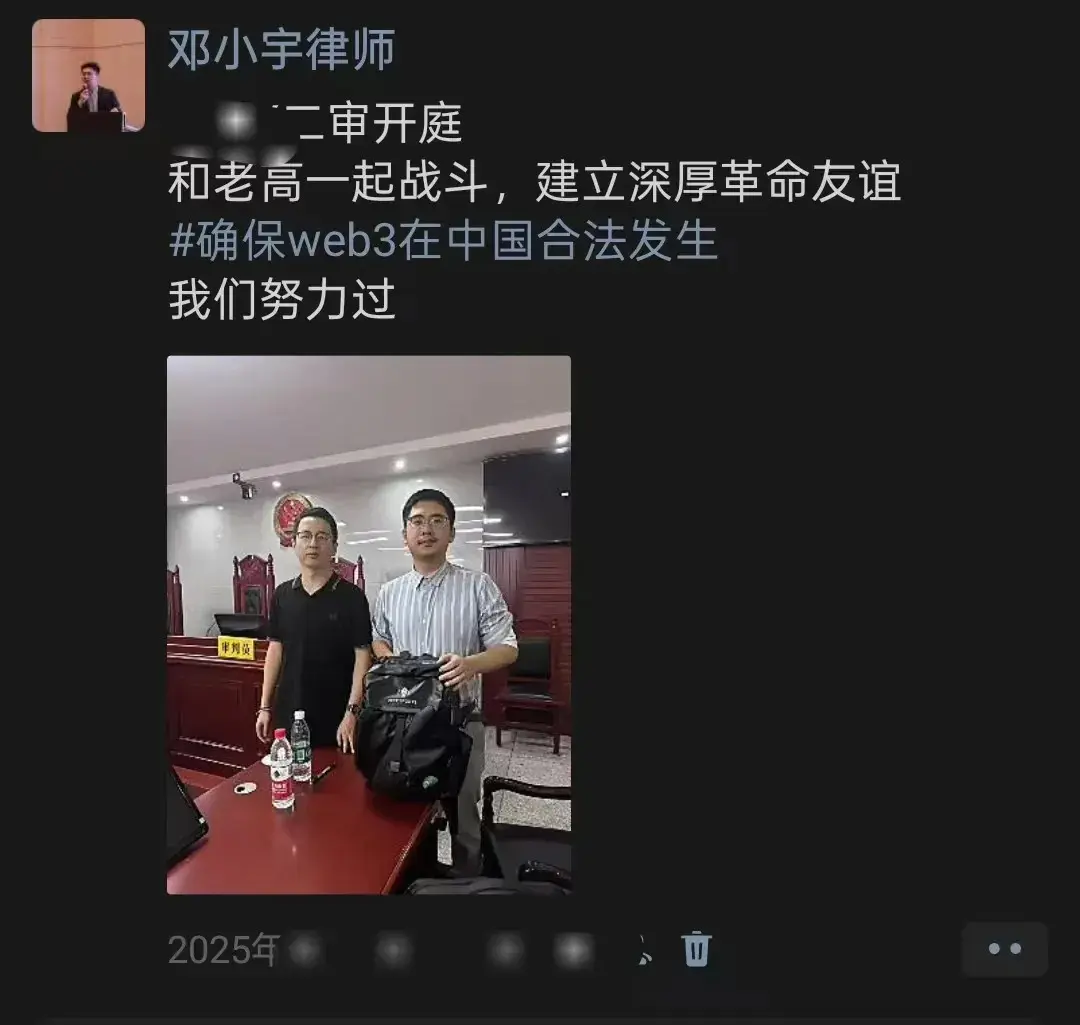
Interestingly, the family members in the audience, due to non-working hours, were not allowed into the courtroom. When the debate phase began without them, I really wished they could see it!
Second Brother made a self-defense speech, reiterating points we discussed during many meetings. He said that if he were to be convicted, it would only be for illegal operation, because the state does not support virtual currency trading. But he firmly refused to admit to gambling—because if they knew it was gambling, they would never do it. Their bottom line as Web3 practitioners is to avoid doing evil.
Before I presented my defense, I proposed to show the PPT on perpetual contracts to the court personnel and explained that they are not a “high-stakes gambling game.” Because betting on size or direction is not certain until the result is revealed, and as a financial activity, guessing the price movement does not necessarily cause losses. Traders can hold their positions and wait for the market to move in their favor. If only one times leverage is used, the position can never be forcibly closed, and the core difference from gambling is whether participants control the risk. Leverage is not the key—there are both high-leverage financial activities and non-leveraged gambling.
I saw some judges exchanging opinions during our defense. I heard subsequent defenders agree with our points, and the prosecutor also acknowledged that the police’s illegal handling of virtual currencies was a serious violation. Everything seemed to be heading in a good direction.
In my concluding remarks, I clarified that I am not defending perpetual contracts because I am a defense lawyer—rather, my deep understanding of the industry and the contracts strengthened my conviction to defend innocence. Second Brother did not intend to do evil or gamble. If perpetual contracts are classified as gambling, many people in mainland China would violate gambling laws, which would not be good for social management.
Epilogue
Around the National Day holiday, we received the case outcome: the second-instance court reversed the conviction, and Second Brother’s sentence was reduced. Coupled with some assets recovered by the family before the trial, we feel at peace and fulfilled.
However, the charge’s nature did not change—that is a frustration I find hard to express. But I want to say that I have worked hard for the Web3 industry, and we firmly believe that the seeds planted in spring will bear fruit in the future. We will continue to promote the legalization of Web3 in China in 2026.
Walking alone is fast; walking together is far. The road to Web3 compliance is long, and it requires more legally skilled professionals to sow the seeds. On March 7-8, you are welcome to join our offline crypto legal training camp in Hangzhou. We focus on real compliance challenges, not empty talk. Come and explore with us.